Heart Block: First, Second & Third Degree AV Block
Heart block (atrioventricular block) is impaired conduction between the atria and ventricles, graded from first to third degree. Boards emphasize the ECG patterns that distinguish the types, the important Mobitz I versus II distinction, and which blocks require a pacemaker.
Evidence-based · For exam prep, not medical advice
update Updated October 2026
Date of last content change
Built by surgery and anesthesiology residents·Written for USMLE Step 1
bolt The 60-second version
check_circleAV block is delayed or failed conduction from the atria to the ventricles.
check_circleFirst-degree block is a prolonged, constant PR interval (>200 ms).
check_circleMobitz I (Wenckebach) shows progressive PR lengthening until a dropped beat.
check_circleMobitz II shows sudden dropped beats without PR lengthening and can progress to complete block.
check_circleThird-degree (complete) block shows AV dissociation and needs a pacemaker.
First-Degree AV Block
First-degree AV block is a consistent prolongation of the PR interval beyond 200 milliseconds, with every atrial impulse still conducted to the ventricles (no dropped beats). It is usually benign and asymptomatic, often requiring no treatment, though it can be caused by AV nodal blocking drugs, increased vagal tone, or conduction system disease.
Second-Degree AV Block
Second-degree block has two types. Mobitz type I (Wenckebach) shows progressive lengthening of the PR interval until a beat is dropped, then the cycle resets; it is usually at the AV node, often benign, and frequently needs no treatment. Mobitz type II shows intermittent dropped beats without preceding PR prolongation, reflects disease below the AV node, and is more dangerous because it can progress abruptly to complete heart block.
Third-Degree AV Block
Third-degree (complete) heart block is total failure of conduction between atria and ventricles, so they beat independently — AV dissociation. On the ECG, P waves and QRS complexes have no relationship, and an escape rhythm (junctional or ventricular) maintains a slow ventricular rate. It commonly causes symptoms such as syncope, fatigue, and hemodynamic compromise, and is a medical emergency.
Management
Management depends on the type and symptoms. First-degree and Mobitz I block usually require only observation and removing offending drugs. Mobitz II and third-degree block require a permanent pacemaker because of the risk of progression and hemodynamic compromise. In acute symptomatic bradycardia, atropine and temporary pacing are used while arranging definitive therapy.
Try it now
3 real questions on Heart Block
Straight from the Progress Note question bank, each with a cited explanation. No account needed.
123
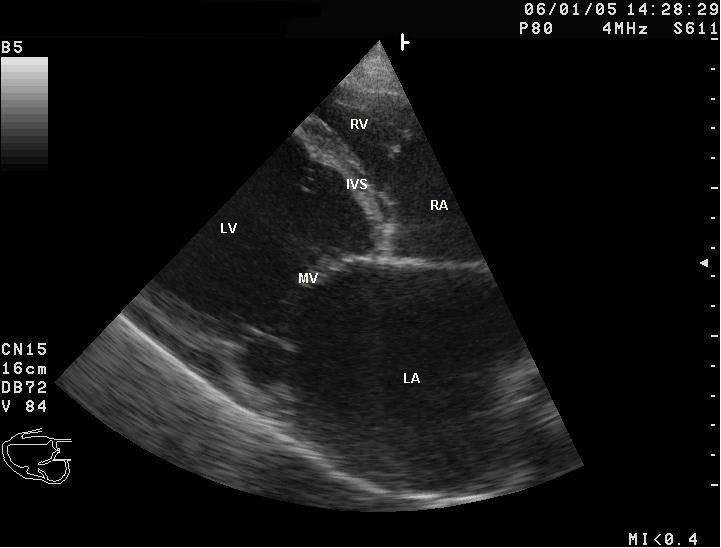
A 45-year-old man presents with progressive exertional dyspnea, fatigue, and bilateral lower extremity edema over 6 months, without prior infarction or valvular disease. Echocardiography is shown below. Gross examination of an explanted heart from a similar case shows a markedly enlarged, globular heart with thin, dilated ventricular walls. Genetic testing identifies a truncating mutation in the gene encoding titin. Which of the following best explains how this mutation produces systolic dysfunction?
Kalumet, CC BY-SA 3.0 <http://creativecommons.org/licenses/by-sa/3.0/>, via Wikimedia Commons
Answer: E. Titin is the largest known protein and forms the sarcomere's molecular spring, providing passive elastic recoil and force transmission across the Z-disc and M-line; truncating mutations, the most common identifiable genetic cause of dilated cardiomyopathy, disrupt this scaffolding function, impairing contractile efficiency and driving progressive four-chamber dilation and systolic failure. Myosin heavy chain 'poison peptide' mutations classically produce hypertrophic cardiomyopathy with diastolic dysfunction rather than the dilated, systolic phenotype seen here. Desmoplakin mutations cause arrhythmogenic right ventricular cardiomyopathy with fibrofatty replacement and arrhythmia as the dominant feature, lamin A/C mutations principally cause conduction disease, and dystrophin mutations cause a distinct X-linked skeletal and cardiac myopathy pattern.
Source: McNally, E. M., & Mestroni, L. (2017). Dilated cardiomyopathy: Genetic determinants and mechanisms. Circulation Research, 121(7).
From our NCLEX bank
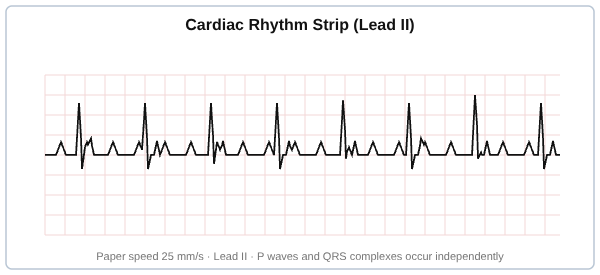
A nurse observes the rhythm shown on the monitor of a client who is dizzy with a heart rate in the 30s. How should the nurse interpret and respond to this rhythm?
Answer: A. The strip shows P waves and QRS complexes occurring independently of one another, which is third-degree (complete) AV block; in a symptomatic client with a very slow ventricular rate, the nurse prepares for transcutaneous pacing (option A). This is clearly not normal sinus rhythm (B), which has a consistent P-QRS relationship. Atrial fibrillation (C) has no discrete P waves and an irregularly irregular rhythm, which does not match. Sinus tachycardia (D) is a fast rhythm and a beta-blocker would dangerously slow this already bradycardic client. The nurse also anticipates atropine and possible permanent pacemaker placement. Complete heart block with symptoms is a cardiac emergency.
Source: Harding, M. M., Kwong, J., Hagler, D., & Reinisch, C. (2023). Lewis's medical-surgical nursing (12th ed.). Elsevier.
From our NCLEX bank
A nurse assesses a client on the third postoperative day and finds a temperature of 38.7 °C, a heart rate of 116, and new confusion. Which action should the nurse take?
Answer: A. Fever with tachycardia and new confusion in a postoperative client suggests infection that may be progressing toward sepsis, so the nurse notifies the provider promptly (option A). Giving an antipyretic and waiting 4 hours (B) treats a number while the underlying infection advances. Attributing new confusion to the environment (C) is a dangerous assumption, since altered mental status often signals poor perfusion. Encouraging rest and rechecking at bedtime (D) delays time-sensitive evaluation. The nurse anticipates cultures, fluids, and early antibiotics.
Atrioventricular (AV) block is graded as first degree (prolonged but constant PR interval with no dropped beats), second degree (Mobitz I with progressive PR lengthening and dropped beats, or Mobitz II with sudden dropped beats), and third degree (complete block with AV dissociation).
What is the difference between Mobitz I and Mobitz II?expand_more
Mobitz I (Wenckebach) shows progressive PR-interval lengthening until a beat is dropped and is usually benign. Mobitz II shows sudden dropped beats without PR lengthening, reflects disease below the AV node, and is dangerous because it can progress abruptly to complete heart block, so it needs a pacemaker.
Which heart blocks need a pacemaker?expand_more
Mobitz type II second-degree block and third-degree (complete) heart block require a permanent pacemaker because of the risk of progression and hemodynamic compromise. First-degree and Mobitz I block are usually observed and often need no treatment.
What is third-degree heart block?expand_more
Third-degree, or complete, heart block is total failure of conduction between the atria and ventricles, so they beat independently (AV dissociation). A slow escape rhythm maintains ventricular activity, and it often causes syncope and hemodynamic compromise, requiring urgent pacing.
Free weekly high-yield email
One high-yield concept + one question, every week
Study smarter with a short weekly email. No spam — unsubscribe anytime.
✓ You're in — talk soon.
Reading is one thing. Remembering is another.
Turn this guide into questions you’ll actually remember
Progress Note turns concepts like this into adaptive questions and spaced review, so difficult topics come back to you exactly when you’re about to forget them.