How the MCAT tests atomic structure
Atomic structure falls under AAMC content category 4E — “Atoms, Nuclear Decay, Electronic Structure, and Atomic Chemical Behavior.” The MCAT rarely asks you to simply recite a definition; instead it uses atomic structure as the reasoning layer beneath periodic trends, bonding, and spectroscopy. Expect passages that hand you an element and ask you to infer reactivity, or that show a spectrum and ask what transition produced it.
Three skills carry almost every question: (1) reading an element’s identity from Z and A, (2) translating between quantum numbers and where an electron lives, and (3) connecting energy levels to the light an atom absorbs or emits. Master those and the rest of general chemistry becomes far more predictable.
Atomic structure is not tested in isolation — it is the prerequisite for periodic trends, bonding, and spectroscopy. Points you earn here pay off across the whole Chem/Phys section.
Inside the atom: particles, isotopes, and ions
An atom has a dense central nucleus of protons and neutrons, surrounded by electrons in regions of space called orbitals. The three subatomic particles differ enormously in mass and charge.
| Particle | Charge | Relative mass | Location |
|---|---|---|---|
| Proton | +1 | ≈ 1 amu | Nucleus |
| Neutron | 0 | ≈ 1 amu | Nucleus |
| Electron | −1 | ≈ 1/1836 amu | Orbitals |
Electron mass is negligible, so mass number counts only protons + neutrons.
Atomic number, mass number, isotopes, and ions
- Atomic number (Z) = number of protons. It defines the element — carbon is always Z = 6.
- Mass number (A) = protons + neutrons. Written as the superscript in notation like ¹⁴C.
- Isotopes = same Z, different number of neutrons (¹²C vs ¹⁴C). Same chemistry, different mass.
- Ions = same Z, different number of electrons. Losing electrons makes a cation (+); gaining them makes an anion (−).
Changing neutrons makes an isotope, not an ion; changing electrons makes an ion, not a new element. Only changing protons changes the element.
The four quantum numbers
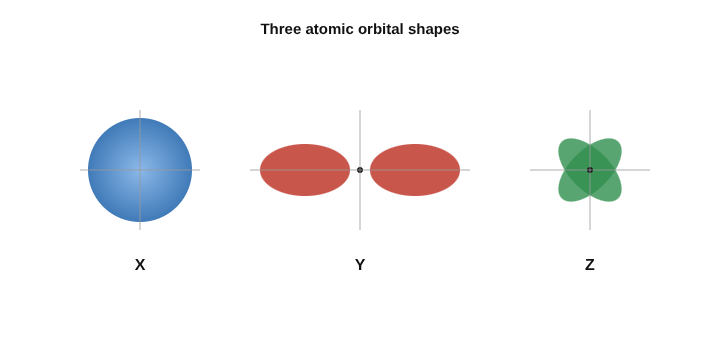
Quantum numbers are the “address” of an electron. Together, the four numbers specify exactly which orbital an electron occupies and which way it spins. No two electrons in the same atom can have an identical set — the Pauli exclusion principle.
| Quantum number | Symbol | Tells you | Allowed values |
|---|---|---|---|
| Principal | n | Shell & energy/size | 1, 2, 3, … |
| Azimuthal (angular) | ℓ | Subshell shape | 0 to n−1 (s, p, d, f) |
| Magnetic | mℓ | Orbital orientation | −ℓ to +ℓ |
| Spin | ms | Electron spin | +½ or −½ |
ℓ = 0,1,2,3 correspond to the s, p, d, f subshells.
Each orbital (a unique n, ℓ, mℓ set) holds at most two electrons of opposite spin. So an s subshell (1 orbital) holds 2 electrons, p (3 orbitals) holds 6, d (5 orbitals) holds 10, and f (7 orbitals) holds 14.
Read the counts as “2, 6, 10, 14” for s, p, d, f — each is 2 × (number of orbitals), and the orbital count climbs by odd numbers 1, 3, 5, 7.
Electron configuration: Aufbau, Hund, and Pauli
An electron configuration lists which subshells the electrons occupy. Three rules build it: fill lowest-energy orbitals first (Aufbau), place one electron in each orbital of a subshell before pairing (Hund’s rule), and never duplicate all four quantum numbers (Pauli).
Write the ground-state electron configuration of iron.
- Fill 26 electrons in Aufbau order: 1s² 2s² 2p⁶ 3s² 3p⁶ 4s² 3d⁶.
- Check the count: 2+2+6+2+6+2+6 = 26. ✓
- Condense using the previous noble gas (Ar, Z = 18): [Ar] 4s² 3d⁶.
Answer. 1s² 2s² 2p⁶ 3s² 3p⁶ 4s² 3d⁶, or [Ar] 4s² 3d⁶. (When iron ionizes, it loses the 4s electrons first — Fe²⁺ is [Ar] 3d⁶.)
A half-filled or fully filled d-subshell is unusually stable, so chromium is [Ar] 4s¹ 3d⁵ (not 4s² 3d⁴) and copper is [Ar] 4s¹ 3d¹⁰ (not 4s² 3d⁹). These two show up on the MCAT constantly.
Atomic spectra and the Bohr model
Because electrons can only occupy discrete energy levels, an atom can only absorb or emit specific amounts of energy — producing sharp line spectra rather than a continuous rainbow. When an electron drops from a higher level to a lower one, the energy gap is carried off as a single photon.
How much energy is released when a hydrogen electron falls from n = 3 to n = 2?
- E₃ = −13.6/3² = −1.51 eV; E₂ = −13.6/2² = −3.40 eV.
- ΔE = E₂ − E₃ = −3.40 − (−1.51) = −1.89 eV (negative = energy released).
- The atom emits a photon of 1.89 eV — visible red light (this is the H-alpha line of the Balmer series).
Answer. ≈ 1.89 eV is emitted as a red visible photon.
Absorption is the mirror image: an electron jumps up only if a photon delivers exactly the gap energy. This is why each element has a unique spectral fingerprint.
From structure to periodic trends
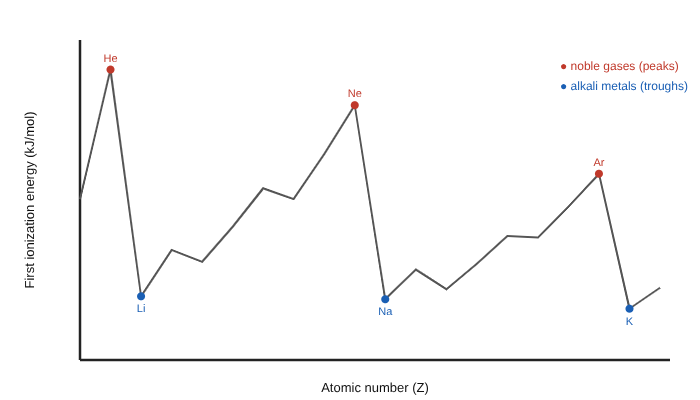
Effective nuclear charge (Zeff) — the net positive pull an electron actually feels after inner electrons shield it — is the bridge from atomic structure to periodic trends. Across a period Zeff rises, pulling electrons in tighter; down a group added shells push the outer electrons farther out.
- Atomic radius shrinks left-to-right (rising Zeff) and grows top-to-bottom (added shells).
- Ionization energy and electronegativity follow the opposite pattern — tighter-held electrons are harder to remove.
We cover these in depth in the MCAT periodic trends guide; for the bigger picture see MCAT general chemistry.
How to study it — and the traps to avoid
Atomic structure rewards a small number of reusable skills over memorization. Drill until each is automatic, then move on.
- Practice writing condensed configurations for the first 36 elements until you never miscount 4s vs 3d.
- Memorize the two exceptions (Cr, Cu) and the rule behind them (half/full d stability).
- Be fluent converting between energy (eV), frequency, and wavelength with E = hf = hc/λ.
- Know that ions form by removing the highest-n electrons first (the 4s-before-3d removal trap).
When a transition metal ionizes, electrons leave the 4s orbital before the 3d — even though 4s filled first. Fe → Fe²⁺ removes both 4s electrons, giving [Ar] 3d⁶, not [Ar] 4s² 3d⁴.