MCAT genetics explains how traits pass from one generation to the next. Starting from Mendel’s laws and Punnett squares, it builds to the meiosis that shuffles alleles and the pedigrees used to trace disease. It connects the molecular biology of genes to the physiology of whole organisms.
Evidence-based · For exam prep, not medical advice
update Updated October 2026
Date of last content change
Built by surgery and anesthesiology residents
Written for the MCAT · Free to read
bolt The 60-second version
check_circleGenes have alleles; genotype is the allele pair, phenotype is the observable trait.
check_circleLaw of segregation: the two alleles separate so each gamete gets one.
check_circleA monohybrid cross of two heterozygotes gives a 3:1 phenotype and 1:2:1 genotype ratio.
check_circleMeiosis halves the chromosome number and, with crossing over and independent assortment, creates variation.
check_circleAutosomal recessive traits can skip generations and appear in children of unaffected carriers.
check_circleSex-linked (X-linked) traits affect males more often because they have a single X.
target What you'll be able to do · aligned to AAMC content category 1C
1CApply Mendel’s laws of segregation and independent assortment with Punnett squares.
1CPredict genotype and phenotype ratios for monohybrid and dihybrid crosses.
1CExplain how meiosis and crossing over generate genetic variation.
1CInterpret pedigrees to determine modes of inheritance.
How the MCAT tests genetics
Genetics is AAMC content category 1C — the transmission of heritable information from generation to generation. The MCAT favors applied problem-solving: Punnett squares, probability, and pedigree analysis. It links molecular genes to inheritance patterns and disease.
workspace_premium Vocabulary first
Genotype is the alleles you carry (e.g., Aa); phenotype is what shows (dominant trait). Homozygous means two identical alleles, heterozygous means two different ones. Keep these straight and the crosses become easy.
Mendel’s laws
Gregor Mendel’s two laws describe how alleles are inherited.
Law of segregation: the two alleles of a gene separate during gamete formation, so each gamete carries just one.
Law of independent assortment: alleles of different genes assort independently (for genes on separate chromosomes).
Dominant vs recessive: a dominant allele masks a recessive one, so a heterozygote shows the dominant phenotype.
Punnett squares and cross ratios
A Punnett square lays out how parental alleles combine, giving the probabilities of each offspring genotype.
Monohybrid cross. Crossing two heterozygotes (Aa × Aa) yields a 1:2:1 genotype ratio and a 3:1 dominant-to-recessive phenotype ratio.
functions Worked example — probability of an affected child
Two parents are both carriers (Aa) for an autosomal recessive disease. What is the chance a given child is affected (aa)?
Set up the cross Aa × Aa in a Punnett square.
The genotype outcomes are 1 AA : 2 Aa : 1 aa.
Only aa is affected, which is 1 of the 4 equally likely boxes.
Answer. ¼ (25%) chance affected, with a ½ chance of being an unaffected carrier and ¼ unaffected non-carrier.
Meiosis and genetic variation
Meiosis produces haploid gametes and is the source of the variation that Mendelian ratios describe. Two mechanisms shuffle alleles.
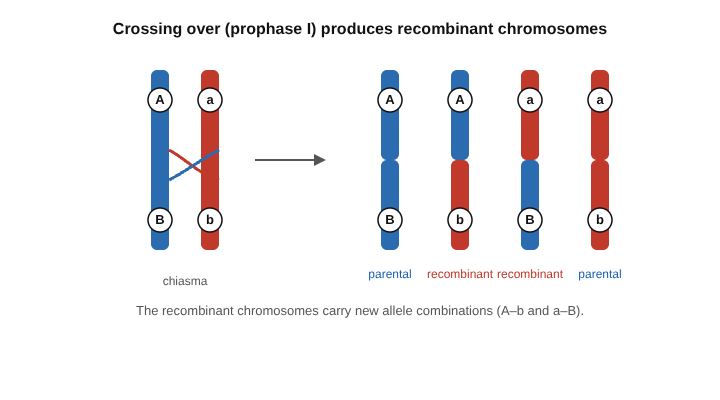
Crossing over. Homologous chromosomes exchange segments during meiosis I, producing recombinant chromosomes with new allele combinations.
Crossing over (prophase I) exchanges segments between homologous chromosomes, recombining linked alleles.
Independent assortment randomly orients each homologous pair, generating many gamete combinations.
Meiosis reduces the chromosome number from diploid (2n) to haploid (n), restored to 2n at fertilization.
Non-Mendelian and sex-linked inheritance
Many traits do not follow simple dominance, and genes on the sex chromosomes have distinctive patterns.
Incomplete dominance blends phenotypes (red × white → pink); codominance shows both (AB blood type).
X-linked recessive traits (e.g., hemophilia, color blindness) affect males more often, since one recessive X allele is enough with no second X to mask it.
Polygenic traits (like height) result from many genes and show continuous variation.
Pedigrees
A pedigree diagrams inheritance across a family and lets you deduce the mode of inheritance.
Autosomal recessive pedigree. Two unaffected carrier parents can have an affected child, and the trait can skip generations — hallmarks of recessive inheritance.
Recessive traits often skip generations and appear from unaffected parents.
Dominant traits typically appear in every generation with an affected parent.
X-linked patterns show more affected males and no male-to-male transmission.
How to study it — and the traps to avoid
Genetics is applied probability. Practice crosses and pedigrees until the patterns are automatic.
Nail the vocabulary (genotype/phenotype, homo/heterozygous, dominant/recessive).
Use Punnett squares and multiply probabilities for multiple traits.
Recognize inheritance patterns from pedigree clues.
Remember meiosis (not mitosis) creates gametes and variation.
error Highest-yield trap
Dominant does not mean more common. Dominance describes which allele is expressed in a heterozygote, not how frequent the trait is in a population. A recessive trait can be far more common than a rare dominant one.
Straight from the Progress Note question bank, each with a cited explanation. No account needed.
123
The figure shows an event occurring between homologous chromosomes during prophase I of meiosis. What is the primary genetic consequence of this event?
Answer: A. The figure depicts crossing over — the reciprocal exchange of segments between homologous chromosomes during prophase I — which generates new combinations of alleles and is a major source of genetic variation in gametes. It is not primarily a DNA-repair process (B). Sister chromatids separate later, in meiosis II (C), and crossing over does not change chromosome number (D). Rather than making gametes identical (E), recombination diversifies them.
During meiosis, homologous chromosomes pair up and physically exchange corresponding segments of DNA. What is the main genetic significance of this 'crossing over'?
Answer: D. Crossing over, which occurs during prophase I of meiosis when homologous chromosomes exchange segments, recombines the alleles carried on maternal and paternal chromosomes, generating new combinations of alleles not present in either parent and thereby increasing genetic variation in the offspring. It does not change chromosome number (A), is not a general mutation-repair mechanism (B), produces novel rather than identical chromosomes (C), and does not determine sex (E, which depends on the sex chromosomes inherited). Creating new allele combinations to boost variation is the significance of crossing over.
During meiosis, homologous chromosomes pair up and exchange corresponding segments in a process called crossing over. What is the main genetic consequence of crossing over?
Answer: D. Crossing over swaps segments between homologous chromosomes, creating new combinations of alleles on each chromosome and thereby increasing genetic variation among the resulting gametes and offspring. A describes mitosis rather than meiosis, B is false because DNA is copied only once before meiosis, C is the opposite of what crossing over does, and E confuses one event with the entire process of forming a gamete. Crossing over increases genetic variation.
Source: Griffiths, A. J. F., Wessler, S. R., Carroll, S. B., & Doebley, J. (2015). Introduction to genetic analysis (11th ed.). W. H. Freeman.
Your next questions are ready.
The question bank picks up from here: it adapts to what you just missed and brings it back right before you'd forget it.
What is the difference between genotype and phenotype?expand_more
Genotype is the genetic makeup — the pair of alleles an organism carries for a gene (for example, Aa). Phenotype is the observable trait that results (for example, the dominant appearance). The same phenotype can arise from different genotypes, since AA and Aa both show the dominant trait.
What ratio results from crossing two heterozygotes?expand_more
A monohybrid cross of two heterozygotes (Aa × Aa) produces a genotype ratio of 1 AA : 2 Aa : 1 aa and a phenotype ratio of 3 dominant : 1 recessive. This 3:1 phenotype ratio is one of the most tested results in Mendelian genetics.
How does meiosis create genetic variation?expand_more
Meiosis generates variation in two main ways: crossing over during prophase I exchanges segments between homologous chromosomes to recombine alleles, and independent assortment randomly orients each homologous pair, producing many possible combinations of chromosomes in the gametes. Random fertilization adds further variation.
Why are X-linked recessive traits more common in males?expand_more
Males have only one X chromosome, so a single recessive allele on the X is expressed with no second X to mask it. Females need two copies of the recessive allele to show the trait, making X-linked recessive conditions like hemophilia and color blindness more common in males.
How do you recognize autosomal recessive inheritance in a pedigree?expand_more
Autosomal recessive traits often skip generations and can appear in the children of two unaffected (carrier) parents. Affected individuals may have no affected parents, and the trait affects males and females about equally, which distinguishes it from dominant or X-linked patterns.
Study smarter with a short weekly email. No spam — unsubscribe anytime.
✓ You're in — talk soon.
Reading is one thing. Remembering is another.
Turn this guide into questions you’ll actually remember
Progress Note turns concepts like this into adaptive questions and spaced review, so difficult topics come back to you exactly when you’re about to forget them.