USMLE Step 1 is now pass/fail, so the goal is efficient, durable mastery of high-yield material rather than chasing a three-digit score. A small set of resources — used together and in the right order — covers nearly everything tested. This guide explains the core toolkit and how to combine it.
edit_note
Progress Note Editorial
Evidence-based · For exam prep, not medical advice
update Updated October 2026
Date of last content change
Built by surgery and anesthesiology residents·Written for USMLE Step 1
bolt The 60-second version
check_circleFirst Aid is the anchor: a review outline you annotate with everything else, not a primary teacher.
check_circleUWorld is the single most important question bank — treat its explanations as a learning resource.
check_circlePathoma (with Dr. Sattar) is the go-to for pathology fundamentals.
check_circleSketchy uses visual mnemonics to make microbiology and pharmacology stick.
check_circleThe AnKing Anki deck delivers spaced repetition tied to the other resources.
First Aid — The Anchor
First Aid for the USMLE Step 1 is the shared skeleton of Step 1 prep. It is a condensed, high-yield outline rather than a teaching text, so it works best as the document you annotate with pearls from videos, question banks, and Pathoma. Returning to the same First Aid pages repeatedly turns it into a personalized master reference and reinforces organization of the material across organ systems and disciplines.
UWorld — The Core Question Bank
UWorld is the most important single resource for Step 1. Its questions build clinical reasoning and its explanations function as a textbook in their own right. Most students complete the bank at least once, often in tutor mode aligned to their study blocks, and many do a second pass. Treat every question — right or wrong — as a learning opportunity, and fold new facts back into First Aid and your Anki deck.
Pathoma, Sketchy, and Boards & Beyond
For content teaching, a few resources dominate. Pathoma, taught by Dr. Sattar, is the standard for pathology and is concise enough to review multiple times. Sketchy uses memorable visual stories to lock in microbiology and pharmacology, two high-yield and memorization-heavy areas. Boards & Beyond provides comprehensive video lectures that build the underlying physiology and mechanisms, making it a strong first-pass content resource.
Anki and How to Combine Everything
Anki, most commonly the community-maintained AnKing deck, applies spaced repetition to keep facts from fading over a long study period. A common workflow: learn a system with Boards & Beyond or Pathoma, do the matching UWorld blocks, annotate First Aid, and unsuspend the relevant AnKing cards to review daily. Because Step 1 is pass/fail, aim for consistent coverage and steady practice-exam performance rather than maximizing a number.
Straight from the Progress Note question bank, each with a cited explanation. No account needed.
123
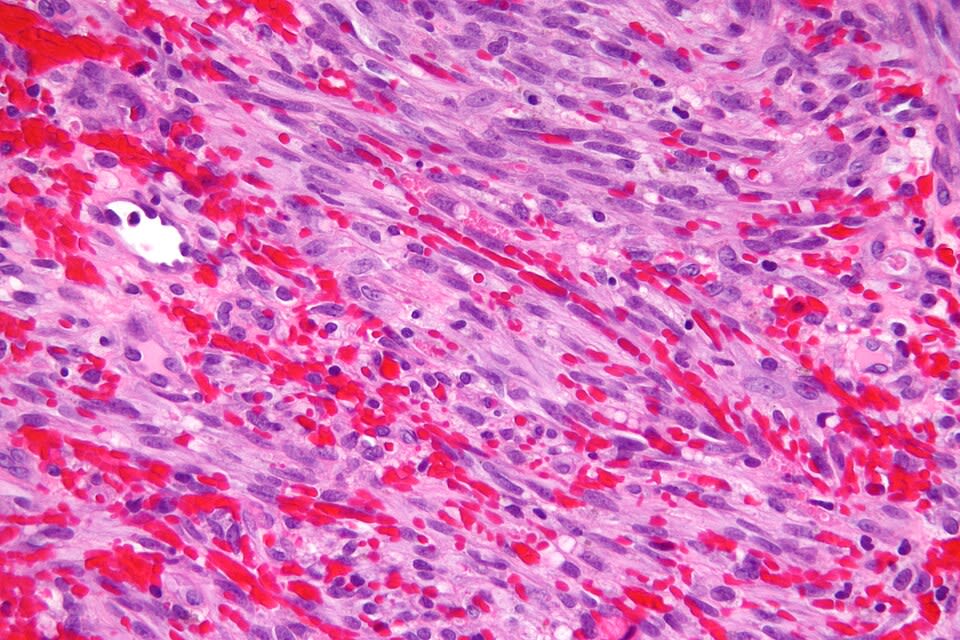
A 38-year-old man with HIV (CD4 count 90 cells/microliter) presents with violaceous plaques on the skin and hard palate. Biopsy is shown below; cells stain positive for a latent viral nuclear antigen by immunohistochemistry. Which statement about its pathogenesis is correct?
Nephron, CC BY-SA 3.0 <https://creativecommons.org/licenses/by-sa/3.0>, via Wikimedia Commons
Answer: A. Kaposi sarcoma requires latent HHV-8 (KSHV) infection of spindle cells; the latency-associated nuclear antigen (LANA) is expressed in nearly all lesions and promotes cell survival and proliferation in part by disrupting the p53 and Rb tumor suppressor pathways, contributing to the neoplastic phenotype. Option B incorrectly attributes transformation directly to HIV rather than to HHV-8 infection, which is the necessary oncogenic driver; HIV instead contributes indirectly through immunosuppression and cytokine effects. Option C incorrectly labels LANA as a lytic-cycle marker, when it specifically marks latent infection. Option D contradicts the well-established viral-driven neoplastic nature of the lesion. Option E is incorrect because HHV-8 seroprevalence substantially exceeds the incidence of clinically apparent Kaposi sarcoma, indicating that host immunosuppression is an important additional contributing factor.
Source: Cesarman, E., et al. (2019). Kaposi sarcoma. Nature Reviews Disease Primers, 5(1).
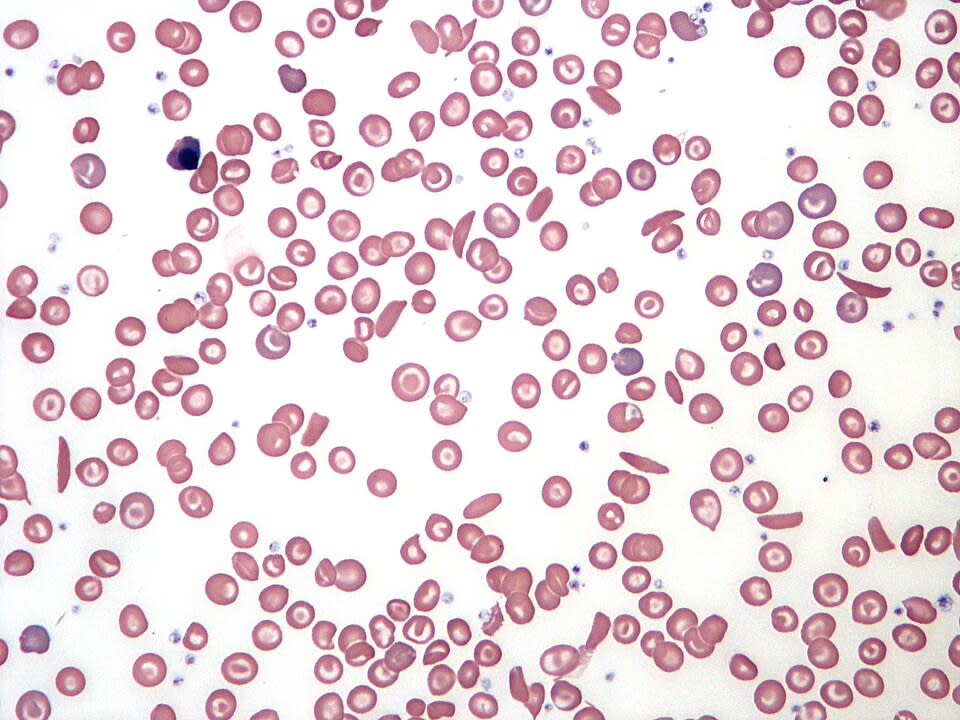
A 6-year-old boy with a history of dactylitis presents with acute severe abdominal pain, pallor, and a rapidly enlarging spleen; hemoglobin has dropped from a baseline of 8 g/dL to 4 g/dL. A peripheral blood smear image is shown below. Which of the following conditions most directly triggers erythrocyte sickling in this patient's disease, based on the underlying molecular mechanism?
Keith Chambers, CC BY-SA 3.0 <https://creativecommons.org/licenses/by-sa/3.0>, via Wikimedia Commons
Answer: A. In sickle cell disease, deoxygenation of hemoglobin S exposes a hydrophobic valine residue substituted for glutamic acid at position 6 of the beta-globin chain, promoting polymerization of hemoglobin tetramers into rigid fibers that distort the erythrocyte into its characteristic sickle shape. Repeated sickling and unsickling damage the red cell membrane, shortening erythrocyte lifespan and predisposing to vaso-occlusion and, in young children, acute splenic sequestration crisis as seen in this patient. Heinz body formation reflects oxidative hemoglobin denaturation characteristic of G6PD deficiency, not HbS polymerization, and reduced spectrin content describes the membrane defect of hereditary spherocytosis rather than sickle cell disease.
Source: Kato, G. J., et al. (2018). Sickle cell disease. Nature Reviews Disease Primers, 4, 18010.
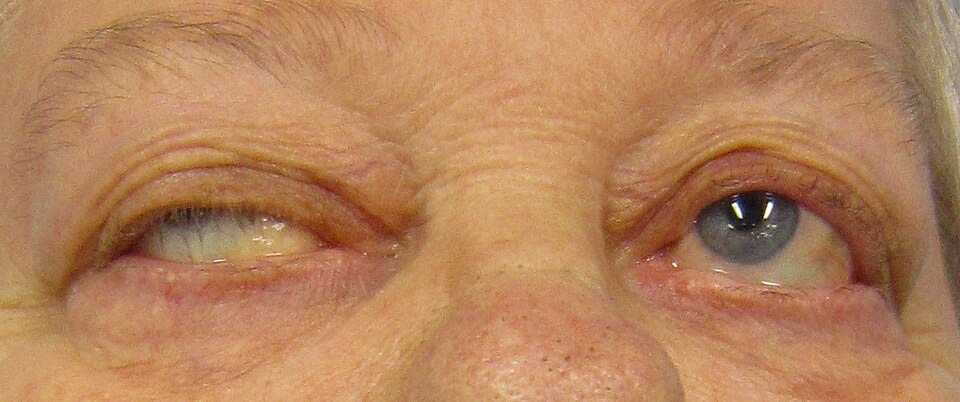
A patient presents with ptosis and diplopia that worsens throughout the day. Edrophonium administration transiently improves symptoms. Which underlying mechanism is most likely?
James Heilman, MD, CC BY-SA 3.0 <https://creativecommons.org/licenses/by-sa/3.0>, via Wikimedia Commons
Answer: D. Myasthenia gravis is caused by IgG antibodies against postsynaptic acetylcholine receptors at the neuromuscular junction. This leads to fatigable muscle weakness that improves with acetylcholinesterase inhibitors like edrophonium. Presynaptic calcium channel antibodies are seen in Lambert-Eaton syndrome. Dopamine depletion is associated with Parkinson disease. Demyelination and upper motor neuron loss describe other neurologic disorders.
What are the best resources for USMLE Step 1?expand_more
The core toolkit is First Aid as the annotated anchor, UWorld as the main question bank, Pathoma for pathology, Sketchy for microbiology and pharmacology, Boards & Beyond for video content, and the AnKing Anki deck for spaced repetition. Used together, these cover nearly all high-yield Step 1 material.
How should I use First Aid for Step 1?expand_more
Use First Aid as an anchor rather than a primary teacher. It is a condensed high-yield outline, so annotate its pages with pearls from UWorld, Pathoma, and video resources, and return to the same pages repeatedly. Over time it becomes a personalized master review document.
Is UWorld enough for Step 1 now that it is pass/fail?expand_more
UWorld is essential and, combined with First Aid and a content resource like Pathoma or Boards & Beyond, forms a complete preparation. Since Step 1 is pass/fail, the goal is reliable mastery and consistent passing performance on NBME and UWSA practice exams rather than maximizing a score.
When should I start doing UWorld questions?expand_more
Many students begin UWorld during dedicated study aligned to each organ system, while others weave it into their coursework earlier. Doing questions alongside content review — rather than saving them all for the end — helps build reasoning and reveals weak areas in time to remediate them.
Free weekly high-yield email
One high-yield concept + one question, every week
Study smarter with a short weekly email. No spam — unsubscribe anytime.
✓ You're in — talk soon.
Practice makes permanent
Lock this into long-term memory
Progress Note's adaptive engine spaces your reviews automatically — so this stays with you through boards and onto the wards.