Strong test-taking strategy turns knowledge into points. Beyond knowing the material, technique — reading the question carefully, using elimination, managing the clock, and handling uncertainty — meaningfully raises scores on high-stakes multiple-choice exams like the USMLE, NCLEX, and MCAT.
edit_note
Progress Note Editorial
Evidence-based · For exam prep, not medical advice
update Updated October 2026
Date of last content change
Built by surgery and anesthesiology residents·Written for USMLE Step 1
bolt The 60-second version
check_circleIdentify exactly what the question asks before looking at the options.
check_circlePredict an answer first, then eliminate clearly wrong choices.
check_circleManage the clock — flag hard questions and move on rather than stalling.
check_circleDo not leave blanks; an educated guess beats no answer.
check_circleChoose the best answer, not a perfect one, and be wary of absolute wording.
Read the Question Correctly
Most avoidable errors come from misreading the stem. Determine precisely what is being asked — the next best step, the most likely diagnosis, the mechanism — and watch for qualifiers like "except," "least," and "initial." On long clinical vignettes, many students read the final sentence first to know what to look for, then read the stem with that question in mind, which prevents getting lost in detail.
Predict, Then Eliminate
Before reading the options, try to answer the question in your own words; this keeps attractive distractors from anchoring you. Then work by elimination, ruling out choices you can justify as wrong to narrow the field. If you have a reasoned answer, avoid changing it without a concrete reason — second-guessing driven by anxiety more often turns right answers into wrong ones.
Manage Time and Flags
Pace yourself against the clock so no single question consumes time that belongs to several others. When a question is hard, make your best choice, flag it, and move on; returning later with a fresh perspective — and sometimes clues from later questions — is more efficient than stalling. Never leave an answer blank when there is no penalty for guessing.
Handle Uncertainty
On tough items, aim for the best-supported answer rather than a flawless one, since exam questions often force a choice among imperfect options. Be cautious with absolute words like "always" and "never," which are frequently wrong, and lean on your preparation instead of anxiety. Trusting a well-reasoned first instinct usually serves you better than repeated reconsideration.
Try it now
Try 3 real questions
Straight from the Progress Note question bank, each with a cited explanation. No account needed.
123
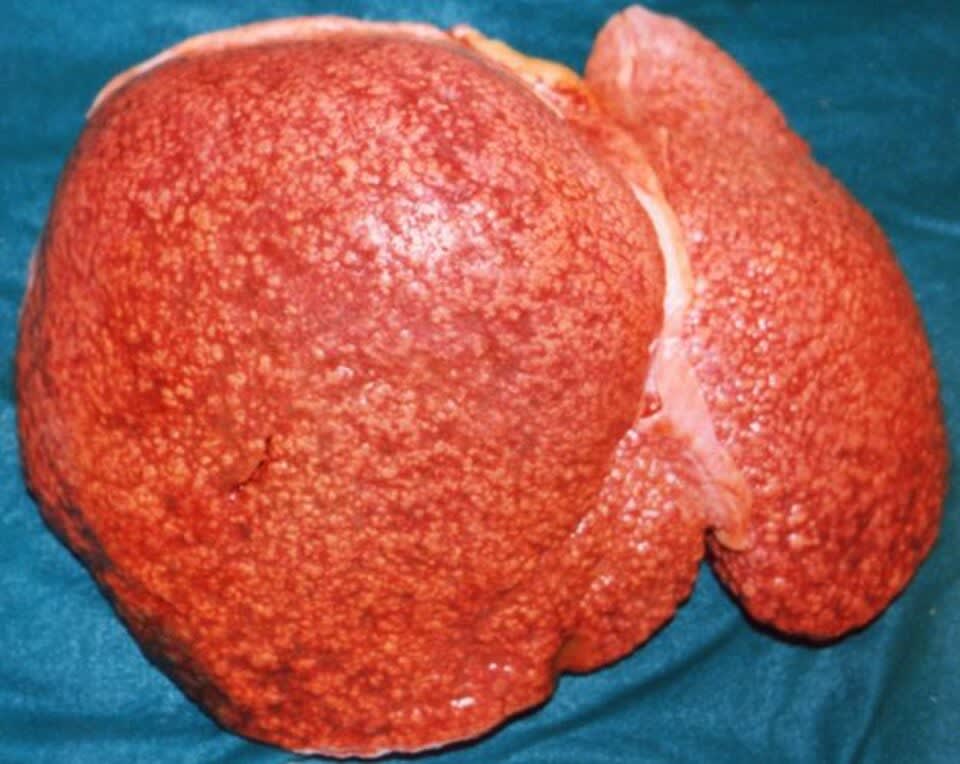
A 58-year-old man with a 30-year history of alcohol use disorder undergoes liver transplantation for end-stage liver disease. Gross pathology specimen is shown below. Histology demonstrates extensive bridging fibrosis with thin fibrous bands connecting portal tracts to central veins and separating regenerative hepatocyte nodules. Which of the following best explains how chronic ethanol-induced hepatocyte injury, stellate cell activation, and aberrant extracellular matrix remodeling collectively lead to the morphologic findings observed?
Amadalvarez, CC BY-SA 4.0 <https://creativecommons.org/licenses/by-sa/4.0>, via Wikimedia Commons
Answer: D. Alcoholic cirrhosis results from a chronic necrosis-regeneration-fibrosis cycle: ethanol-derived acetaldehyde and oxidative stress (via CYP2E1 metabolism) damage hepatocytes, triggering apoptosis and necroinflammation; dying hepatocytes release cytokines (TGF-beta, PDGF, TNF-alpha) that activate hepatic stellate cells toward a myofibroblast phenotype; myofibroblasts produce excessive collagen and deposit extracellular matrix. Simultaneously, surviving hepatocytes proliferate to regenerate lost liver mass, but in the setting of continuous injury, regeneration becomes dysfunctional and combines with progressive fibrosis to distort normal hepatic architecture—bridging fibrosis obliterates the normal zone-based hepatic structure. Option A oversimplifies the mechanism by attributing fibrosis solely to hepatocyte death; option B emphasizes steatosis as a necessary precursor (steatosis alone does not cause cirrhosis); option C incorrectly suggests ethanol inhibits stellate cell activation; option E denies the role of regeneration and architectural distortion in cirrhosis formation.
Source: Singal, A. K., & Mathurin, P. (2021). Diagnosis and treatment of alcohol-associated liver disease: A review. JAMA, 326(2).
A 4-year-old boy is evaluated for progressive weakness, hepatomegaly, and fasting hypoglycemia. His parents are consanguineous. Laboratory studies show elevated fasting lactate and markedly elevated liver glycogen on biopsy. The liver biopsy image shows large hepatocytes distended with pale, PAS-positive, diastase-sensitive granules. Enzymatic assay confirms deficiency of glucose-6-phosphatase. Which of the following is the most accurate explanation for the lactic acidosis observed in this patient?
Calicut Medical College, CC BY-SA 4.0 <https://creativecommons.org/licenses/by-sa/4.0>, via Wikimedia Commons
Answer: D. Von Gierke disease (GSD Type Ia) results from glucose-6-phosphatase deficiency, preventing the liver from releasing free glucose from both glycogenolysis and gluconeogenesis. In the fasting state, glucose-6-phosphate accumulates and is shunted into anaerobic glycolysis, generating excess pyruvate that is reduced to lactate by lactate dehydrogenase, causing lactic acidosis. Decreased NADH (option A) would impair lactate production, not promote it. Pyruvate dehydrogenase deficiency (option C) is a separate enzyme defect causing primary lactic acidosis but without hepatomegaly and hypoglycemia as the dominant features. G6P inhibiting PFK-1 (option B) is a feedback mechanism but does not explain the degree of lactic acidosis; the primary driver is the forced redirection of glycolytic flux to lactate. Direct mitochondrial inhibition by glycogen (option E) is not a recognized pathophysiologic mechanism.
Source: Kishnani, et al. (2014). Diagnosis and management of glycogen storage diseases type I. Journal of Pediatrics, 164(5), S4–S30.
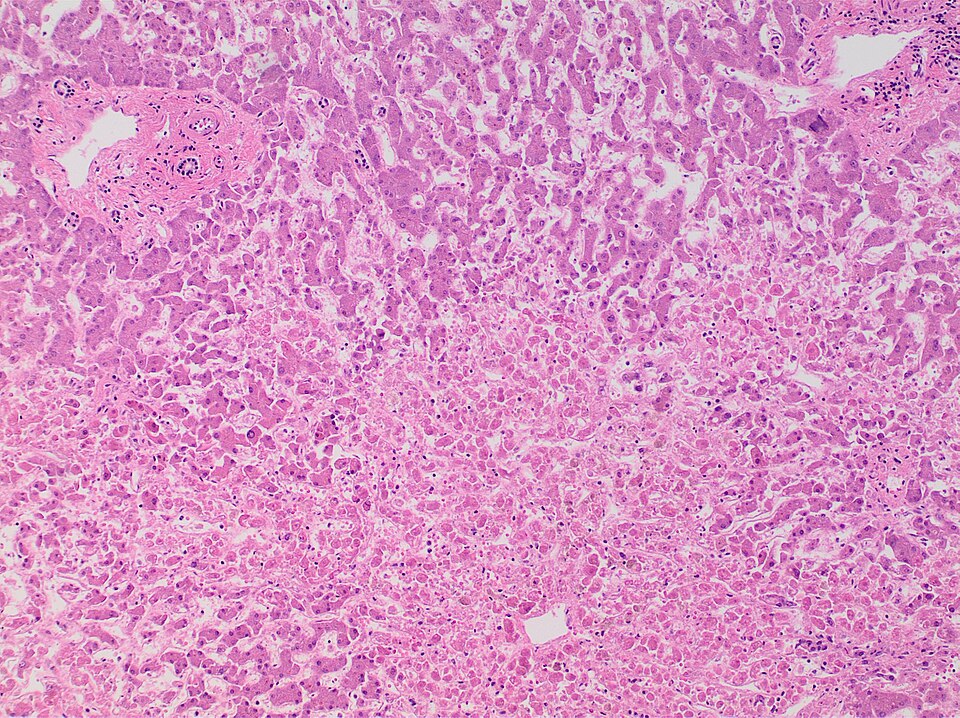
A liver biopsy from a patient taking acetaminophen in overdose shows centrilobular necrosis. Which mechanism is primarily responsible for this injury?
Mikael Häggström, M.D., CC0, via Wikimedia Commons.
Answer: C. Acetaminophen overdose leads to accumulation of the toxic metabolite NAPQI, which causes hepatocellular injury. Normally, NAPQI is detoxified by glutathione, but overdose depletes glutathione stores. This results in centrilobular necrosis, where CYP450 activity is highest. Immune-mediated injury and viral effects are not responsible in this case. Thus, toxic metabolite accumulation is the key mechanism.
Source: Lee, W. M. (2017). Acetaminophen (APAP) hepatotoxicity—Isn't it time for APAP to go away? Journal of Hepatology.
Your next questions are ready.
The question bank picks up from here: it adapts to what you just missed and brings it back right before you'd forget it.
What are the best test-taking strategies for multiple choice?expand_more
Read the stem carefully to know exactly what is asked, predict an answer before viewing the options, eliminate clearly wrong choices, manage your time by flagging hard questions and moving on, and never leave blanks. Aim for the best-supported answer rather than a perfect one.
Should I change my answer if I am unsure?expand_more
Only change an answer if you have a concrete, specific reason — such as spotting a detail you misread. Changing answers based on vague anxiety more often converts correct answers to incorrect ones, so a well-reasoned first choice is usually best left alone.
How do I manage time on a long exam?expand_more
Pace yourself against the clock so no single question steals time from others. When a question is difficult, make your best guess, flag it, and move on, returning later if time allows. This keeps you from running out of time before reaching easier points later in the section.
Is it better to guess or leave a question blank?expand_more
On exams without a penalty for wrong answers — including the USMLE, NCLEX, and MCAT — you should always guess rather than leave a question blank, because a guess has a chance of being correct while a blank guarantees zero points.
Free weekly high-yield email
One high-yield concept + one question, every week
Study smarter with a short weekly email. No spam — unsubscribe anytime.
✓ You're in — talk soon.
Practice makes permanent
Lock this into long-term memory
Progress Note's adaptive engine spaces your reviews automatically — so this stays with you through boards and onto the wards.