Ascites is the accumulation of fluid within the peritoneal cavity, most often from cirrhosis with portal hypertension. Boards emphasize using the serum-ascites albumin gradient (SAAG) to classify the cause, recognizing spontaneous bacterial peritonitis, and the stepwise approach to management.
Evidence-based · For exam prep, not medical advice
update Updated October 2026
Date of last content change
Built by surgery and anesthesiology residents·Written for USMLE Step 1
bolt The 60-second version
check_circleAscites is fluid in the peritoneal cavity, most commonly from cirrhosis.
check_circleThe serum-ascites albumin gradient (SAAG) classifies the cause.
check_circleA high SAAG (≥1.1 g/dL) indicates portal hypertension.
check_circleA low SAAG (<1.1 g/dL) points to non-portal causes such as malignancy or infection.
check_circleSpontaneous bacterial peritonitis is a key, treatable complication.
Causes
The most common cause of ascites is cirrhosis with portal hypertension, which accounts for the majority of cases. Other causes include heart failure, malignancy (peritoneal carcinomatosis), tuberculous peritonitis, pancreatitis, and nephrotic syndrome. Because the mechanism differs — portal hypertension versus peritoneal disease — analysis of the ascitic fluid is central to identifying the cause.
The SAAG
The serum-ascites albumin gradient (SAAG) is calculated by subtracting the ascitic fluid albumin from the serum albumin, and it classifies ascites by mechanism far better than older exudate/transudate labels. A high gradient (SAAG ≥ 1.1 g/dL) indicates portal hypertension — from cirrhosis, heart failure, or Budd-Chiari. A low gradient (SAAG < 1.1 g/dL) indicates a non-portal cause such as malignancy, tuberculosis, or nephrotic syndrome.
Spontaneous Bacterial Peritonitis
Spontaneous bacterial peritonitis (SBP) is infection of ascitic fluid without an obvious surgical source, occurring in cirrhotic ascites. It is diagnosed when the ascitic fluid absolute neutrophil count exceeds 250 cells per microliter, often with a single organism on culture. It can present subtly, so a diagnostic paracentesis is performed in cirrhotic patients with new or worsening ascites; treatment is a third-generation cephalosporin.
Management
For high-SAAG (cirrhotic) ascites, management steps up from sodium restriction and diuretics (spironolactone with furosemide) to therapeutic paracentesis for large or refractory ascites, with albumin replacement after large-volume drainage. Refractory cases may need a transjugular intrahepatic portosystemic shunt (TIPS) or, ultimately, liver transplantation. Low-SAAG ascites is managed by treating the underlying cause, such as malignancy or infection.
Try it now
3 real questions on Ascites
Straight from the Progress Note question bank, each with a cited explanation. No account needed.
123
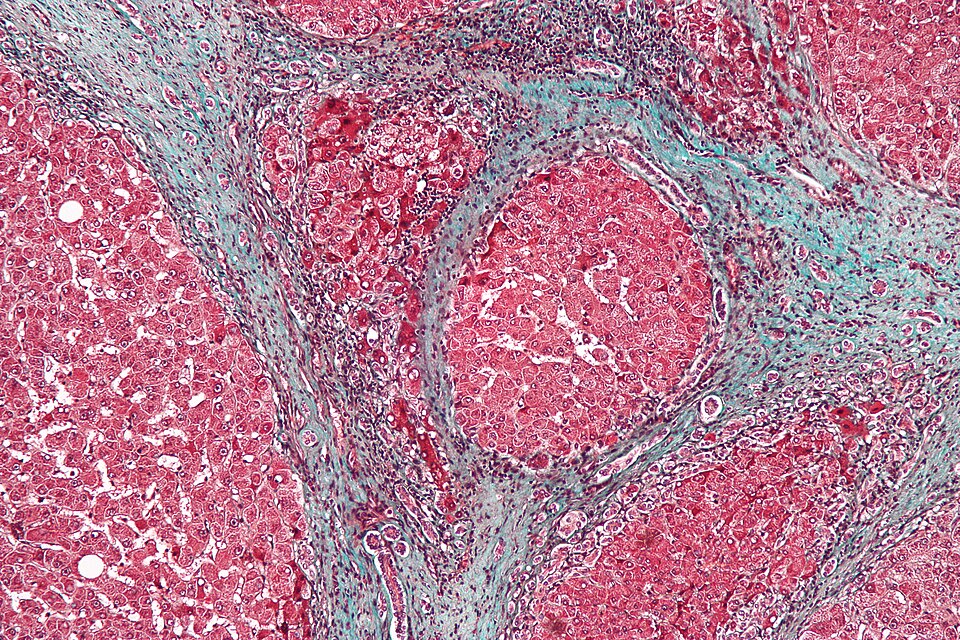
A 51-year-old man with a 25-year history of heavy alcohol use presents with jaundice, ascites, and confusion. Physical examination reveals spider angiomata, palmar erythema, and a firm, nodular liver edge. Liver biopsy is performed and the histologic image below is obtained. Which of the following best describes the cell type most responsible for the architectural changes visible in this specimen?
Nephron, CC BY-SA 3.0 <https://creativecommons.org/licenses/by-sa/3.0>, via Wikimedia Commons
Answer: D. Hepatic cirrhosis represents the end-stage response to chronic hepatocellular injury, characterized histologically by regenerative nodules surrounded by bands of bridging fibrosis and loss of normal lobular architecture, as seen on Masson trichrome stain. The central effectors of hepatic fibrosis are hepatic stellate cells (HSCs), which reside in the space of Disse in a quiescent, vitamin A-storing state; upon chronic injury, activated Kupffer cells and damaged hepatocytes release TGF-β1, PDGF, and reactive oxygen species that activate HSCs to transdifferentiate into myofibroblasts, which proliferate and deposit type I and III fibrillar collagen. Option A is incorrect; Kupffer cells are the resident hepatic macrophages and are critical for HSC activation via cytokine release, but do not themselves deposit fibrillar collagen. Option C describes a mechanism more relevant to primary sclerosing cholangitis, where periductal fibroblasts contribute. Option B is not a recognized primary mechanism of hepatic fibrosis. Option E describes sinusoidal capillarization, a secondary consequence of fibrosis rather than its primary driver.
Source: Bataller, R., & Brenner, D. A. (2005). Liver fibrosis. Journal of Clinical Investigation, 115(2), 209–218.
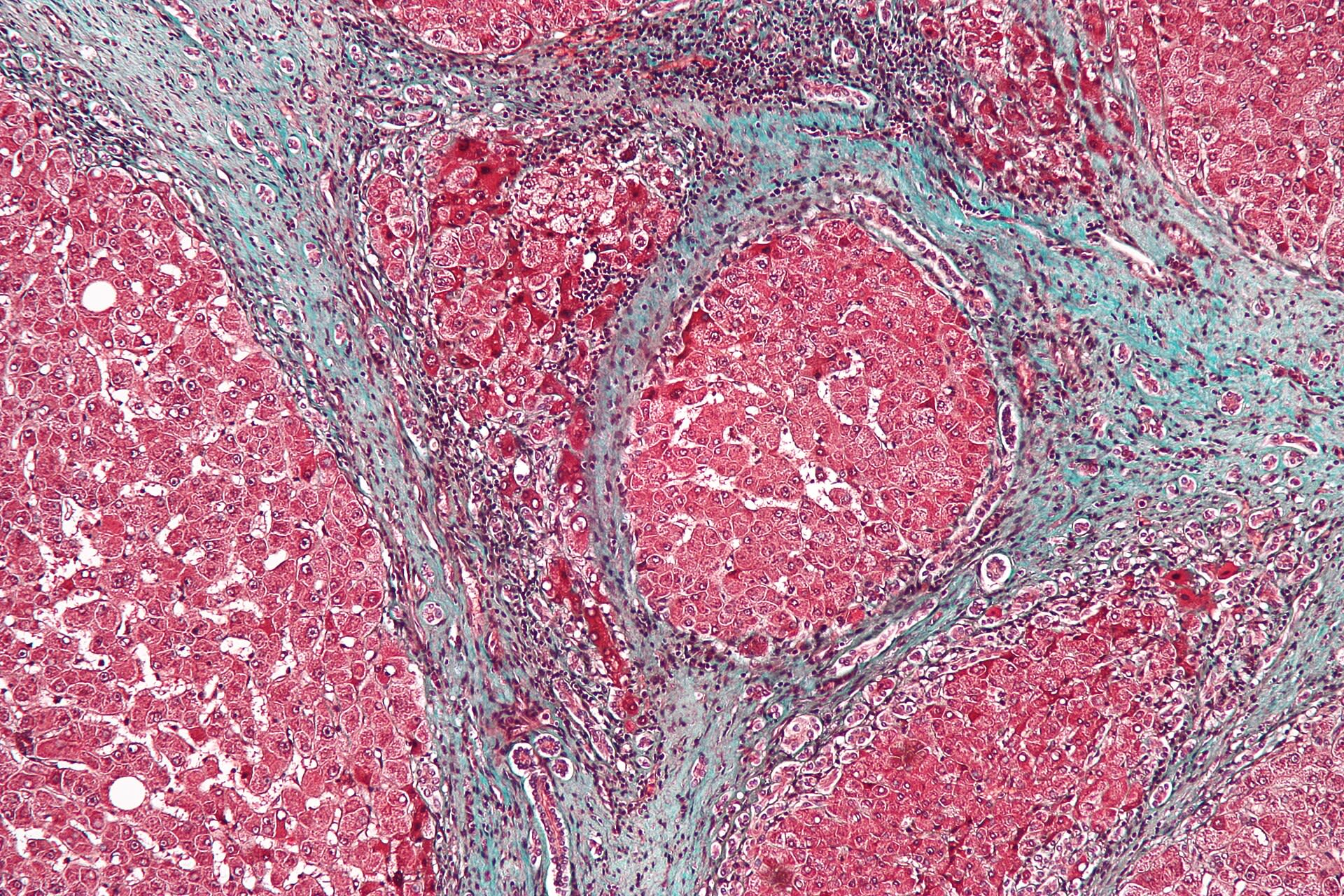
A 52-year-old man with a 25-year history of alcohol use disorder presents with jaundice, ascites, and confusion. Physical examination reveals spider angiomata, palmar erythema, gynecomastia, and caput medusae. Liver biopsy demonstrates bridging fibrosis, regenerative nodules, and loss of normal lobular architecture. Which of the following mechanisms most directly accounts for the development of portal hypertension in this patient?
Nephron, CC BY-SA 3.0 <https://creativecommons.org/licenses/by-sa/3.0>, via Wikimedia Commons
Answer: B. In alcoholic cirrhosis, chronic hepatocyte injury activates hepatic stellate cells (HSCs), which transdifferentiate into myofibroblasts and secrete large quantities of type I and III collagen into the space of Dissé. This fibrous matrix distorts sinusoidal architecture, narrows vascular channels, and — combined with myofibroblast-mediated vasoconstriction — markedly elevates intrahepatic resistance to portal flow, producing sinusoidal portal hypertension. The downstream consequences include portosystemic collateral formation (caput medusae, esophageal varices), splenomegaly, and ascites. Hepatic vein thrombosis (option A) causes post-sinusoidal (Budd-Chiari) portal hypertension and does not produce cirrhotic morphology. Reduced albumin synthesis (option D) contributes to ascites via reduced oncotic pressure but does not cause portal hypertension itself.
Source: Friedman, S. L. (2008). Hepatic stellate cells: protean, multifunctional, and enigmatic cells of the liver. Physiological Reviews, 88(1), 125–172.
From our NCLEX bank
A nurse is caring for a client with cirrhosis who has developed ascites. Which action by the nurse is most appropriate?
Answer: D. Measuring abdominal girth and weight daily with a consistent method tracks fluid accumulation objectively and shows whether treatment is working (option D). A high-sodium diet (A) is the opposite of what is needed, since sodium restriction is central to managing ascites. Lying flat (B) allows the fluid to press upward against the diaphragm and worsens breathing, so the client sits upright instead. A high-protein diet without fluid restriction (C) is inappropriate, because protein is often moderated when encephalopathy is a concern and fluids are typically limited. The nurse marks the measuring point on the abdomen so the site is identical each day.
What is the most common cause of ascites?expand_more
Cirrhosis with portal hypertension is the most common cause of ascites, accounting for the majority of cases. Other causes include heart failure, malignancy, tuberculous peritonitis, and nephrotic syndrome.
What is the SAAG and how is it used?expand_more
The serum-ascites albumin gradient (SAAG) is the serum albumin minus the ascitic fluid albumin. A high gradient (≥1.1 g/dL) indicates portal hypertension (cirrhosis, heart failure), while a low gradient (<1.1 g/dL) indicates a non-portal cause such as malignancy or infection. It classifies ascites by mechanism.
What is spontaneous bacterial peritonitis?expand_more
Spontaneous bacterial peritonitis (SBP) is infection of ascitic fluid without a surgical source, occurring in cirrhotic ascites. It is diagnosed when the ascitic fluid neutrophil count exceeds 250 cells per microliter and is treated with a third-generation cephalosporin such as cefotaxime.
How is ascites treated?expand_more
Cirrhotic (high-SAAG) ascites is managed with sodium restriction and diuretics (spironolactone and furosemide), with therapeutic paracentesis for large or refractory ascites and albumin after large-volume removal. Refractory cases may need TIPS or transplant. Low-SAAG ascites is treated by addressing the underlying cause.
Free weekly high-yield email
One high-yield concept + one question, every week
Study smarter with a short weekly email. No spam — unsubscribe anytime.
✓ You're in — talk soon.
Reading is one thing. Remembering is another.
Turn this guide into questions you’ll actually remember
Progress Note turns concepts like this into adaptive questions and spaced review, so difficult topics come back to you exactly when you’re about to forget them.