MCAT acids and bases is one of the highest-yield topics on the exam because it shows up everywhere — buffer chemistry in physiology, amino acid charge in biochemistry, and pH-dependent solubility in pharmacology. This guide builds from the definitions of acids and bases through pH calculations, strong versus weak behavior, buffers, and the titration curves the test loves to show.
Evidence-based · For exam prep, not medical advice
update Updated October 2026
Date of last content change
Built by surgery and anesthesiology residents
Written for the MCAT · Free to read
bolt The 60-second version
MCAT acids and bases is one of the highest-yield topics on the exam because it shows up everywhere — buffer chemistry in physiology, amino acid charge in biochemistry, and pH-dependent solubility in pharmacology.
check_circlepH = −log[H⁺]; each pH unit is a tenfold change in [H⁺], and pH + pOH = 14 at 25 °C.
check_circleStrong acids/bases dissociate completely; weak ones establish an equilibrium described by Ka or Kb.
check_circleA strong acid has a weak conjugate base; Ka × Kb = Kw.
check_circleBuffers resist pH change and work best when pH ≈ pKa (Henderson–Hasselbalch).
check_circleAt the half-equivalence point of a weak-acid titration, pH = pKa.
check_circleEquivalence-point pH depends on the salt: 7 for strong–strong, >7 for weak acid–strong base, <7 for strong acid–weak base.
target What you'll be able to do · aligned to AAMC content category 5A
5ACalculate pH, pOH, [H⁺], and [OH⁻] and relate them through Kw at 25 °C.
5ADistinguish strong from weak acids and bases and use Ka/pKa to compare strength.
5AExplain buffer action and apply the Henderson–Hasselbalch equation.
5AInterpret titration curves: buffer region, half-equivalence (pKa), and equivalence point.
How the MCAT tests acids and bases
Acid–base chemistry sits in AAMC content category 5A — the unique nature of water and its solutions. It is arguably the most cross-cutting general-chemistry topic: the same math governs blood buffering, the charge on amino acids at a given pH, and drug absorption. Expect quick pH estimates and titration-curve interpretation over grinding calculations.
workspace_premium Why it is so high yield
The bicarbonate buffer, amino-acid pI, and Henderson–Hasselbalch all reuse this one framework. Points here compound across the Chem/Phys and Bio/Biochem sections.
Defining acids and bases
Three definitions build on one another. Arrhenius: acids give H⁺, bases give OH⁻ in water. Brønsted–Lowry (the MCAT default): acids are proton donors, bases are proton acceptors. Lewis: acids accept an electron pair, bases donate one.
Conjugate pairs. An acid (HA) donates a proton to become its conjugate base (A⁻). The stronger the acid, the weaker its conjugate base.
A conjugate acid–base pair differs by exactly one proton. Water is amphoteric — it can act as either — which is why it autoionizes: 2H₂O ⇌ H₃O⁺ + OH⁻, with Kw = 1.0 × 10⁻¹⁴ at 25 °C.
pH, pOH, and the water constant
pH measures acidity on a logarithmic scale, so a difference of one pH unit is a tenfold difference in hydrogen-ion concentration.
The pH scale. Below 7 is acidic, 7 is neutral, above 7 is basic (at 25 °C). Because it is logarithmic, pH 3 is 10,000× more acidic than pH 7.
pH = −log[H⁺]Definition of pHAnd pOH = −log[OH⁻]. At 25 °C, pH + pOH = 14, since Kw = [H⁺][OH⁻] = 10⁻¹⁴.
workspace_premium Fast log trick
For [H⁺] = m × 10⁻ⁿ, pH ≈ n − log m. So [H⁺] = 2 × 10⁻³ gives pH ≈ 3 − 0.3 = 2.7. This estimate is usually all the MCAT needs.
Strong vs weak acids and bases
Strength is about the degree of dissociation, not concentration. Strong acids and bases dissociate essentially completely; weak ones reach an equilibrium quantified by Ka (acids) or Kb (bases).
Property
Strong acid
Weak acid
Dissociation
Complete (~100%)
Partial (equilibrium)
[H⁺] from 0.1 M
≈ 0.1 M
≪ 0.1 M
Described by
Goes to completion
Ka (smaller Ka = weaker)
Examples
HCl, H₂SO₄, HNO₃
CH₃COOH, HF, H₂CO₃
Memorize the six strong acids (HCl, HBr, HI, HNO₃, H₂SO₄, HClO₄); assume anything else is weak.
pKa = −log KaAcid strengthA lower pKa means a stronger acid. pKa also equals the pH at which an acid is half-dissociated.
Buffers and Henderson–Hasselbalch
A buffer is a mixture of a weak acid and its conjugate base that resists pH change when small amounts of acid or base are added. It works because the two components neutralize added base or acid respectively.
pH = pKa + log([A⁻]/[HA])Henderson–HasselbalchWhen [A⁻] = [HA], the log term is zero and pH = pKa — the point of maximum buffering capacity.
functions Worked example — buffer pH
A buffer contains 0.20 M acetic acid (pKa 4.74) and 0.20 M acetate. What is the pH?
Answer. pH = 4.74 — a buffer is centered at (and buffers best near) its pKa.
Titration curves
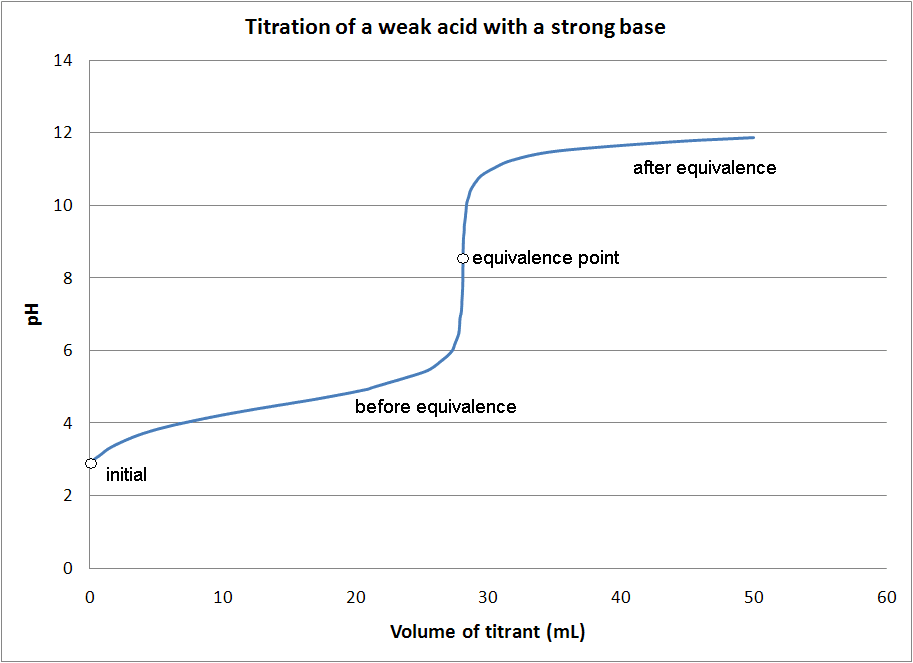
A titration curve plots pH as base (or acid) is added. Its shape reveals whether the analyte is strong or weak and pinpoints the equivalence point.
Weak acid titrated with strong base. The flat buffer region is centered at the half-equivalence point, where pH = pKa; the equivalence point sits above pH 7 because the product is a basic conjugate.
Half-equivalence point: half the acid is neutralized, [HA] = [A⁻], so pH = pKa — the easiest way to read a pKa off a graph.
Equivalence point: moles of base = moles of acid. Strong–strong → pH 7; weak acid–strong base → pH > 7; strong acid–weak base → pH < 7.
Polyprotic acids show one equivalence point per ionizable proton (multiple plateaus).
How to study it — and the traps to avoid
Acid–base rewards fluency with logs and a clear mental map of the titration curve. Build both.
Memorize the strong acids and bases; treat everything else as weak.
Practice fast pH estimates with the n − log m shortcut.
Anchor the titration curve: half-equivalence = pKa, equivalence pH set by the conjugate.
Use Henderson–Hasselbalch for any weak acid/conjugate base mixture.
error Highest-yield trap
The equivalence point of a weak acid–strong base titration is NOT at pH 7. All the acid has been converted to its conjugate base, which is basic, so the equivalence pH is above 7. Only strong–strong titrations hit exactly 7.
Straight from the Progress Note question bank, each with a cited explanation. No account needed.
123
A patient with an anion-gap metabolic acidosis hyperventilates. Which acid–base principle explains why decreasing PaCO₂ partially restores pH?
Answer: B. The Henderson–Hasselbalch equation indicates that for a given bicarbonate concentration, reducing PaCO₂ increases the ratio [HCO₃⁻]/(0.03×PaCO₂) and thus increases pH, providing respiratory compensation for metabolic acidosis.
A buffer solution resists large changes in pH when a small amount of acid or base is added. A buffer is able to do this because it contains...
Answer: C. A buffer contains a weak acid together with its conjugate base (or a weak base and its conjugate acid); the weak acid neutralizes added base, while the conjugate base neutralizes added acid, so the pH changes only slightly. Pure water (A) has no such neutralizing pair, a strong acid alone (B) cannot resist added acid, table salt (D) is a neutral salt that does not buffer, and a solution with no dissolved particles (E) cannot neutralize anything. A buffer works because it holds both a weak acid and its conjugate base.
Source: Silberberg, M. S., & Amateis, P. (2018). Chemistry: The molecular nature of matter and change (8th ed.). McGraw-Hill.
During a titration of 25.0 mL of 0.100 M acetic acid with 0.100 M NaOH at 25°C, which statement best describes the pH at the half-equivalence point?
Answer: B. At the half-equivalence point of a weak acid–strong base titration, the concentrations of the weak acid and its conjugate base are equal. By the Henderson–Hasselbalch relationship, pH = pKa + log([A−]/[HA]) = pKa. Dilution affects total concentrations but not the ratio at this point, so pH approximates the acid’s pKa.
What is the difference between a strong and a weak acid?expand_more
Strength refers to how completely an acid dissociates, not how concentrated it is. A strong acid ionizes essentially 100% in water, while a weak acid reaches an equilibrium and only partially ionizes, described by its Ka. A concentrated weak acid is still weak.
Why does pH = pKa at the half-equivalence point?expand_more
At the half-equivalence point of a weak-acid titration, exactly half the acid has been converted to its conjugate base, so [HA] = [A⁻]. In the Henderson–Hasselbalch equation the log([A⁻]/[HA]) term becomes log 1 = 0, leaving pH = pKa.
How does a buffer resist pH change?expand_more
A buffer contains comparable amounts of a weak acid and its conjugate base. Added strong base is neutralized by the weak acid, and added strong acid is neutralized by the conjugate base, so the ratio (and therefore pH) changes only slightly. Buffers work best when the pH is within about one unit of the pKa.
Is the equivalence point always at pH 7?expand_more
No. Only a strong acid–strong base titration has its equivalence point at pH 7. A weak acid titrated with a strong base ends above 7 (the conjugate base is basic), and a strong acid titrated with a weak base ends below 7.
What does a lower pKa tell you?expand_more
A lower pKa means a stronger acid — it dissociates more and has a larger Ka. pKa is also the pH at which the acid is exactly half-dissociated, which is why it equals the pH at the half-equivalence point of a titration.
Study smarter with a short weekly email. No spam — unsubscribe anytime.
✓ You're in — talk soon.
Reading is one thing. Remembering is another.
Turn this guide into questions you’ll actually remember
Progress Note turns concepts like this into adaptive questions and spaced review, so difficult topics come back to you exactly when you’re about to forget them.