MCAT enzymes are biological catalysts that make life’s reactions fast enough to sustain it. They lower activation energy without being consumed, and the exam tests both how they work — the active site, induced fit — and how we quantify them with Michaelis–Menten kinetics. Enzyme inhibition and regulation tie directly into pharmacology and metabolism.
check_circleEnzymes are regulated by cofactors, allosteric effectors, and feedback inhibition.
target What you'll be able to do · aligned to AAMC content category 1A
1AExplain how enzymes lower activation energy through the active site and induced fit.
1AInterpret Michaelis–Menten kinetics, including the meaning of Km and Vmax.
1ADistinguish competitive, noncompetitive, and uncompetitive inhibition by their effect on Km and Vmax.
1ADescribe enzyme regulation: cofactors, allosteric control, and feedback inhibition.
How the MCAT tests enzymes
Enzymes belong to AAMC content category 1A and are among the most tested biochemistry topics because they connect chemistry (kinetics, catalysis) with biology (metabolism, regulation) and medicine (drug inhibitors). Expect Michaelis–Menten graphs and inhibition scenarios far more than rote definitions.
workspace_premium The key idea
An enzyme speeds a reaction by lowering its activation energy, not by making it more favorable. It changes the rate, never ΔG, K, or the equilibrium position.
How enzymes work
Enzymes bind substrate at a specific pocket — the active site — and stabilize the transition state, lowering the activation energy. The modern view is induced fit: binding subtly reshapes the active site around the substrate.
Enzyme catalysis. Substrate binds the active site to form an enzyme–substrate complex; catalysis yields products, and the enzyme is regenerated unchanged for another cycle.
Enzymes are highly specific — the active site’s shape and chemistry select particular substrates.
They are not consumed and can catalyze many cycles.
Activity depends on temperature and pH; each enzyme has an optimum, and extremes denature it.
Michaelis–Menten kinetics
Enzyme velocity depends on substrate concentration in a characteristic saturating way, captured by the Michaelis–Menten model.
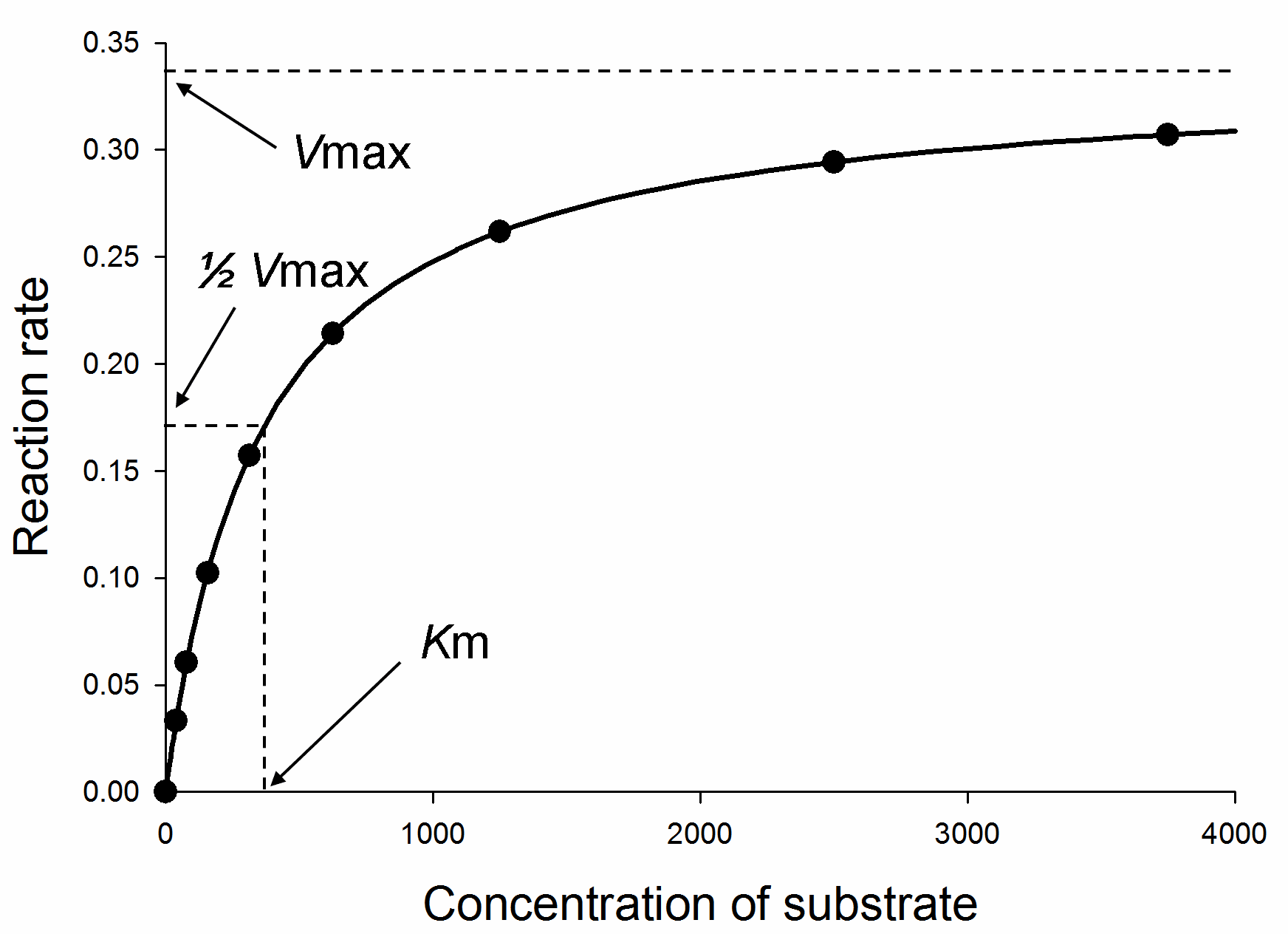
The Michaelis–Menten curve. Velocity rises with [S] and plateaus at Vmax when the enzyme is saturated. Km is the substrate concentration giving half-maximal velocity.
v = Vmax·[S] / (Km + [S])Michaelis–MentenAt low [S], rate is roughly proportional to [S]; at high [S], the enzyme saturates and v approaches Vmax.
Km is the [S] at half Vmax; a low Km means high affinity (little substrate needed to work).
Vmax is the maximum velocity at saturation, proportional to enzyme amount.
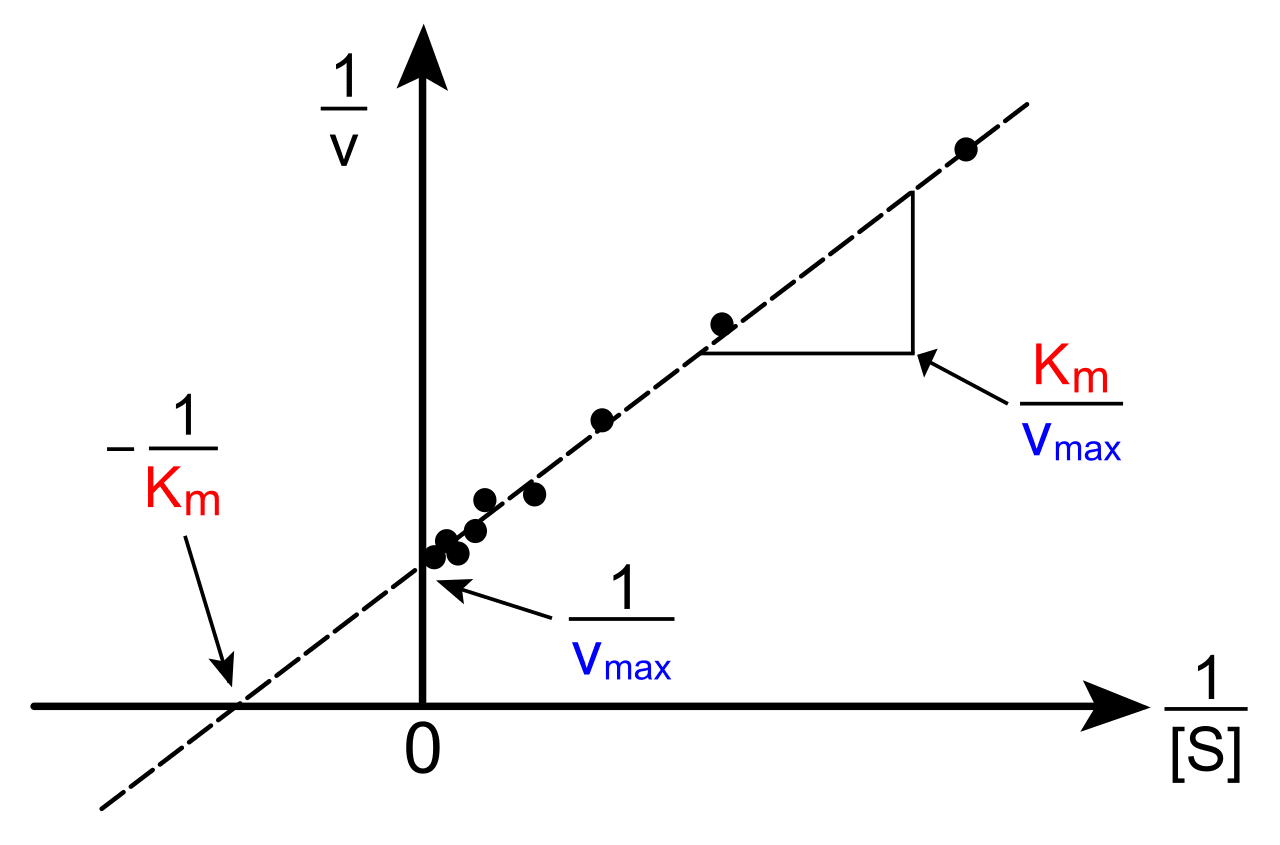
A Lineweaver–Burk plot (1/v vs 1/[S]) linearizes the curve to read Km and Vmax from the intercepts.
Enzyme inhibition
Inhibitors reduce enzyme activity, and how they change Km and Vmax reveals their mechanism — a classic MCAT distinction with direct pharmacology relevance.
Inhibition patterns. A competitive inhibitor raises the apparent Km but Vmax is unchanged (overcome by more substrate); a noncompetitive inhibitor lowers Vmax with Km unchanged.
Inhibitor
Binds
Km
Vmax
Competitive
Active site
Increases
Unchanged
Noncompetitive
Allosteric site
Unchanged
Decreases
Uncompetitive
E–S complex only
Decreases
Decreases
Competitive inhibition can be overcome by adding more substrate; noncompetitive cannot.
Cofactors, allosteric regulation, and feedback
Cells tune enzyme activity through several mechanisms so that pathways respond to need.
Cofactors and coenzymes (metal ions, vitamins like NAD⁺ from niacin) are required helpers for many enzymes.
Allosteric regulation: effectors bind sites away from the active site to activate or inhibit, often giving sigmoidal kinetics (e.g., in cooperative enzymes).
Feedback inhibition: a pathway’s end product inhibits an earlier enzyme, preventing overproduction — a key homeostatic control.
Enzymes, drugs, and metabolism
Much of pharmacology is enzyme inhibition, and metabolic control is enzyme regulation.
Many drugs are competitive or irreversible enzyme inhibitors, and the regulated enzymes of metabolism — like phosphofructokinase in glycolysis — are controlled by exactly these mechanisms.
How to study it — and the traps to avoid
Enzyme questions are usually graph interpretation. Practice reading Km, Vmax, and inhibition off the curve.
Remember an enzyme changes rate only — never ΔG or equilibrium.
Read Km as affinity: lower Km, higher affinity.
Match inhibition type to its Km/Vmax signature.
Connect feedback inhibition to metabolic regulation.
error Highest-yield trap
A low Km means HIGH affinity, not low. Km is the substrate concentration needed to reach half of Vmax, so a small Km means the enzyme works with very little substrate — it binds tightly.
Straight from the Progress Note question bank, each with a cited explanation. No account needed.
123
A tight‑binding transition‑state analog inhibits an enzyme but is not turned over. Which kinetic pattern is most consistent with this inhibitor at low [S]?
Answer: A. Transition‑state analogs commonly act as potent competitive inhibitors that occupy the active site, raising apparent Km without altering Vmax at saturating substrate.
Source: Copeland, R. A. (2016). Evaluation of Enzyme Inhibitors in Drug Discovery (2nd ed.). Wiley; and Cornish‑Bowden, A. (2013). Fundamentals of enzyme kinetics (4th ed.). Wiley‑Blackwell.
An enzyme that follows Michaelis–Menten kinetics is inhibited by a compound that binds only to the enzyme–substrate complex. Which Lineweaver–Burk change is most consistent with this uncompetitive inhibition?
Answer: C. Uncompetitive inhibitors bind exclusively to ES, reducing both Vmax and apparent Km by the same factor; Lineweaver–Burk plots yield parallel lines. This differs from competitive inhibition (Km increases, Vmax unchanged) and noncompetitive inhibition (Vmax decreases, Km unchanged).
Source: Cornish-Bowden, A. (2012). Fundamentals of enzyme kinetics (4th ed.). Wiley-Blackwell.
A competitive inhibitor is added to an enzyme-catalyzed reaction at substrate concentrations around Km. Which immediate kinetic change is expected under Michaelis–Menten conditions?
Answer: C. Competitive inhibitors bind to the active site and increase the apparent Km, reflecting a need for higher substrate concentration to reach half-maximal velocity. Vmax remains unchanged because sufficiently high substrate can outcompete the inhibitor. Noncompetitive and uncompetitive patterns alter Vmax differently and are not consistent with the scenario.
Source: Cornish-Bowden, A. (2012). Fundamentals of enzyme kinetics (4th ed.). Wiley-Blackwell.
Your next questions are ready.
The question bank picks up from here: it adapts to what you just missed and brings it back right before you'd forget it.
Enzymes lower the activation energy of a reaction by binding substrate in their active site and stabilizing the transition state. They increase the reaction rate without being consumed and without changing ΔG, the equilibrium constant, or the position of equilibrium — they only help the reaction get there faster.
What do Km and Vmax represent?expand_more
Vmax is the maximum reaction velocity, reached when the enzyme is saturated with substrate. Km is the substrate concentration that produces half of Vmax and is an inverse measure of affinity: a low Km means the enzyme reaches half-maximal speed at low substrate, indicating high affinity.
How do competitive and noncompetitive inhibitors differ?expand_more
A competitive inhibitor binds the active site and competes with substrate, so it raises the apparent Km while leaving Vmax unchanged — adding more substrate overcomes it. A noncompetitive inhibitor binds an allosteric site and lowers Vmax while leaving Km unchanged, and it cannot be overcome by adding substrate.
What is feedback inhibition?expand_more
Feedback inhibition is a regulatory mechanism in which the final product of a metabolic pathway inhibits an enzyme earlier in that pathway. This prevents the cell from overproducing the product and is a key way pathways are kept in balance with the cell’s needs.
Does an enzyme change the equilibrium of a reaction?expand_more
No. An enzyme speeds up both the forward and reverse reactions equally by lowering activation energy, so the reaction reaches equilibrium faster but the equilibrium position, ΔG, and K are all unchanged.
Study smarter with a short weekly email. No spam — unsubscribe anytime.
✓ You're in — talk soon.
Reading is one thing. Remembering is another.
Turn this guide into questions you’ll actually remember
Progress Note turns concepts like this into adaptive questions and spaced review, so difficult topics come back to you exactly when you’re about to forget them.