Contrast media are agents given to improve visualization on imaging, most commonly iodinated contrast for CT and gadolinium for MRI. Boards emphasize the adverse reactions — allergic reactions, contrast-induced nephropathy, and nephrogenic systemic fibrosis — and the precautions before use.
edit_note
Progress Note Editorial
Evidence-based · For exam prep, not medical advice
update Updated October 2026
Date of last content change
Built by surgery and anesthesiology residents·Written for USMLE Step 1
bolt The 60-second version
check_circleIodinated contrast is used for CT; gadolinium is used for MRI.
check_circleAllergic-type reactions range from hives to anaphylaxis.
check_circleIodinated contrast can cause contrast-induced acute kidney injury.
check_circleGadolinium is linked to nephrogenic systemic fibrosis in severe kidney disease.
check_circleKidney function and allergy history are checked before contrast studies.
The two main contrast agents are used with different modalities. Iodinated contrast is used to enhance CT scans and angiography by absorbing X-rays, and modern agents are low- or iso-osmolar to reduce reactions. Gadolinium-based agents are used to enhance MRI by altering local magnetic properties. Barium and iodinated agents are also used for gastrointestinal studies. Each carries its own risk profile.
Allergic and Adverse Reactions
Contrast can cause acute reactions that are usually not true IgE-mediated allergies but present similarly, ranging from mild (nausea, warmth, urticaria) to severe (bronchospasm, anaphylaxis-like reactions). Patients with a prior significant reaction are at higher risk and may receive premedication with corticosteroids and antihistamines when contrast is necessary. A shellfish allergy is not a specific contraindication to iodinated contrast, a common misconception.
Contrast-Induced Nephropathy
Iodinated contrast can cause contrast-induced acute kidney injury, an acute decline in renal function after administration, more likely in patients with pre-existing chronic kidney disease, diabetes, volume depletion, or receiving large contrast loads. Prevention centers on identifying at-risk patients, using the lowest necessary contrast volume, ensuring adequate hydration, and avoiding other nephrotoxins around the time of the study.
Gadolinium and NSF
Gadolinium-based contrast is associated with nephrogenic systemic fibrosis (NSF), a rare but serious fibrosing disorder that occurs almost exclusively in patients with severe kidney impairment. For this reason, kidney function is assessed before gadolinium administration, and its use is restricted or avoided in advanced renal disease. Newer agents carry a lower risk, and gadolinium can also be retained in tissues.
Try it now
3 real questions on Contrast Media
Straight from the Progress Note question bank, each with a cited explanation. No account needed.
123
From our NCLEX bank
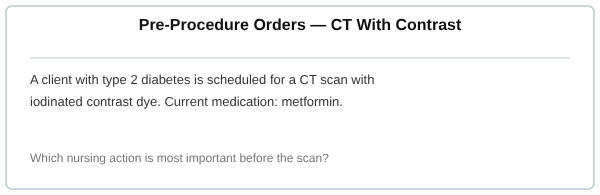
A nurse prepares the client described in the orders shown for a CT scan with iodinated contrast. Which nursing action is most important before the scan?
Answer: A. Before a contrast CT, the most important action is to confirm that metformin is withheld and to assess for an iodine or shellfish allergy, because contrast can trigger an allergic reaction and, combined with metformin, increases the risk of lactic acidosis and contrast-induced kidney injury (option A). Giving the metformin dose (B) is unsafe for this reason. A 24-hour fast from all fluids (C) is excessive and risks dehydration, which itself worsens contrast nephrotoxicity. Telling the client no preparation is needed (D) overlooks essential safety steps. The nurse also verifies kidney function and ensures the client is well hydrated per protocol.
Source: Burchum, J. R., & Rosenthal, L. D. (2022). Lehne's pharmacology for nursing care (11th ed.). Elsevier.
From our NCLEX bank
A client with reduced kidney function is scheduled for magnetic resonance imaging with gadolinium contrast. Which finding is most important for the nurse to report before the scan?
Answer: C. Severe renal impairment increases the risk of nephrogenic systemic fibrosis with gadolinium contrast, so it is most important to report before the scan (option C). Mild claustrophobia (A) should be addressed but is not the priority safety issue. A small dental filling placed years ago (B) is generally not a concern for the magnetic field. Stable baseline vital signs (D) are reassuring. Recognizing the kidney-related risk of gadolinium is the key judgment. The nurse reports the renal status, confirms the most recent kidney function, and verifies the contrast plan with the radiology team.
A nurse is preparing a client for a cardiac catheterization that uses contrast dye. Which finding is most important for the nurse to report before the procedure?
Answer: C. An allergy to iodine-based contrast or shellfish raises the risk of a contrast reaction, so it is most important to report before the procedure (option C). Mild anxiety (A) should be addressed but is not the priority safety issue. Being NPO as instructed (B) is an expected, reassuring finding. Stable baseline vital signs (D) are also reassuring, not a concern. Identifying a possible contrast allergy allows the team to premedicate or adjust the plan and prevents a serious reaction. The nurse also confirms renal function, current metformin use, and consent before the procedure.
What is the difference between CT and MRI contrast?expand_more
CT uses iodinated contrast, which absorbs X-rays to enhance images, while MRI uses gadolinium-based agents, which alter local magnetic properties. They have different risk profiles: iodinated contrast is associated with contrast-induced nephropathy, and gadolinium with nephrogenic systemic fibrosis in severe kidney disease.
What is contrast-induced nephropathy?expand_more
Contrast-induced nephropathy is an acute decline in kidney function after receiving iodinated contrast. It is more likely in patients with pre-existing kidney disease, diabetes, or volume depletion, and prevention focuses on hydration, using the least contrast necessary, and avoiding other nephrotoxins.
Does a shellfish allergy mean I cannot have contrast?expand_more
No. A shellfish allergy is not a specific contraindication to iodinated contrast; this is a common misconception. The relevant risk factor is a prior significant reaction to contrast itself, in which case premedication may be used when contrast is necessary.
What is nephrogenic systemic fibrosis?expand_more
Nephrogenic systemic fibrosis (NSF) is a rare, serious fibrosing disorder associated with gadolinium-based MRI contrast, occurring almost exclusively in patients with severe kidney impairment. Kidney function is checked before gadolinium, and its use is limited in advanced renal disease.
Free weekly high-yield email
One high-yield concept + one question, every week
Study smarter with a short weekly email. No spam — unsubscribe anytime.
✓ You're in — talk soon.
Practice makes permanent
Lock this into long-term memory
Progress Note's adaptive engine spaces your reviews automatically — so this stays with you through boards and onto the wards.