The Pomodoro Technique is a time-management method that breaks studying into focused 25-minute intervals separated by short breaks. It counters procrastination and mental fatigue, and it works especially well for the dense, high-volume material of medicine and other demanding programs.
edit_note
Progress Note Editorial
Evidence-based · For exam prep, not medical advice
update Updated October 2026
Date of last content change
Built by surgery and anesthesiology residents·Written for USMLE Step 1
bolt The 60-second version
check_circleOne "pomodoro" is 25 minutes of focused work followed by a 5-minute break.
check_circleAfter four pomodoros, take a longer 15–30 minute break.
check_circleShort intervals make starting easier and sustain attention.
check_circleProtect each focus block from notifications and task-switching.
check_circleAdjust the interval length to fit the task and your attention span.
How the Technique Works
The method is simple: pick one task, set a timer for 25 minutes, and work with full focus until it rings — that is one pomodoro. Take a 5-minute break, then repeat. After four pomodoros, take a longer break of 15 to 30 minutes. The fixed structure turns an open-ended study session into a series of small, finite sprints that are psychologically easier to begin and sustain.
Why It Helps
Breaking work into short intervals combats the two biggest barriers to studying: procrastination and fatigue. A 25-minute commitment lowers the activation energy to start, while regular breaks prevent the diminishing returns of long unbroken sessions. The ticking timer also creates a mild sense of urgency that discourages distraction and helps you notice when your attention drifts.
Using It for Studying
Pomodoros are most powerful when the focus blocks are spent on active work — doing practice questions, recalling material, or working problems — rather than passive rereading. Before starting, clear distractions and decide exactly what the block will cover. Use the short breaks to rest your eyes and move, not to open social media, which fragments attention and bleeds into the next block.
Adapting the Method
The classic 25/5 split is a starting point, not a rule. For deep, absorbing work many people prefer longer 50/10 blocks, while 15-minute intervals can help when motivation is low or the material is tedious. Tracking how many pomodoros a task takes builds realistic planning, and the key discipline is never breaking a focus block early for a notification.
Try it now
Try 3 real questions
Straight from the Progress Note question bank, each with a cited explanation. No account needed.
123
A 52-year-old woman presents with a slowly enlarging, painless neck mass. She reports no symptoms of hyperthyroidism or hypothyroidism. Thyroid ultrasound shows multiple nodules of varying sizes. Which histopathologic finding is most likely?
Doc James, CC BY-SA 4.0 <https://creativecommons.org/licenses/by-sa/4.0>, via Wikimedia Commons
Answer: A. Multinodular goiter is characterized by heterogeneous enlargement of the thyroid gland with multiple nodules of varying sizes. Histologically, it shows irregularly dilated follicles filled with colloid, along with areas of fibrosis, hemorrhage, and cystic degeneration. It is typically associated with long-standing iodine deficiency or fluctuating TSH stimulation. Option B describes medullary thyroid carcinoma. Option C describes papillary thyroid carcinoma. Option D is seen in medullary carcinoma due to calcitonin-related amyloid deposition. Option E is characteristic of Hashimoto thyroiditis.
Source: Durante, et al. (2018). The diagnosis and management of thyroid nodules: a review. JAMA.
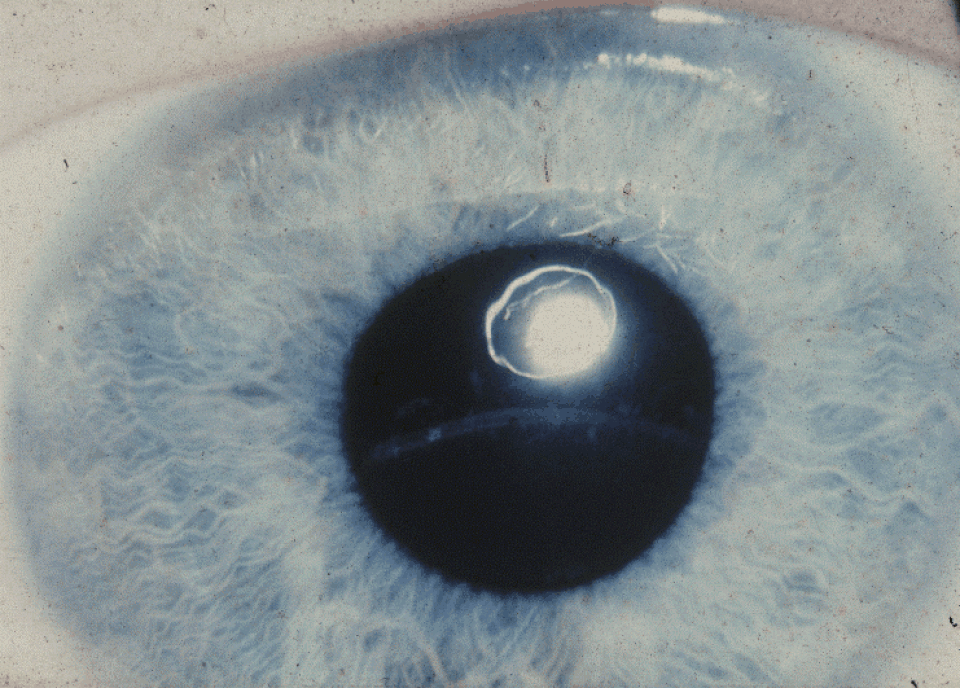
A tall, thin 10-year-old boy has intellectual disability and a history of an unprovoked deep vein thrombosis. A photo of his slit-lamp exam is shown below. Urine nitroprusside testing is positive, and plasma amino acid analysis shows markedly elevated homocysteine and methionine. Which enzyme deficiency and mechanism best account for both the connective tissue and thrombotic findings?
National Eye Institute, Public domain, via Wikimedia Commons
Answer: A. Classic homocystinuria results from cystathionine beta-synthase deficiency, which blocks the transsulfuration pathway and causes accumulation of both homocysteine and its precursor methionine; elevated homocysteine promotes endothelial damage and a prothrombotic state (explaining the thromboembolic risk) and also interferes with normal lysine-derived collagen and elastin cross-linking, contributing to the connective tissue laxity responsible for lens dislocation (characteristically downward, helping distinguish it clinically from the upward lens dislocation typical of Marfan syndrome) and skeletal features. Option B incorrectly proposes MTHFR deficiency, which causes homocystinuria with low (not elevated) methionine due to impaired remethylation, the opposite pattern from what is described. Option C incorrectly attributes the findings to a fibrillin-1 structural defect, the mechanism underlying Marfan syndrome, a distinct condition with a different lens dislocation direction and no thrombotic predisposition. Option D incorrectly dismisses the enzymatic block, attributing methionine elevation to diet alone. Option E incorrectly substitutes an unrelated primary platelet disorder for the amino acid metabolism defect actually responsible.
Source: Morris, A. A., et al. (2017). Guidelines for the diagnosis and management of cystathionine beta-synthase deficiency. Journal of Inherited Metabolic Disease.
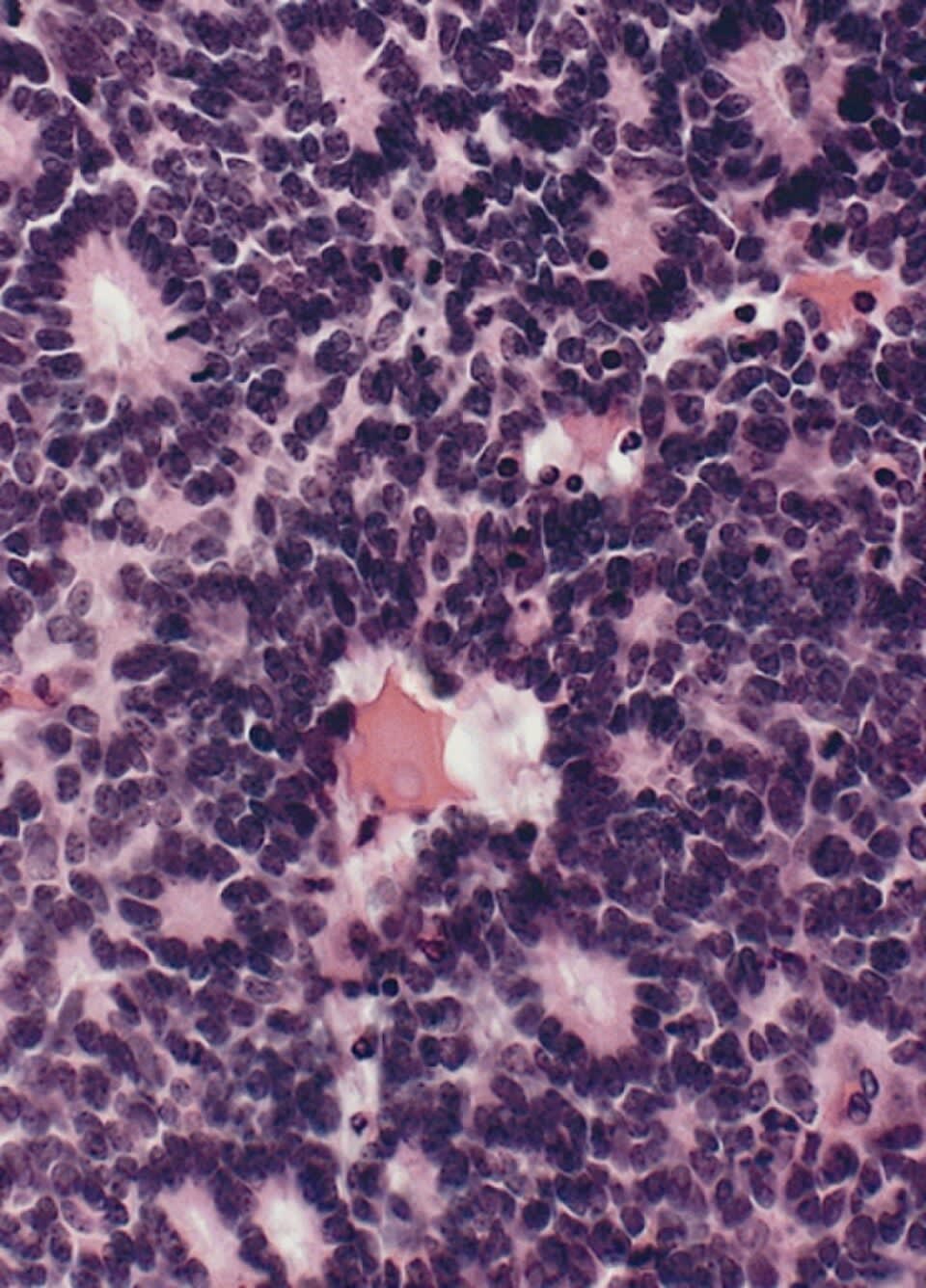
What is the diagnosis?
The Armed Forces Institute of Pathology (AFIP), Public domain, via Wikimedia Commons
Answer: E. Retinoblastoma, the most common intraocular malignancy of childhood, arises from biallelic loss of the RB1 tumor suppressor gene and classically presents with leukocoria. Histology shows small round blue cells forming Flexner-Wintersteiner rosettes, distinguished by a true central lumen, unlike the Homer-Wright rosettes (cells encircling a tangle of neural processes without a lumen) seen in neuroblastoma and medulloblastoma. Ewing sarcoma shows sheets of small round blue cells without rosette formation, and astrocytic hamartomas show bland, glial-appearing cells rather than malignant small round blue cells.
A standard pomodoro is 25 minutes of focused work followed by a 5-minute break. After completing four pomodoros, you take a longer break of about 15 to 30 minutes. The intervals can be adjusted to suit the task and your attention span.
Does the Pomodoro Technique work for studying?expand_more
Yes, it works well for studying because it lowers the barrier to starting, sustains attention through short focused blocks, and prevents fatigue with regular breaks. It is most effective when the focus blocks are spent on active study such as practice questions rather than passive rereading.
Can I use longer intervals than 25 minutes?expand_more
Absolutely. The 25/5 split is a starting template. Many people use longer 50/10 blocks for deep work that benefits from sustained immersion, or shorter intervals when motivation is low. The important part is deliberate focus followed by a real break.
What should I do during Pomodoro breaks?expand_more
Use breaks to genuinely rest — stand up, stretch, move, hydrate, or rest your eyes. Avoid activities like social media that fragment your attention and can spill over into the next focus block, undermining the technique.
Free weekly high-yield email
One high-yield concept + one question, every week
Study smarter with a short weekly email. No spam — unsubscribe anytime.
✓ You're in — talk soon.
Practice makes permanent
Lock this into long-term memory
Progress Note's adaptive engine spaces your reviews automatically — so this stays with you through boards and onto the wards.