The memory palace, or method of loci, is an ancient memorization technique that stores information as vivid images placed along a familiar route. By using the brain's strong spatial memory, it makes long lists and hard-to-remember facts far easier to recall.
edit_note
Progress Note Editorial
Evidence-based · For exam prep, not medical advice
update Updated October 2026
Date of last content change
Built by surgery and anesthesiology residents·Written for USMLE Step 1
bolt The 60-second version
check_circleThe memory palace stores information as images along a familiar physical route.
check_circleIt leverages the brain's powerful spatial and visual memory.
check_circleChoose a well-known place and a fixed order of locations (loci).
check_circleConvert facts into vivid, exaggerated images placed at each locus.
check_circleTo recall, mentally walk the route and "see" each image.
The method of loci works by attaching what you want to remember to places you already know extremely well, such as the rooms of your home. Human spatial memory is remarkably strong and durable, so information anchored to a location and a vivid image is recalled far more reliably than an abstract list. The route provides both the items and their order.
Building a Palace
Choose a familiar place — your house, a daily walk, a campus building — and define a fixed sequence of distinct locations (loci) within it, always visited in the same order. The consistency of the route matters: the same loci in the same sequence become reusable "slots" into which you can place different sets of information over time.
Placing the Information
Convert each item into a memorable image and place it at a locus along the route. The images should be vivid, exaggerated, and even absurd or emotional, because the unusual is more memorable than the mundane. For abstract facts, turn them into a concrete symbol or scene. To recall, take a mental walk through the palace and observe each image in order.
Using It for Exams
Students use memory palaces for material that resists rote learning — ordered lists, classifications, cranial nerves, drug side effects, or the steps of a pathway. It is a powerful complement to, not a replacement for, understanding: build palaces for the memorization-heavy pieces and pair them with active recall and spaced repetition to keep them durable.
Try it now
Try 3 real questions
Straight from the Progress Note question bank, each with a cited explanation. No account needed.
123
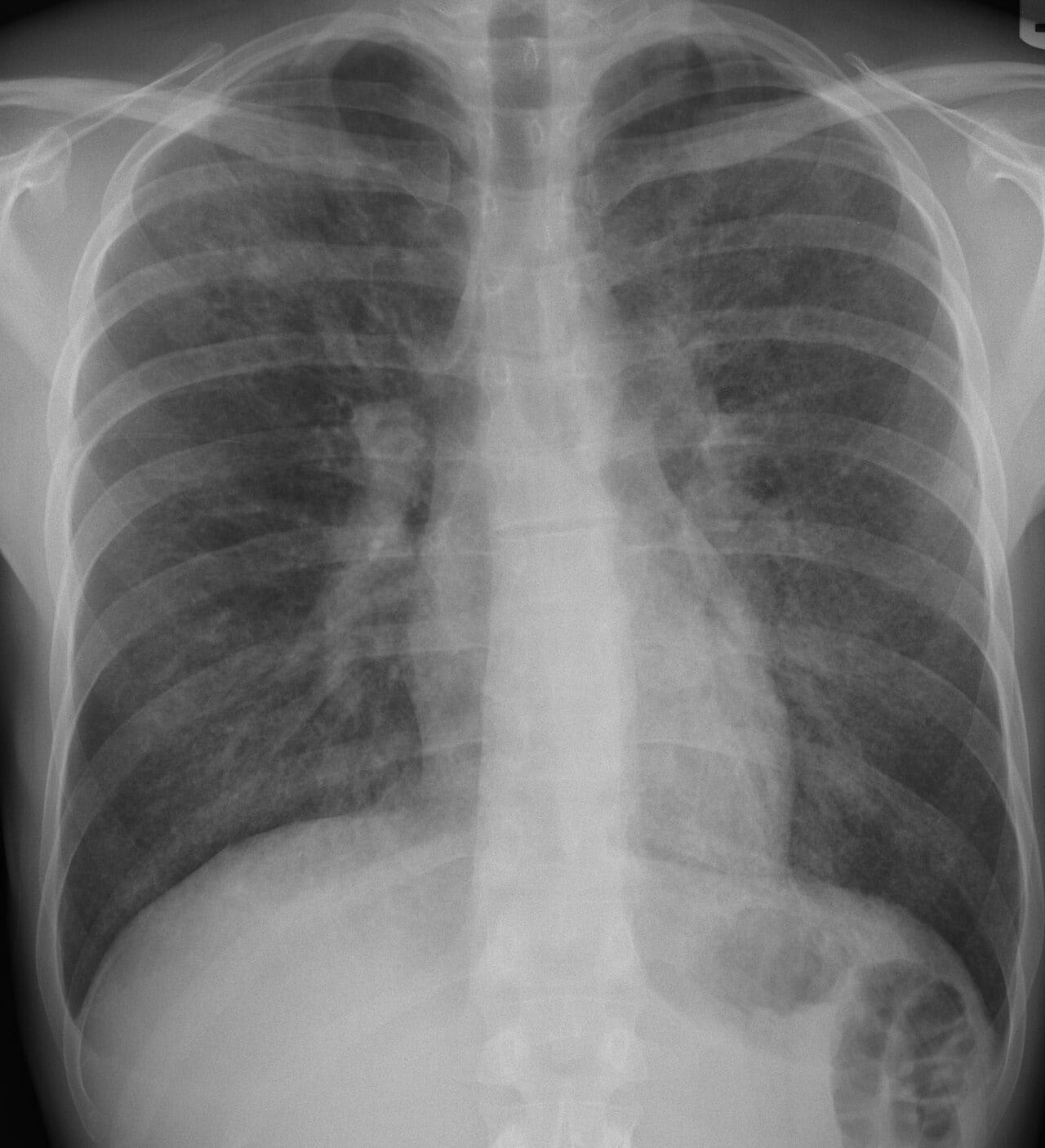
A 36-year-old man with newly diagnosed HIV infection (CD4 count 90 cells/microL) presents with progressive exertional dyspnea, dry cough, and fever over two weeks. Chest radiograph, image shown below, shows bilateral diffuse, perihilar ground-glass infiltrates. Bronchoalveolar lavage with methenamine silver stain shows cup-shaped cystic structures. Which of the following best describes the mechanism by which this patient's underlying immunodeficiency predisposes him to this specific opportunistic infection?
Public Domain, Wikimedia Commons
Answer: A. Pneumocystis jirovecii pneumonia is an AIDS-defining opportunistic infection that occurs almost exclusively when CD4+ T helper cell counts fall below approximately 200 cells/microL, because effective clearance of this organism from alveolar spaces depends on CD4+ T-cell-mediated activation of alveolar macrophages and coordination of the cellular immune response. This explains why HIV, which selectively depletes CD4+ T cells, dramatically increases susceptibility to this infection, producing the classic bilateral, diffuse, perihilar ground-glass infiltrates and cup-shaped organisms seen on silver stain. CD8+ T-cell function, humoral immunity, neutrophil counts, and complement activity are relatively preserved in early-to-moderate HIV infection and are not the primary determinants of susceptibility to this particular opportunistic pathogen.
Source: Salzer, H. J. F., et al. (2018). Clinical, diagnostic, and treatment disparities between HIV-infected and non-HIV-infected immunocompromised patients with Pneumocystis jirovecii pneumonia. Respiration, 96(1).
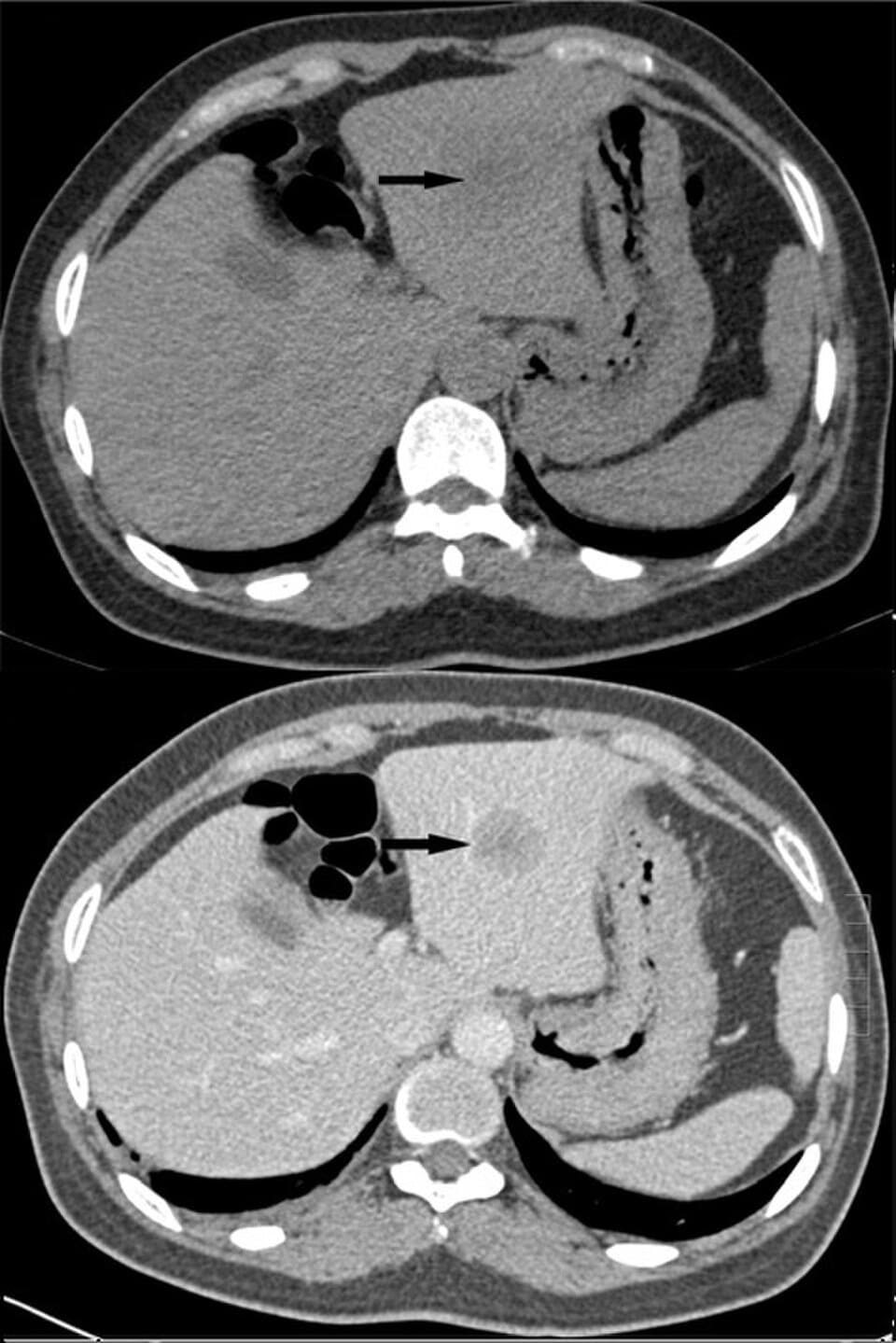
A 58-year-old man with chronic hepatitis B undergoes contrast-enhanced CT of the abdomen for surveillance. Imaging reveals a 3 cm hepatic lesion that demonstrates arterial phase hyperenhancement with subsequent venous phase washout. Alpha-fetoprotein is elevated. Which underlying pathophysiologic process most directly explains these imaging findings?
Zhenyu Pan, Guozi Yang, Tingting Yuan, Lihua Dong, Lihua Dong, CC BY 4.0 <https://creativecommons.org/licenses/by/4.0>, via Wikimedia Commons
Answer: A. Hepatocellular carcinoma (HCC) typically develops in the setting of chronic liver disease such as hepatitis B infection. As malignant hepatocytes transform, they become primarily supplied by hepatic arterial circulation rather than the normal dual blood supply dominated by the portal vein. This shift leads to arterial phase hyperenhancement on imaging, followed by rapid contrast washout in the venous phase due to lack of normal portal venous retention. Option B describes cholangiocarcinoma, which tends to show delayed enhancement due to fibrous stroma. Option C is characteristic of cirrhosis with regenerative nodules, which are not typically hypervascular. Options D and E do not produce the classic vascular imaging pattern seen in HCC.
Source: Forner, A., Reig, M., & Bruix, J. (2018). Hepatocellular carcinoma. The Lancet.
An 18-year-old has several lesions on his hands, shown below, and an LDL cholesterol of 260 mg/dL; his father, similarly affected, had a myocardial infarction at age 40. Genetic testing identifies a heterozygous loss-of-function mutation in the gene encoding the hepatic receptor responsible for LDL particle uptake. Which statement about the mechanism is correct?
Anita A Kumar , Ghanshyam Palamaner Subash Shantha , Yadav Srinivasan , N Senthil , K Rajkumar , Neeta Paunikar and MK Sudhakar, CC BY 2.0 <https://creativecommons.org/licenses/by/2.0>, via Wikimedia Commons
Answer: A. Familial hypercholesterolemia most commonly results from loss-of-function mutations in the LDL receptor gene, which normally mediates receptor-mediated endocytosis of circulating LDL particles by hepatocytes; reduced receptor function impairs hepatic LDL clearance, producing lifelong elevation of LDL cholesterol and accelerated atherosclerosis (including premature myocardial infarction) as well as tendon xanthomas from cholesterol deposition, and the condition behaves in an autosomal codominant fashion, with heterozygotes showing clinically significant elevation and homozygotes showing much more severe, earlier-onset disease. Option B is incorrect on two counts: the vignette specifies an LDL receptor mutation, and PCSK9 gain-of-function mutations raise rather than lower LDL cholesterol (it is PCSK9 loss-of-function that lowers LDL). Option C incorrectly claims recessive inheritance with no heterozygote phenotype, contradicting the clinically affected heterozygous father and child. Option D incorrectly substitutes a generic HMG-CoA reductase mechanism unrelated to the specific LDL receptor defect described. Option E incorrectly substitutes a distinct genetic cause (apoB defect) for the LDL receptor mutation specified in the vignette.
Source: Defesche, J. C., et al. (2017). Familial hypercholesterolaemia. Nature Reviews Disease Primers.
Your next questions are ready.
The question bank picks up from here: it adapts to what you just missed and brings it back right before you'd forget it.
A memory palace, also called the method of loci, is a memorization technique in which you store information as vivid images placed along a familiar physical route, such as the rooms of your home. Recalling the information means mentally walking the route and observing each image in order.
How do you build a memory palace?expand_more
Choose a place you know well and define a fixed sequence of distinct locations within it. Convert each fact into a vivid, exaggerated image and place it at each location in order. To recall, take a mental walk through the route and "see" each image.
Does the memory palace technique actually work?expand_more
Yes. It leverages the brain's strong spatial and visual memory, so information tied to a location and a striking image is recalled far more reliably than an abstract list. It is especially useful for ordered lists and memorization-heavy material.
What should I use a memory palace for?expand_more
Memory palaces work best for material that is hard to memorize by rote — ordered lists, classifications, cranial nerves, drug side effects, or the steps of a process. Pair them with understanding, active recall, and spaced repetition for the best results.
Free weekly high-yield email
One high-yield concept + one question, every week
Study smarter with a short weekly email. No spam — unsubscribe anytime.
✓ You're in — talk soon.
Practice makes permanent
Lock this into long-term memory
Progress Note's adaptive engine spaces your reviews automatically — so this stays with you through boards and onto the wards.