Elaborative interrogation is the study strategy of generating an explanation for why a stated fact is true, rather than simply reading and rereading it. By forcing you to connect new information to what you already know, the technique deepens encoding and makes facts easier to retrieve later — a natural fit for the mechanism-heavy material of medical education.
edit_note
Progress Note Editorial
Evidence-based · For exam prep, not medical advice
update Updated October 2026
Date of last content change
Built by surgery and anesthesiology residents·Written for USMLE Step 1
bolt The 60-second version
Elaborative interrogation is the study strategy of generating an explanation for why a stated fact is true, rather than simply reading and rereading it.
check_circleElaborative interrogation means asking and answering "why is this true?" for each fact you study.
check_circleIt works by integrating new facts with existing knowledge, creating more retrieval routes to the information.
check_circleIt is closely related to self-explanation, which extends the same "why and how" questioning to steps in a process.
check_circleLearning-science reviews rate it as moderately effective, and it is strongest when you already have background knowledge to connect to.
check_circleIt combines well with active recall and spaced repetition, which handle the retrieval and timing of practice.
What the Technique Is
Elaborative interrogation replaces passive reading with a simple prompt applied to each fact: why would this be true? Instead of memorizing that a drug lowers blood pressure, you explain the mechanism by which it does so and why that follows from its target. The act of generating the explanation, rather than being handed it, is what matters, because it forces you to search your existing knowledge and build a bridge to the new fact.
Why It Helps
Facts learned in isolation have few retrieval cues, so they are easy to forget. Elaborative interrogation embeds a new fact within a web of related knowledge, giving the memory multiple routes back to it and making the fact more meaningful and less arbitrary. It also exposes gaps: if you cannot answer your own "why," you have found precisely the concept you do not yet understand, which directs further study efficiently.
workspace_premium Turn facts into reasons
For every fact you would otherwise memorize, ask "why does this make sense?" — if you cannot answer, that gap is your next study target.
Evidence and Limits
Reviews of learning techniques classify elaborative interrogation as having moderate utility, with the clearest benefits for factual material and for learners who already possess relevant background knowledge to connect to. Its effect is smaller when the material is unfamiliar or when the generated explanations are inaccurate, so it is not a substitute for having a correct foundation. Used alongside high-utility methods such as spaced practice and retrieval, it adds depth rather than standing alone.
How to Apply It
As you review, pause at each key fact and articulate why it is true in a sentence, ideally out loud or in writing. Extend the habit to processes with self-explanation by asking why each step follows from the last. Because generating wrong explanations can mislead, verify your reasoning against a reliable source. Then convert the fact and its explanation into an active-recall prompt and schedule it with spaced repetition so you both understand and retain it.
Try it now
Try 3 real questions
Straight from the Progress Note question bank, each with a cited explanation. No account needed.
123
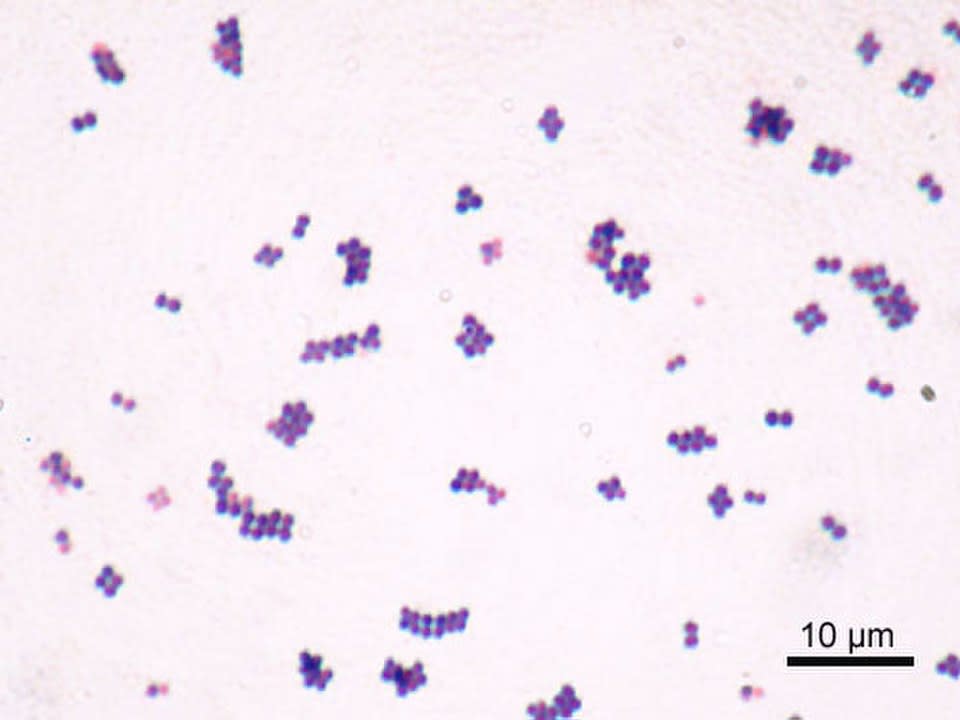
A wound culture from a patient with a skin abscess grows an organism that is resistant to oxacillin, shown below. Molecular testing identifies the mecA gene. Which mechanism best explains this organism's resistance to virtually all beta-lactam antibiotics, including antistaphylococcal penicillins and most cephalosporins?
Y Tambe, CC BY-SA 3.0 <http://creativecommons.org/licenses/by-sa/3.0/>, via Wikimedia Commons
Answer: A. Methicillin resistance in Staphylococcus aureus is conferred by the mecA gene, carried on the SCCmec cassette, which encodes PBP2a, an alternative transpeptidase that continues catalyzing peptidoglycan cross-linking even when native penicillin-binding proteins are inhibited, because PBP2a's active site is refractory to essentially all beta-lactam antibiotics. Option B describes the mechanism relevant to methicillin-susceptible, penicillin-resistant staphylococci, not the mecA-mediated mechanism specific to MRSA. Option C describes an efflux-based mechanism relevant to other antibiotic classes. Option D (erm-mediated ribosomal methylation) confers macrolide-lincosamide-streptogramin B resistance, an unrelated pathway. Option E describes fluoroquinolone resistance, mechanistically distinct from beta-lactam resistance.
Source: Peacock, S. J., & Paterson, G. K. (2015). Mechanisms of methicillin resistance in Staphylococcus aureus. Annual Review of Biochemistry, 84.
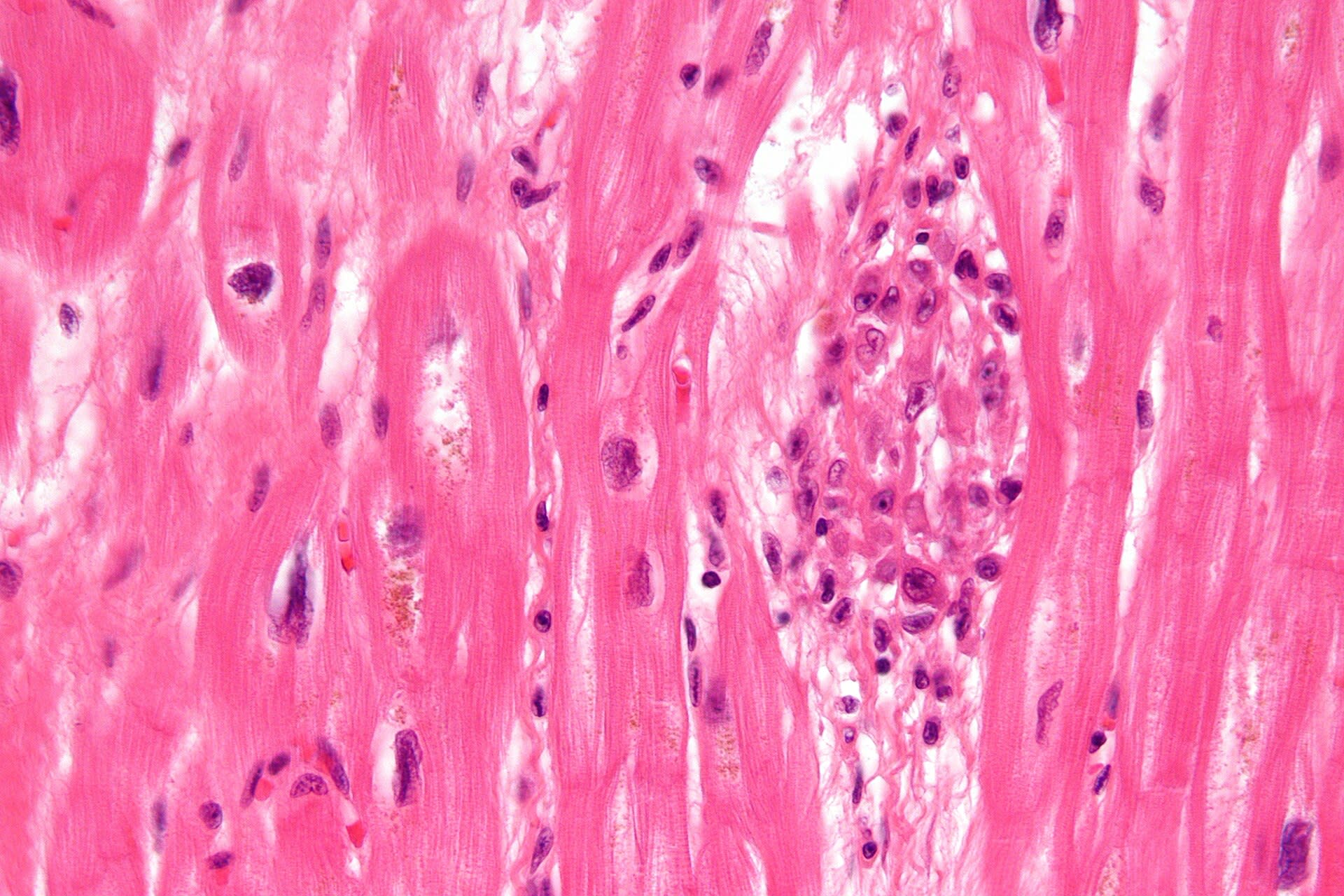
An 8-year-old boy presents two weeks after an untreated episode of streptococcal pharyngitis with migratory polyarthritis, subcutaneous nodules, erythema marginatum, and a new holosystolic murmur at the apex. Echocardiography shows mitral valve thickening with regurgitation. Myocardial biopsy, photomicrograph shown below, reveals a nodular focus of fibrinoid necrosis surrounded by lymphocytes and enlarged macrophages with caterpillar-shaped nuclei. Which of the following mechanisms is most directly responsible for the valvular damage in this patient?
Nephron, CC BY-SA 3.0 <https://creativecommons.org/licenses/by-sa/3.0>, via Wikimedia Commons
Answer: D. Acute rheumatic fever arises from an autoimmune response to group A Streptococcus pharyngitis in which antibodies directed against the bacterial M protein cross-react with structurally similar epitopes on cardiac myosin and valvular endothelium, a phenomenon known as molecular mimicry. This cross-reactivity, together with CD4+ T-cell-mediated inflammation, produces the characteristic Aschoff bodies in the myocardium and progressive valvular scarring, most often affecting the mitral valve. Unlike infective endocarditis, rheumatic fever does not involve direct bacterial invasion of the valve, and streptolysin O is a pore-forming toxin relevant to hemolysis, not valvulitis. Immune complex deposition is instead the mechanism of poststreptococcal glomerulonephritis, a distinct sequela of streptococcal infection.
Source: Carapetis, J. R., et al. (2016). Acute rheumatic fever and rheumatic heart disease. Nature Reviews Disease Primers, 2, 15084.
A renal biopsy from a patient with a history of chronic hypertension shows hyaline arteriolosclerosis affecting afferent and efferent arterioles, with associated ischemic glomerular collapse and tubular atrophy. Which primary pathophysiologic mechanism best explains these findings?
Nephron, CC BY-SA 3.0 <https://creativecommons.org/licenses/by-sa/3.0>, via Wikimedia Commons
Answer: C. Hyaline arteriolosclerosis in chronic hypertension is caused by endothelial injury leading to increased vascular permeability and leakage of plasma proteins into the vessel wall, along with increased smooth muscle matrix production. This results in homogeneous pink hyaline thickening and narrowing of the arteriolar lumen, causing downstream ischemic damage including glomerular collapse and tubular atrophy. Immune complex deposition would suggest glomerulonephritides such as lupus nephritis or postinfectious GN. Nonenzymatic glycation is characteristic of diabetic nephropathy. Anti-GBM disease and IgA nephropathy are immune-mediated glomerular diseases with distinct histologic patterns.
Source: Lerman, et al. (2019). Animal models of hypertension: a scientific statement from the American Heart Association. Hypertension.
Your next questions are ready.
The question bank picks up from here: it adapts to what you just missed and brings it back right before you'd forget it.
Elaborative interrogation is a study technique in which you generate an explanation for why a stated fact is true instead of simply rereading it. Producing the reason yourself connects the new fact to your existing knowledge, which makes it more memorable and easier to retrieve.
How is it different from self-explanation?expand_more
The two are closely related. Elaborative interrogation focuses on explaining why a given fact is true, while self-explanation is broader and includes explaining how and why each step of a process or worked example follows from the previous one. Both rely on generating explanations rather than receiving them.
Does elaborative interrogation actually work?expand_more
Reviews of study strategies rate it as moderately effective. It helps most with factual material and when you already have background knowledge to link to, and less when the material is unfamiliar or your explanations are inaccurate. It is best used to add depth alongside retrieval practice and spaced repetition.
How do I use it while studying medicine?expand_more
For each key fact, pause and state in a sentence why it is true, connecting it to a mechanism you already understand, and verify your reasoning against a trusted source. Where you cannot explain a fact, you have found a knowledge gap to study, then turn the fact and its explanation into a recall prompt scheduled with spaced repetition.
Free weekly high-yield email
One high-yield concept + one question, every week
Study smarter with a short weekly email. No spam — unsubscribe anytime.
✓ You're in — talk soon.
Practice makes permanent
Lock this into long-term memory
Progress Note's adaptive engine spaces your reviews automatically — so this stays with you through boards and onto the wards.