Interleaved practice means mixing different topics or problem types within a single study session instead of practicing one skill in a long, uninterrupted block. It feels harder and slower than blocked study, yet the research consistently shows better long-term retention and, most importantly, a stronger ability to choose the right approach for an unfamiliar problem — exactly what board exams demand.
edit_note
Progress Note Editorial
Evidence-based · For exam prep, not medical advice
update Updated October 2026
Date of last content change
Built by surgery and anesthesiology residents·Written for USMLE Step 1
bolt The 60-second version
Interleaved practice means mixing different topics or problem types within a single study session instead of practicing one skill in a long, uninterrupted block.
check_circleInterleaving mixes problem types within a session; blocking practices one type at a time until moving on.
check_circleInterleaving improves the ability to discriminate between concepts and to select the correct strategy for a new problem.
check_circleIt produces better long-term retention and transfer even though it feels less fluent while you study — a "desirable difficulty."
check_circleIt pairs naturally with spaced repetition, which distributes practice of each topic over time.
check_circleA practical application is mixing organ systems and question types in a question bank rather than doing one subject at a time.
Interleaving Versus Blocking
Blocked practice studies one topic in a long stretch — all cardiology, then all renal — which feels productive because performance improves quickly within the block. Interleaved practice mixes topics so that consecutive problems require different approaches. The cost is that practice feels harder and progress feels slower, but that difficulty is the mechanism: forcing yourself to repeatedly identify which concept applies builds the discrimination skill that blocked practice never exercises.
Why It Works
Two mechanisms are usually cited. First, interleaving requires retrieval of the correct method from among competing options on every problem, strengthening the link between problem features and the right response rather than letting you run the same procedure on autopilot. Second, juxtaposing different problem types highlights the contrasts between them, sharpening conceptual boundaries. The result is knowledge that transfers to novel problems instead of only reproducing practiced ones.
workspace_premium Desirable difficulty
If mixed practice feels harder than blocked practice, that is expected — the added effort of choosing an approach is what drives durable learning.
Evidence
Controlled studies in mathematics have shown that students who interleave problem types perform substantially better on delayed tests than those who block, even when total practice is equal. Comparable benefits appear in perceptual and classification learning, and the approach maps well onto clinical reasoning, where the real challenge is recognizing which diagnosis or mechanism a presentation represents. The consistent finding is that interleaving depresses performance during practice but improves it on later, meaningful assessments.
How to Apply It
Use a question bank in mixed or random mode rather than filtering to a single subject, so consecutive questions force you to reidentify the topic. Shuffle flashcard decks across systems instead of drilling one deck to completion. When reviewing, rotate among a few subjects in a session rather than spending the whole session on one. Because interleaving feels harder, expect lower in-session accuracy and judge progress by performance on later practice tests, and combine it with spaced repetition for the strongest effect.
Try it now
Try 3 real questions
Straight from the Progress Note question bank, each with a cited explanation. No account needed.
123
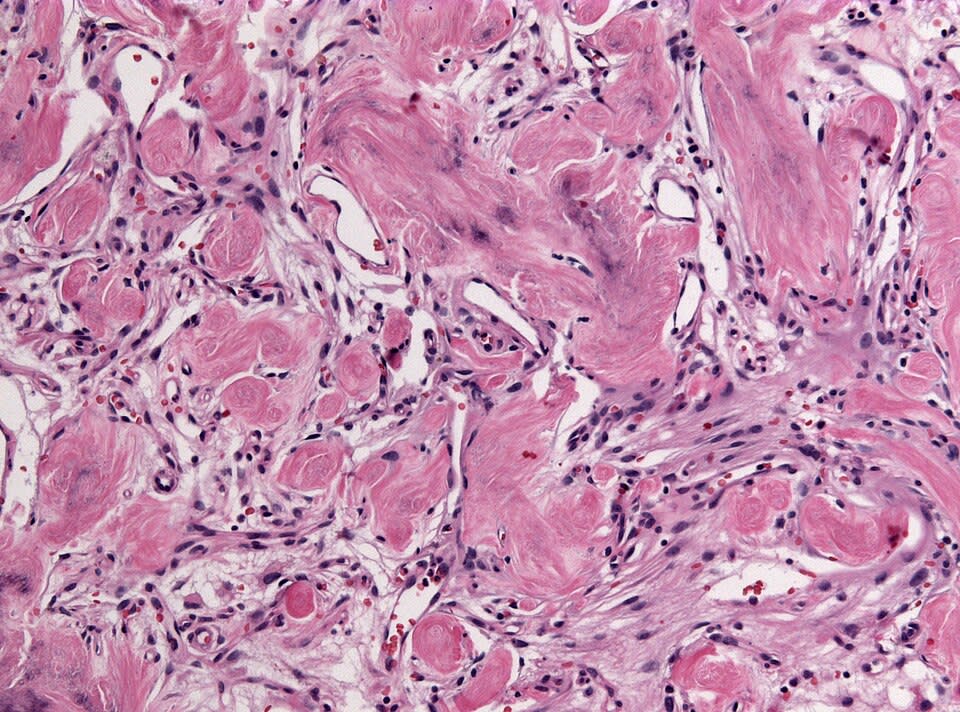
A 55-year-old woman has progressive headaches. MRI shows a dural-based, extra-axial, homogeneously enhancing mass with an adjacent 'dural tail' compressing the underlying brain. A photomicrograph of the resection is shown below. Molecular testing shows biallelic inactivation of a tumor suppressor gene on chromosome 22. Which statement about this gene and its relationship to a related inherited tumor syndrome is correct?
Jensflorian, CC BY-SA 4.0 <https://creativecommons.org/licenses/by-sa/4.0>, via Wikimedia Commons
Answer: D. A substantial proportion of meningiomas, particularly those with a psammomatous or fibrous histologic pattern, arise from biallelic inactivation of NF2, which encodes merlin, a protein that links the cell membrane to the actin cytoskeleton and normally functions as a tumor suppressor by regulating contact-dependent inhibition of proliferation; germline NF2 mutations cause neurofibromatosis type 2, a syndrome predisposing to bilateral vestibular schwannomas as well as multiple meningiomas, reflecting the shared genetic basis of these tumor types. Option A incorrectly substitutes NF1 (neurofibromin), which is associated with a distinct clinical syndrome (café-au-lait macules, neurofibromas, Lisch nodules) rather than meningioma predisposition. Option B incorrectly substitutes the VHL gene and its HIF-related mechanism, relevant to a different tumor syndrome. Option C incorrectly reassigns NF2 a mismatch repair function. Option E incorrectly proposes a gain-of-function receptor mechanism rather than the tumor-suppressor loss-of-function mechanism that characterizes NF2-associated meningiomas.
Source: Goldbrunner, R., et al. (2021). EANO guideline on the diagnosis and management of meningiomas. Neuro-Oncology.
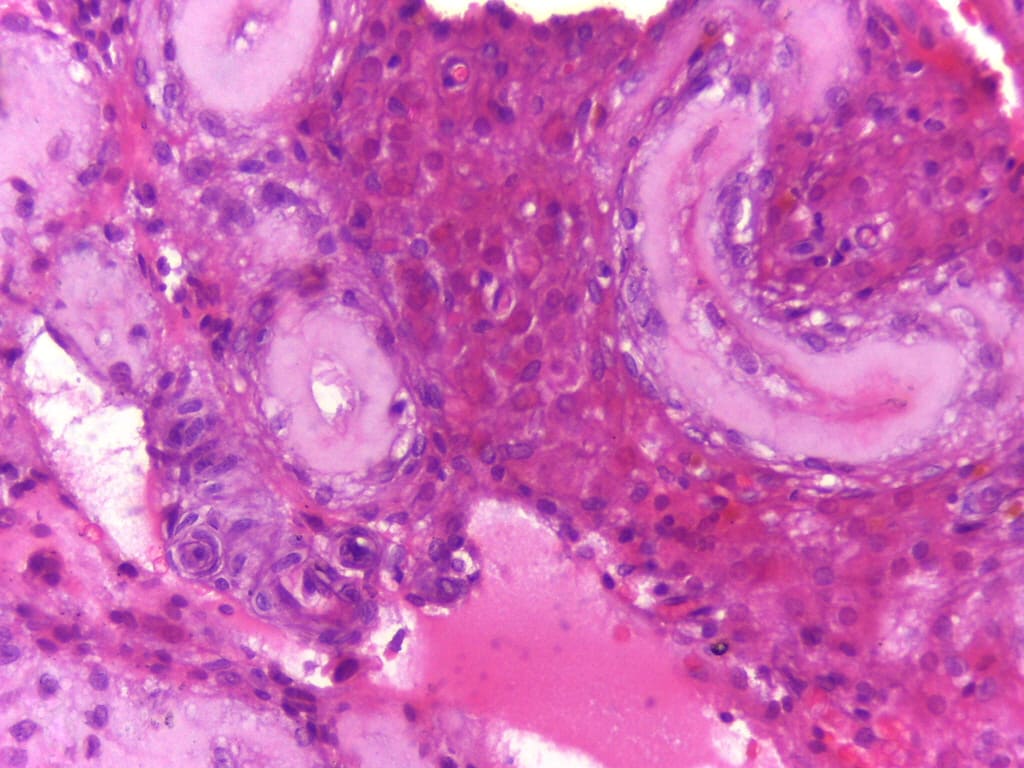
A 17-year-old boy presents with tall stature, gynecomastia, small testes, and delayed puberty, along with mild learning difficulties. Serum testosterone is low, while LH and FSH are elevated. Testicular biopsy is shown below. Karyotype shows 47,XXY. The elevated gonadotropin levels observed in this patient result most directly from which of the following mechanisms?
Calicut Medical College, CC BY-SA 4.0 <https://creativecommons.org/licenses/by-sa/4.0>, via Wikimedia Commons
Answer: A. In Klinefelter syndrome, the additional X chromosome disrupts normal seminiferous tubule development, leading to progressive hyalinization and fibrosis with loss of Sertoli cell function and markedly reduced inhibin B, as well as impaired Leydig cell testosterone production; the resulting loss of normal negative feedback at the hypothalamus and pituitary produces the hypergonadotropic hypogonadism characteristic of this condition. This primary testicular failure pattern is distinguished from androgen insensitivity syndrome, in which the karyotype is 46,XY and gonadotropins rise due to androgen receptor dysfunction despite normal or elevated testosterone production, and from 5-alpha-reductase deficiency, which involves a distinct enzymatic defect in androgen metabolism. A primary hypothalamic or pituitary tumor would not explain the karyotypic abnormality or testicular histology described in this patient.
Source: Groth, K. A., et al. (2013). Klinefelter syndrome—A clinical update. Journal of Clinical Endocrinology & Metabolism, 98(1).
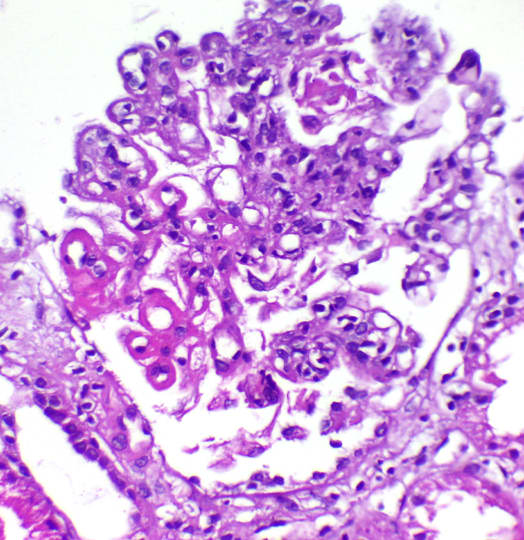
A young woman presents with malar rash, photosensitivity, and proteinuria. Renal biopsy shows thickened capillary loops with a 'wire loop' appearance. Which immunopathologic mechanism is responsible?
Kparavindan, CC BY-SA 4.0 <https://creativecommons.org/licenses/by-sa/4.0>, via Wikimedia Commons
Answer: D. Systemic lupus erythematosus is primarily mediated by type III hypersensitivity reactions involving immune complex deposition. These complexes deposit in glomeruli, producing 'wire loop' lesions due to thickened capillary walls. Type I hypersensitivity involves IgE-mediated allergy. Type II involves antibody-mediated cytotoxicity. Type IV involves T-cell mediated delayed hypersensitivity.
Source: Tsokos, G. C. (2011). Systemic lupus erythematosus. New England Journal of Medicine.
Your next questions are ready.
The question bank picks up from here: it adapts to what you just missed and brings it back right before you'd forget it.
Interleaved practice is a study method in which you mix different topics or problem types within one session rather than practicing a single type in a long block. Mixing forces you to repeatedly decide which approach fits each problem, which strengthens learning that transfers to new situations.
Is interleaving better than blocked practice?expand_more
For long-term retention and the ability to apply knowledge to unfamiliar problems, interleaving generally outperforms blocking, even though it feels harder while studying. Blocked practice can produce faster in-session gains, but those gains fade and transfer poorly compared with interleaved practice.
Why does interleaving feel harder?expand_more
Interleaving is a "desirable difficulty": switching between problem types prevents you from running the same procedure automatically and forces effortful retrieval and discrimination on each item. That extra effort lowers in-session fluency but is exactly what builds durable, transferable knowledge.
How do I use interleaving with a question bank?expand_more
Set the question bank to mixed or random mode instead of filtering to one subject, so consecutive questions span different systems and require you to reidentify the topic. Combine this with spaced repetition and judge progress by later practice-test performance rather than in-session accuracy.
Free weekly high-yield email
One high-yield concept + one question, every week
Study smarter with a short weekly email. No spam — unsubscribe anytime.
✓ You're in — talk soon.
Practice makes permanent
Lock this into long-term memory
Progress Note's adaptive engine spaces your reviews automatically — so this stays with you through boards and onto the wards.