Mind mapping is a visual study technique that arranges information as a branching diagram radiating from a central concept. It helps you see how ideas connect and organize complex topics, which supports both understanding and recall.
edit_note
Progress Note Editorial
Evidence-based · For exam prep, not medical advice
update Updated October 2026
Date of last content change
Built by surgery and anesthesiology residents·Written for USMLE Step 1
bolt The 60-second version
check_circleA mind map is a radial diagram with a central topic and branching subtopics.
check_circleIt emphasizes the relationships between ideas, not just isolated facts.
check_circleCreating one is an active process that aids understanding.
check_circleIt works well for organizing complex, interconnected topics.
check_circleBest paired with active recall and spaced repetition, not used alone.
What a Mind Map Is
A mind map places a central concept in the middle of the page and branches outward into subtopics, which branch again into details, using keywords, short phrases, colors, and sometimes images. Unlike linear notes, its radial structure mirrors how ideas relate to one another, making the overall structure of a topic visible at a glance.
Why It Helps
Building a mind map is an active, generative task: you must decide what the main branches are and how details connect, which forces you to organize and understand the material rather than transcribe it. The visual, spatial layout also gives memory extra hooks, and seeing relationships between concepts supports the kind of integrated understanding that application questions reward.
Using It for Studying
Mind mapping is especially useful for complex, interconnected topics — a disease with its causes, mechanism, features, and treatment, or a pathway with multiple branches. Start from the central concept, add main branches for the major sub-themes, then fill in details, keeping entries to keywords rather than sentences. Draw the map from memory where possible, which turns it into a form of active recall.
Combining With Other Methods
A mind map is a tool for organizing and understanding, not a complete study system on its own. Use it to structure a topic and reveal connections, then reinforce the content with active recall (testing yourself) and spaced repetition so it sticks. Re-drawing a map from memory, or using it as a scaffold for self-quizzing, combines its organizational strength with proven retention techniques.
Try it now
Try 3 real questions
Straight from the Progress Note question bank, each with a cited explanation. No account needed.
123
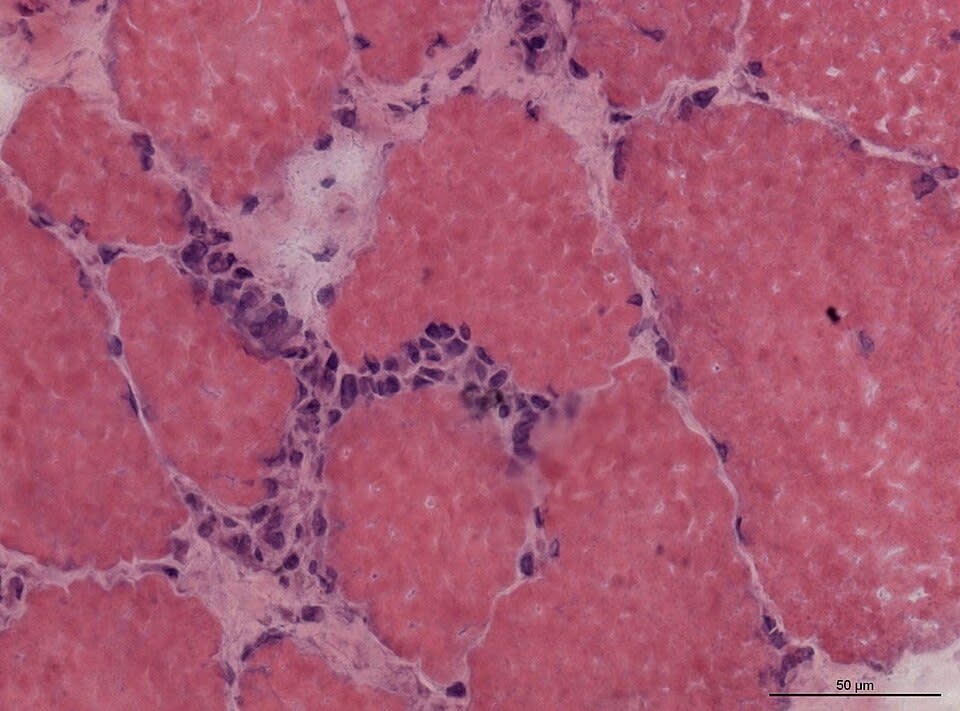
A skeletal muscle biopsy from an adult patient with progressive proximal muscle weakness shows endomysial inflammatory infiltrates with invasion of non-necrotic muscle fibers. Which diagnosis is most consistent with this histologic pattern?
Jensflorian, CC BY-SA 4.0 <https://creativecommons.org/licenses/by-sa/4.0>, via Wikimedia Commons.
Answer: D. Polymyositis is characterized by CD8+ T-cell–mediated inflammation with endomysial infiltration and direct invasion of non-necrotic muscle fibers, leading to symmetric proximal muscle weakness. Dermatomyositis instead shows perifascicular atrophy and a perivascular inflammatory pattern due to complement-mediated microangiopathy. Inclusion body myositis typically affects older adults and shows rimmed vacuoles and inclusion bodies. Myasthenia gravis is a neuromuscular junction disorder without primary muscle inflammation. Rhabdomyolysis shows acute muscle necrosis rather than chronic inflammatory infiltrates.
Source: Dalakas, M. C. (2015). Inflammatory muscle diseases. New England Journal of Medicine.
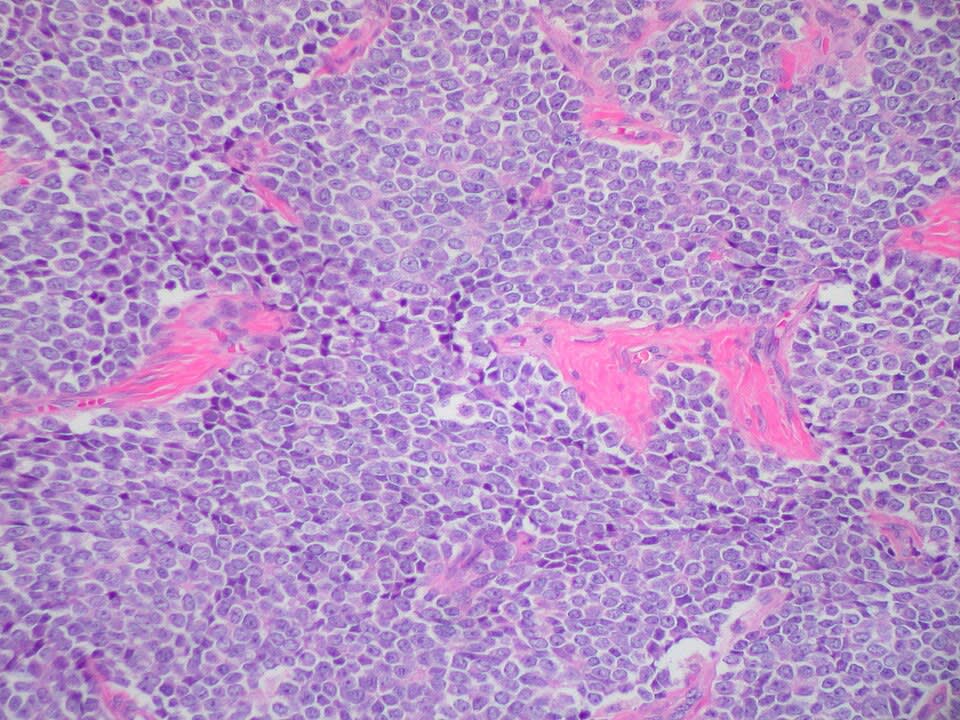
A 13-year-old boy has progressive thigh pain, low-grade fever, and a diaphyseal femoral mass. Radiograph shows a permeative lesion with a multilayered 'onion-skin' periosteal reaction and an associated soft tissue mass. Biopsy is shown below; the cells stain positive for CD99. Molecular testing identifies an EWSR1-FLI1 fusion transcript. Which statement about this tumor's molecular pathogenesis and its radiographic correlate is correct?
Euthman, CC BY-SA 2.0 <https://creativecommons.org/licenses/by-sa/2.0>, via Wikimedia Commons
Answer: A. Ewing sarcoma is defined by the EWSR1-FLI1 fusion (from t(11;22)), which functions as an aberrant chimeric transcription factor that reprograms gene expression to drive oncogenic proliferation; the onion-skin periosteal reaction reflects repeated cycles of periosteal elevation by the rapidly growing tumor followed by attempted reactive bone formation, producing the layered radiographic appearance. Option B incorrectly attributes the onion-skin pattern to osteosarcoma; this pattern is classically associated with Ewing sarcoma. Option C mischaracterizes EWSR1-FLI1 as a receptor tyrosine kinase rather than the transcription factor it actually is. Option D overstates CD99 specificity, since it is sensitive but also expressed in other small round blue cell tumors, requiring molecular confirmation. Option E overstates prognostic uniformity and dismisses the established clinical relevance of molecular and stage-based risk stratification.
Source: Grünewald, T. G. P., et al. (2018). Ewing sarcoma. Nature Reviews Disease Primers, 4(1).
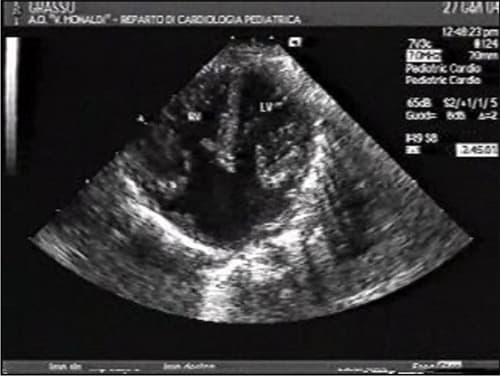
A newborn female is noted to have hypotonia, epicanthal folds, a single palmar crease, and a systolic murmur. The echocardiograph is shown below. Karyotype shows 47 chromosomes with three copies of chromosome 21. Which of the following best explains the most common cytogenetic mechanism underlying this infant's condition, and the associated recurrence risk for future pregnancies?
Calabrò R, Limongelli G, CC BY 2.0 <https://creativecommons.org/licenses/by/2.0>, via Wikimedia Commons
Answer: A. Down syndrome most commonly results from meiotic nondisjunction, predominantly occurring during maternal meiosis I, accounting for approximately 95% of cases; the risk of nondisjunction increases significantly with advancing maternal age, likely related to prolonged arrest of oocytes in meiotic prophase I over decades. This contrasts with the less common Robertsonian translocation form of trisomy 21, which is not associated with maternal age but carries a substantial recurrence risk when a parent is a balanced translocation carrier. Mosaic Down syndrome, arising from postzygotic mitotic nondisjunction, is rarer and often associated with a milder phenotype due to the presence of a normal diploid cell line alongside the trisomic line. Complete atrioventricular septal defects, as seen in this infant, are among the cardiac anomalies most strongly associated with trisomy 21.
Source: Antonarakis, S. E., et al. (2020). Down syndrome. Nature Reviews Disease Primers, 6(1), 9.
Your next questions are ready.
The question bank picks up from here: it adapts to what you just missed and brings it back right before you'd forget it.
Mind mapping is a visual study technique that arranges information as a branching diagram radiating from a central concept, using keywords, colors, and sometimes images. Its radial structure shows how ideas connect and makes the overall shape of a topic visible at a glance.
Why is mind mapping effective for studying?expand_more
Creating a mind map is an active task that forces you to organize material and decide how ideas connect, which builds understanding rather than passive transcription. The visual, spatial layout also adds memory hooks and highlights relationships that support integrated understanding.
How do you make a mind map for studying?expand_more
Put the central concept in the middle, branch out into the major sub-themes, then add details on further branches, using keywords rather than full sentences. Drawing the map from memory turns it into active recall, and colors or images can strengthen the associations.
Is mind mapping enough on its own?expand_more
No — mind mapping is best for organizing and understanding a topic, not for long-term retention by itself. Pair it with active recall (self-testing) and spaced repetition, for example by re-drawing maps from memory or using them as a scaffold for quizzing.
Free weekly high-yield email
One high-yield concept + one question, every week
Study smarter with a short weekly email. No spam — unsubscribe anytime.
✓ You're in — talk soon.
Practice makes permanent
Lock this into long-term memory
Progress Note's adaptive engine spaces your reviews automatically — so this stays with you through boards and onto the wards.