How colorectal cancer is tested on Step 1
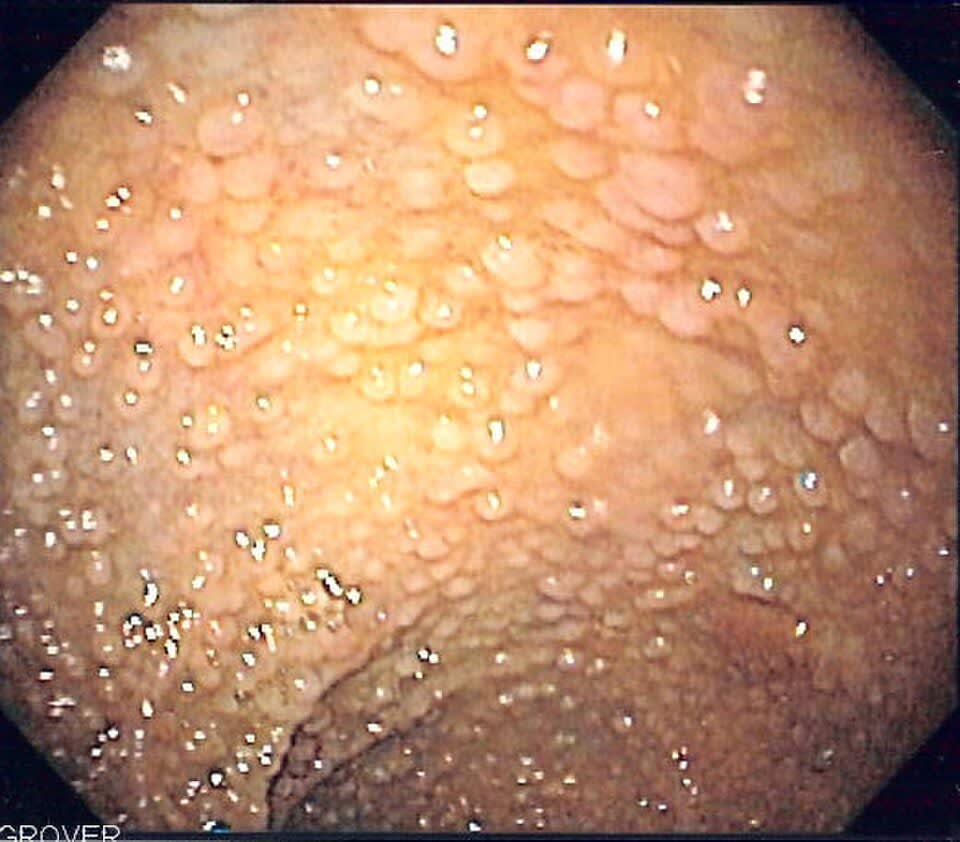
Vignettes give iron deficiency in an older adult, a family history, or many polyps, and ask about genes or pathways.
Hereditary syndromes
Gene, inheritance, and associated features are frequently tested.
| Syndrome | Gene | Key features |
|---|---|---|
| FAP | APC (5q), autosomal dominant | Hundreds to thousands of adenomas; prophylactic colectomy |
| Gardner syndrome | APC variant | FAP plus osteomas, soft tissue tumors, desmoids, extra or impacted teeth |
| Turcot syndrome | APC or mismatch repair | Polyposis plus brain tumors |
| Lynch syndrome (HNPCC) | MLH1, MSH2, MSH6, PMS2 | Proximal colon, endometrial, ovarian cancers; few polyps |
| Peutz-Jeghers syndrome | STK11 | Hamartomatous polyps, mucocutaneous pigmentation, ↑ cancer risk |
| Juvenile polyposis | SMAD4 or BMPR1A | Multiple juvenile (hamartomatous) polyps |
Lynch syndrome is the most common hereditary colorectal cancer syndrome.
Polyps
Histology and size predict malignant potential.
Screening and spread
Screening removes precursors before they become cancer.
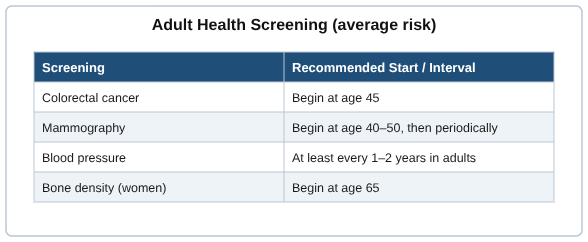
- Average-risk screening in the US begins at age 45, with options such as colonoscopy every 10 years or annual fecal immunochemical testing.
- People with Lynch syndrome or FAP start colonoscopy much earlier and repeat it often.
- The liver is the most common site of distant metastasis, via the portal circulation; rectal cancer can also spread to the lungs.
- Staging depends on depth of invasion, lymph nodes, and distant metastasis (TNM).
Worked example
Recognize a hereditary pattern.
functions Worked example — young cancers in one family
A 42-year-old has a right-sided colon cancer. His mother had endometrial cancer at 48 and his uncle colon cancer at 45. Tumor testing shows microsatellite instability. What is the likely syndrome and mechanism?
- Several relatives with colon and endometrial cancer at young ages suggest a hereditary syndrome.
- Few polyps and a right-sided cancer fit Lynch syndrome rather than FAP.
- Microsatellite instability reflects defective DNA mismatch repair.
- Inheritance is autosomal dominant; relatives should be offered genetic testing.
Answer. Lynch syndrome (hereditary nonpolyposis colorectal cancer) from a germline mismatch repair gene mutation.