MCAT waves, sound, and optics apply one framework — periodic disturbances carrying energy — to hearing, light, and imaging. Wave properties explain the Doppler shift and resonance; the behavior of light explains refraction and how lenses form images. Because much of it is geometric, careful diagrams matter more than heavy math.
Evidence-based · For exam prep, not medical advice
update Updated October 2026
Date of last content change
Built by surgery and anesthesiology residents
Written for the MCAT · Free to read
bolt The 60-second version
check_circleWave speed v = fλ; frequency and wavelength are inversely related at fixed speed.
check_circleSound is a longitudinal wave; loudness follows a logarithmic decibel scale.
check_circleThe Doppler effect raises perceived frequency for approach and lowers it for recession.
check_circleStanding waves form at resonant frequencies set by the boundary conditions.
check_circleLight bends toward the normal entering a denser (higher-n) medium (Snell’s law).
check_circleA converging lens forms a real, inverted image when the object is beyond the focal point.
target What you'll be able to do · aligned to AAMC content category 4D
4DRelate wavelength, frequency, period, and speed for waves (v = fλ).
4DExplain sound intensity, the decibel scale, and the Doppler effect.
4DApply superposition, standing waves, and resonance to strings and pipes.
4DUse Snell’s law and the thin-lens equation to analyze refraction and image formation.
How the MCAT tests waves and optics
Waves, sound, and light make up AAMC content category 4D — how light and sound interact with matter. The MCAT connects it to hearing, vision, and imaging technology. Much of the topic is geometric (ray diagrams, angles), so drawing the situation is usually the fastest path to the answer.
workspace_premium One framework, many phenomena
Sound and light are both waves, so the same ideas — frequency, wavelength, superposition — describe a musical pipe and a camera lens. Learn the wave logic once and reuse it.
Wave properties
A wave transfers energy without transferring matter. Its speed, frequency, and wavelength are locked together, and its amplitude sets how much energy it carries.
Wave anatomy. Wavelength is crest-to-crest distance, amplitude is the displacement from the midline, and speed relates them through v = fλ.
v = fλWave equationAt a fixed speed, higher frequency means shorter wavelength. Frequency f = 1/T, where T is the period.
Sound and the Doppler effect
Sound is a longitudinal pressure wave that needs a medium. Two exam favorites are the decibel scale and the Doppler effect.
Intensity and decibels: loudness is measured on a logarithmic dB scale — every 10 dB is a tenfold increase in intensity.
Doppler effect: relative motion shifts perceived frequency — higher as a source approaches, lower as it recedes (the passing-siren drop).
Speed of sound depends on the medium: fastest in solids, slowest in gases (the opposite of light).
Superposition, standing waves, and resonance
When waves overlap, their displacements add (superposition). Confined waves form standing waves only at specific resonant frequencies set by the boundaries.
Constructive vs destructive interference: in-phase waves reinforce; out-of-phase waves cancel.
Standing waves have fixed nodes (no motion) and antinodes (maximum motion); a string fixed at both ends fits half-wavelength multiples.
Resonance occurs when a driving frequency matches a natural frequency, producing large-amplitude oscillation.
workspace_premium Beats
Two slightly different frequencies produce beats — a slow throbbing at a frequency equal to the difference between them, used to tune instruments.
Light: reflection and refraction
Light is an electromagnetic wave. At a boundary it partly reflects and partly refracts, bending as its speed changes between media.
Refraction. Entering a denser medium (higher n), light slows and bends toward the normal; Snell’s law gives the exact angle.
n₁sinθ₁ = n₂sinθ₂Snell’s lawHigher refractive index n means slower light and more bending. Past the critical angle, light totally internally reflects.
Lenses, mirrors, and image formation
Lenses and mirrors form images by bending or reflecting rays to a focus. The thin-lens equation predicts where the image forms and whether it is real or virtual.
Converging lens. An object beyond 2F forms a real, inverted, reduced image on the far side — the geometry behind a camera.
functions Worked example — locating an image
An object sits 30 cm from a converging lens with focal length 10 cm. Where is the image?
dᵢ = 15 cm (positive), so the image is real and on the opposite side.
Answer. The image forms 15 cm from the lens, real and inverted (positive dᵢ). It is reduced because the object is beyond 2F.
How to study it — and the traps to avoid
Waves and optics reward drawing the situation. Sketch the wave or ray diagram before reaching for equations.
Use v = fλ fluently and remember v is set by the medium.
Get Doppler direction right: approaching raises frequency, receding lowers it.
For optics, draw the principal rays; sign conventions tell you real vs virtual.
Remember sound travels fastest in solids, light fastest in vacuum.
error Highest-yield trap
Changing the medium changes a wave’s speed and wavelength, but NOT its frequency. When light enters glass it slows and its wavelength shortens, yet its frequency (and color) is unchanged — frequency is set by the source.
Straight from the Progress Note question bank, each with a cited explanation. No account needed.
123
A sound wave travels from warm air into cooler air. What happens to its speed?
Answer: B. Speed of sound in air increases with temperature. Moving into cooler air lowers temperature and reduces sound speed. Frequency remains constant, but wavelength adjusts accordingly.
Source: Pierce, A. D. (2019). Acoustics: An Introduction to Its Physical Principles and Applications. Springer.
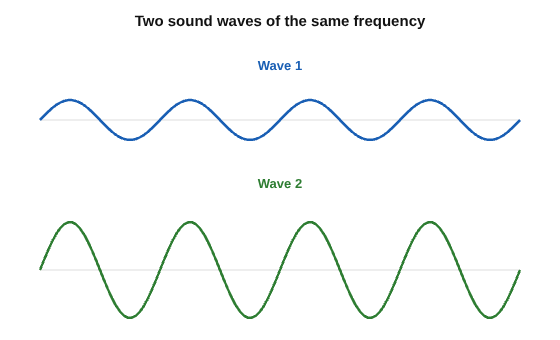
The figure shows two sound waves that have the SAME frequency but different amplitudes. Based on their amplitudes, which wave represents the LOUDER sound?
Answer: B. The loudness (intensity) of a sound is determined mainly by the wave's amplitude — the height of its peaks — so the wave with the larger amplitude, Wave 2, represents the louder sound. Because both waves share the same frequency, they have the same pitch, which is why loudness must be judged by amplitude rather than frequency. A picks the smaller-amplitude, quieter wave, C ignores the clear difference in amplitude, and D and E are contradicted by the figure. The larger-amplitude Wave 2 is louder.
Source: Rossing, T. D., Moore, F. R., & Wheeler, P. A. (2014). The science of sound (3rd ed.). Pearson.
An ambulance siren sounds higher in pitch as it approaches you and lower as it recedes. What causes this shift in the perceived frequency?
Answer: B. The Doppler effect arises because the source's motion relative to the observer changes the spacing of the sound wavefronts reaching you: as the ambulance approaches, each successive wave is emitted from a closer position, compressing the wavefronts into a shorter wavelength and thus a higher perceived frequency; as it recedes, the waves are stretched to a lower frequency. The siren's actual emitted frequency never changes (so A is wrong), the speed of sound in air is essentially constant regardless of source motion (C), and the effect is physical rather than a change in ear sensitivity (D) or air temperature (E). Motion-induced compression and stretching of the waves produce the Doppler shift.
What is the relationship between frequency, wavelength, and wave speed?expand_more
They are related by v = fλ. At a fixed wave speed, frequency and wavelength are inversely proportional: a higher frequency means a shorter wavelength. Frequency is the number of cycles per second and equals 1/T, where T is the period.
What is the Doppler effect?expand_more
The Doppler effect is the change in perceived frequency due to relative motion between a source and observer. When they move toward each other, the observed frequency increases; when they move apart, it decreases. It is why a passing siren drops in pitch as it goes by.
When does light bend toward the normal?expand_more
Light bends toward the normal when it enters a medium with a higher refractive index (a denser optical medium), because it slows down. Snell’s law, n₁sinθ₁ = n₂sinθ₂, gives the exact angle. Going the other way — into a less dense medium — it bends away from the normal.
When does a converging lens form a real versus a virtual image?expand_more
A converging lens forms a real, inverted image when the object is beyond the focal point, and a virtual, upright, magnified image (like a magnifying glass) when the object is inside the focal length. The thin-lens equation with sign conventions tells you which: a positive image distance is real.
Does the frequency of a wave change when it enters a new medium?expand_more
No. When a wave passes into a new medium its speed and wavelength change, but its frequency stays the same because it is set by the source. This is why light keeps its color when it enters glass even though it slows down and its wavelength shortens.
Study smarter with a short weekly email. No spam — unsubscribe anytime.
✓ You're in — talk soon.
Reading is one thing. Remembering is another.
Turn this guide into questions you’ll actually remember
Progress Note turns concepts like this into adaptive questions and spaced review, so difficult topics come back to you exactly when you’re about to forget them.