Spinal cord injury damages the neural pathways of the cord, causing motor and sensory loss below the level of injury. Boards emphasize the distinction between complete and incomplete injuries, the classic incomplete cord syndromes and their patterns, and the principles of early management.
Evidence-based · For exam prep, not medical advice
update Updated October 2026
Date of last content change
Built by surgery and anesthesiology residents·Written for USMLE Step 1
bolt The 60-second version
check_circleSpinal cord injury causes loss of function below the level of the lesion.
check_circleComplete injury is total loss; incomplete injury spares some function.
check_circleThe tracts affected determine the pattern: motor, pain/temperature, or proprioception.
check_circleClassic syndromes include central cord, Brown-Sequard, and anterior cord.
check_circleEarly management protects the airway and spine and maintains perfusion.
Complete vs Incomplete Injury
Spinal cord injury is classified as complete — no motor or sensory function below the level of injury — or incomplete, in which some function is preserved. The neurologic level and completeness determine prognosis. Understanding the three long tracts is key: the corticospinal tract (motor), the spinothalamic tract (pain and temperature, which crosses at the cord), and the dorsal columns (proprioception, vibration, fine touch).
Cord Syndromes
Incomplete injuries produce characteristic syndromes. Central cord syndrome (often from hyperextension in older adults) causes weakness that is worse in the upper than lower limbs. Brown-Sequard syndrome (cord hemisection) causes ipsilateral motor and proprioceptive loss with contralateral pain and temperature loss below the lesion. Anterior cord syndrome (anterior spinal artery injury) causes bilateral motor and pain/temperature loss with preserved proprioception.
Spinal and Neurogenic Shock
Two forms of "shock" are important. Spinal shock is a transient loss of all reflexes and function below the injury immediately after trauma, which gradually resolves. Neurogenic shock, seen with high (cervical or upper thoracic) injuries, is a distributive shock from loss of sympathetic tone causing hypotension with bradycardia — distinct from other shock states, which usually cause tachycardia.
Management
Initial care follows trauma priorities: protect the airway and breathing (high cervical injuries can impair the diaphragm), immobilize the spine to prevent further injury, and support circulation, treating neurogenic shock with fluids and vasopressors as needed. Imaging (CT and MRI) defines the injury, and early involvement of spine specialists guides surgical decompression and stabilization. Prevention of complications and rehabilitation are central to long-term care.
Try it now
3 real questions on Spinal Cord Injury
Straight from the Progress Note question bank, each with a cited explanation. No account needed.
123
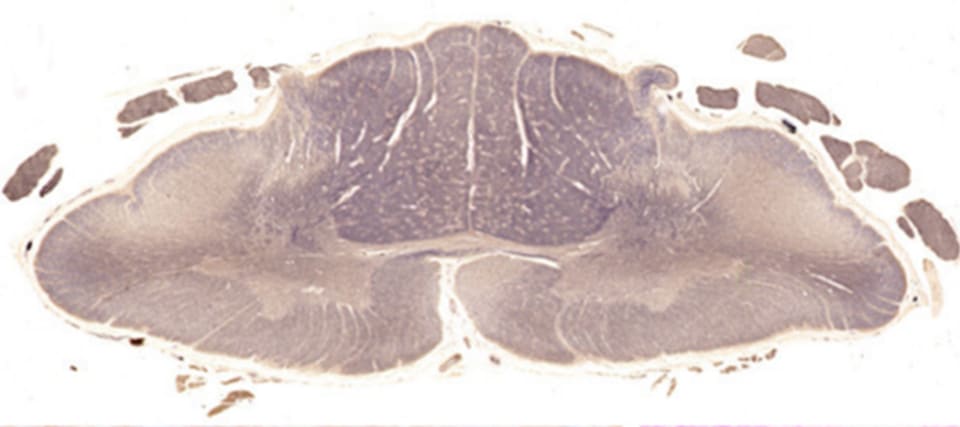
A 58-year-old man presents with progressive limb weakness, muscle atrophy, fasciculations, and hyperreflexia with a positive Babinski sign. Tongue fasciculations are noted, and he has no sensory deficits or bowel/bladder dysfunction. A spinal cord specimen from a similar case is shown below. The combination of upper and lower motor neuron signs in this patient is best explained by which of the following pathophysiologic processes?
TnoXX, CC BY 2.0 <https://creativecommons.org/licenses/by/2.0>, via Wikimedia Commons.
Answer: E. Amyotrophic lateral sclerosis is characterized by selective, progressive degeneration of both upper motor neurons in the motor cortex and corticospinal tracts and lower motor neurons in the brainstem and spinal cord anterior horns, with cytoplasmic aggregation of TDP-43 protein implicated in neuronal dysfunction and death in most cases; this combined degeneration produces the mixture of upper motor neuron signs and lower motor neuron signs seen in this patient, notably without sensory or autonomic involvement. This distinguishes ALS from Lambert-Eaton myasthenic syndrome and myasthenia gravis, both neuromuscular junction disorders without corticospinal tract involvement, from Guillain-Barré syndrome, a demyelinating peripheral neuropathy that typically involves sensory fibers, and from subacute combined degeneration due to vitamin B12 deficiency, which characteristically also involves the sensory dorsal columns.
A client with an acute cervical spinal cord injury has hypotension with bradycardia and warm, dry skin below the level of injury. Which condition does the nurse recognize, and what should the nurse anticipate?
Answer: D. A cervical spinal cord injury can disrupt sympathetic outflow, causing neurogenic shock with hypotension, bradycardia, and warm, dry skin from vasodilation, so the nurse recognizes it and anticipates intravenous fluids and vasopressors along with treatment of the bradycardia (option D). Hypovolemic shock (A) produces tachycardia with cool, clammy skin, which is the opposite of this presentation. Septic shock (B) would involve fever and a rising lactate. Calling it an expected finding needing no treatment (C) ignores a dangerous perfusion problem. Distinguishing neurogenic from hypovolemic shock guides the correct treatment. The nurse maintains perfusion, monitors for the bradycardia, and protects the injured spine.
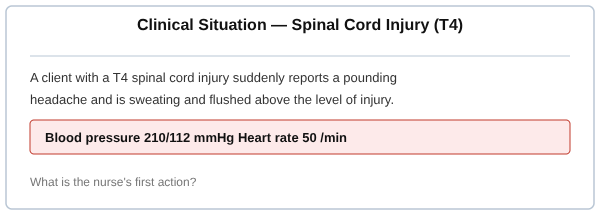
A nurse cares for the client with a spinal cord injury described in the exhibit. What is the nurse's first action?
Answer: C. The client is showing autonomic dysreflexia—a pounding headache, severe hypertension, sweating, and flushing above a spinal cord injury—so the nurse first raises the head of the bed to sit the client upright, which helps lower the blood pressure, and then looks for the trigger such as a distended bladder (option C). Laying the client flat and elevating the legs (A) would raise the blood pressure even higher. A fluid bolus (B) is not indicated and could worsen the hypertension. Having the client bear down (D) is a Valsalva maneuver that can further raise blood pressure. Autonomic dysreflexia is an emergency; removing the trigger, most often a full bladder or bowel, relieves the crisis.
Source: Ignatavicius, D. D., Workman, M. L., & Rebar, C. R. (2021). Medical-surgical nursing: Concepts for interprofessional collaborative care (10th ed.). Elsevier.
Your next questions are ready.
The question bank picks up from here: it adapts to what you just missed and brings it back right before you'd forget it.
What is the difference between complete and incomplete spinal cord injury?expand_more
A complete spinal cord injury causes total loss of motor and sensory function below the level of injury, while an incomplete injury spares some function. Incomplete injuries often produce specific cord syndromes depending on which tracts are damaged, and they generally have a better prognosis.
What is Brown-Sequard syndrome?expand_more
Brown-Sequard syndrome results from hemisection (one-sided damage) of the spinal cord. It causes ipsilateral loss of motor function and proprioception and contralateral loss of pain and temperature below the lesion, because the spinothalamic tract crosses within the cord while the other tracts cross higher up.
What is spinal shock?expand_more
Spinal shock is a transient loss of all reflexes, motor function, and sensation below a spinal cord injury immediately after trauma. It is temporary and gradually resolves over days to weeks, after which reflexes return. It is distinct from neurogenic shock, which is a circulatory problem.
What is neurogenic shock?expand_more
Neurogenic shock is a form of distributive shock seen with high spinal cord injuries, caused by loss of sympathetic tone. It produces hypotension with bradycardia — unlike most shock states, which cause a compensatory tachycardia — and is treated with fluids and vasopressors.
Free weekly high-yield email
One high-yield concept + one question, every week
Study smarter with a short weekly email. No spam — unsubscribe anytime.
✓ You're in — talk soon.
Reading is one thing. Remembering is another.
Turn this guide into questions you’ll actually remember
Progress Note turns concepts like this into adaptive questions and spaced review, so difficult topics come back to you exactly when you’re about to forget them.