Peripheral neuropathy is damage to the peripheral nerves, causing numbness, tingling, pain, or weakness, most often in a symmetric stocking-glove pattern. Boards emphasize the many causes led by diabetes, the clinical pattern, the basic workup, and treating both the cause and the neuropathic pain.
Evidence-based · For exam prep, not medical advice
update Updated October 2026
Date of last content change
Built by surgery and anesthesiology residents·Written for USMLE Step 1
bolt The 60-second version
check_circlePeripheral neuropathy is damage to peripheral sensory, motor, or autonomic nerves.
check_circleDiabetes is the most common cause of chronic polyneuropathy.
check_circleA symmetric, distal "stocking-glove" sensory loss is the classic pattern.
check_circleOther causes include alcohol, B12 deficiency, and certain drugs and toxins.
check_circleTreatment addresses the underlying cause plus neuropathic pain.
Causes
Peripheral neuropathy has many causes. Diabetes mellitus is the most common cause of chronic polyneuropathy through a length-dependent process. Other important causes include chronic alcohol use, vitamin B12 deficiency, hypothyroidism, chronic kidney disease, certain medications (such as chemotherapy agents and isoniazid) and toxins, autoimmune conditions, and hereditary neuropathies. Guillain-Barre syndrome is a distinct acute, ascending, demyelinating neuropathy.
Clinical Features
Sensory polyneuropathy typically begins in the feet and progresses proximally in a symmetric "stocking-glove" distribution, as the longest nerves are affected first. Symptoms include numbness, tingling, burning pain, and loss of vibration and proprioception; motor involvement causes distal weakness and atrophy, and autonomic involvement causes orthostatic hypotension and other findings. The pattern (symmetric versus focal, sensory versus motor) helps localize the cause.
Diagnosis
Evaluation combines the history and neurologic exam with targeted testing to find a treatable cause: glucose or HbA1c, vitamin B12, thyroid and kidney function, and others as indicated. Nerve conduction studies and electromyography characterize the neuropathy as axonal or demyelinating and gauge severity. Identifying a reversible cause — such as B12 deficiency or a culprit drug — is a priority.
Treatment
Management has two arms: treating the underlying cause and controlling symptoms. Optimizing glycemic control slows diabetic neuropathy, correcting B12 deficiency reverses that cause, and removing an offending drug or toxin helps. Neuropathic pain is treated with agents such as gabapentin or pregabalin, certain antidepressants (duloxetine, tricyclics), and topical therapies, along with foot care to prevent injury from sensory loss.
Try it now
3 real questions on Peripheral Neuropathy
Straight from the Progress Note question bank, each with a cited explanation. No account needed.
123
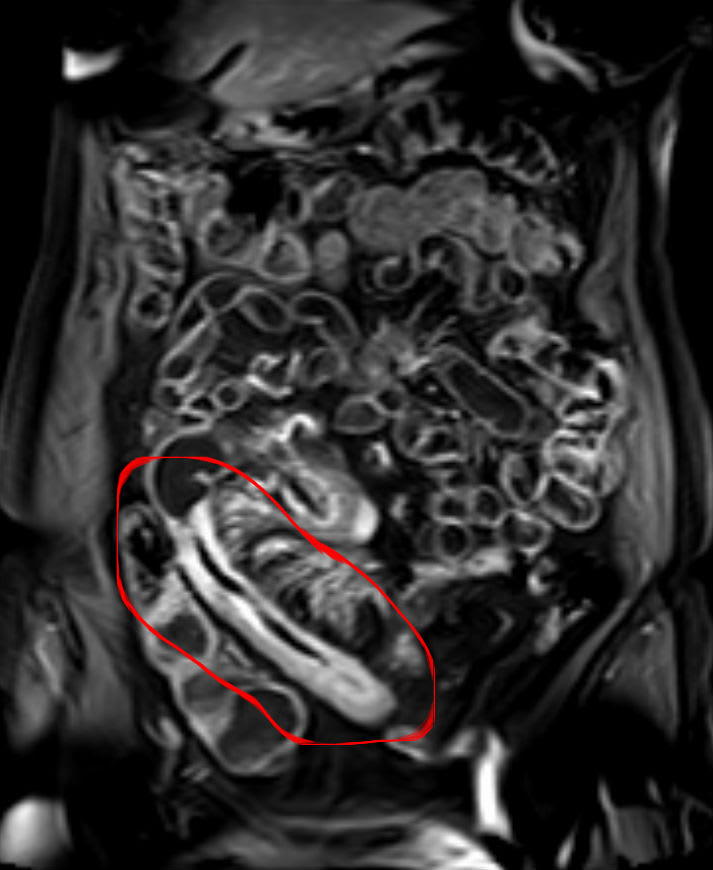
A 58-year-old man with a history of Crohn's disease involving the terminal ileum presents with peripheral neuropathy, glossitis, and macrocytic anemia. He reports no alcohol use. Serum vitamin B12 is 95 pg/mL (normal >200). Serum methylmalonic acid and homocysteine are both elevated. Schilling test with intrinsic factor does not correct his vitamin B12 absorption. Which of the following best explains the mechanism of B12 deficiency in this patient?
Hellerhoff, CC BY-SA 3.0 <https://creativecommons.org/licenses/by-sa/3.0>, via Wikimedia Commons
Answer: B. The terminal ileum is the exclusive site of cubilin/amnionless receptor–mediated absorption of the intrinsic factor–B12 complex; destruction or resection of this segment by Crohn's disease abolishes this process regardless of intrinsic factor availability, explaining why the Schilling test fails to correct even with exogenous IF. Elevated methylmalonic acid reflects impaired conversion of methylmalonyl-CoA to succinyl-CoA (B12-dependent), while elevated homocysteine reflects impaired methionine synthase activity — both are sensitive markers of functional B12 deficiency. Pernicious anemia (option A) is caused by anti-parietal cell or anti-IF antibodies and would be corrected by exogenous IF on Schilling testing. Bacterial overgrowth (option C) can cause B12 deficiency but would be suggested by a positive glucose breath test and is not the primary mechanism here given the documented ileal Crohn's disease.
Source: Green, R., et al. (2017). Vitamin B12 deficiency. Nature Reviews Disease Primers, 3, 17040.
An unvaccinated child in a region with low vaccination coverage develops a fever and marked cervical lymphadenopathy. A photo of his pharynx is shown below. Which mechanism accounts for the systemic toxicity (e.g., myocarditis, peripheral neuropathy) seen in this disease, distinct from the local pharyngeal findings?
Dileepunnikri, CC BY-SA 3.0 <https://creativecommons.org/licenses/by-sa/3.0>, via Wikimedia Commons
Answer: B. Diphtheria toxin, encoded by a gene (tox) carried on a lysogenic corynephage, is absorbed into the bloodstream and catalyzes ADP-ribosylation of diphthamide, a modified histidine residue on eukaryotic elongation factor 2, which halts ribosomal translocation and protein synthesis in host cells throughout the body, explaining systemic complications such as myocarditis and demyelinating peripheral neuropathy that occur distant from the localized pharyngeal infection. Option A incorrectly attributes systemic disease to bacteremic organ seeding, when C. diphtheriae typically remains localized to the pharynx while its toxin disseminates hematogenously. Option C incorrectly borrows the cAMP-based mechanism specific to cholera toxin, a mechanistically distinct exotoxin. Option D incorrectly substitutes an immune complex mechanism for the direct toxin-mediated protein synthesis inhibition that is actually responsible. Option E correctly notes phage lysogenization is required but incorrectly claims this genetic element has no bearing on toxin production, when in fact the phage-encoded tox gene is precisely what enables toxin production.
Source: Sharma, N. C., et al. (2019). Diphtheria. Nature Reviews Disease Primers.
From our NCLEX bank
A nurse is teaching foot care to a client with diabetes who has peripheral neuropathy. Which instruction is correct?
Answer: D. Neuropathy means the client may not feel an injury, so daily inspection including between the toes is essential to find wounds before they become serious (option D). Soaking the feet in hot water (A) risks burns that the client cannot feel and macerates the skin. Walking barefoot indoors (B) exposes insensate feet to puncture and trauma. Trimming the nails in a rounded shape close to the nail bed (C) promotes ingrown nails and injury, since nails are cut straight across. The nurse teaches the client to check water temperature with a thermometer or elbow and to report any wound promptly.
Source: American Diabetes Association Professional Practice Committee. (2024). 12. Retinopathy, neuropathy, and foot care: Standards of care in diabetes—2024. Diabetes Care, 47(Suppl. 1), S231–S243.
Your next questions are ready.
The question bank picks up from here: it adapts to what you just missed and brings it back right before you'd forget it.
What is the most common cause of peripheral neuropathy?expand_more
Diabetes mellitus is the most common cause of chronic peripheral neuropathy. Other frequent causes include chronic alcohol use, vitamin B12 deficiency, hypothyroidism, kidney disease, and certain medications and toxins.
What does peripheral neuropathy feel like?expand_more
Peripheral neuropathy typically causes numbness, tingling, and burning pain that begins in the feet and progresses upward in a symmetric "stocking-glove" pattern, along with loss of vibration and position sense. Motor involvement can cause distal weakness, and autonomic involvement can cause dizziness on standing.
How is peripheral neuropathy diagnosed?expand_more
Diagnosis combines the history and neurologic exam with tests to find a treatable cause — glucose or HbA1c, vitamin B12, thyroid and kidney function — and often nerve conduction studies and EMG to characterize the neuropathy as axonal or demyelinating and assess severity.
How is peripheral neuropathy treated?expand_more
Treatment addresses the underlying cause — for example, controlling blood sugar in diabetes or replacing vitamin B12 — and manages neuropathic pain with medications such as gabapentin, pregabalin, duloxetine, or tricyclic antidepressants, along with protective foot care.
Free weekly high-yield email
One high-yield concept + one question, every week
Study smarter with a short weekly email. No spam — unsubscribe anytime.
✓ You're in — talk soon.
Reading is one thing. Remembering is another.
Turn this guide into questions you’ll actually remember
Progress Note turns concepts like this into adaptive questions and spaced review, so difficult topics come back to you exactly when you’re about to forget them.