Heparin and Low-Molecular-Weight Heparin: Step 1 Guide
Heparin works by supercharging antithrombin, the body's own inhibitor of thrombin and factor Xa. Unfractionated heparin acts immediately, is monitored with the aPTT, and is fully reversible; low-molecular-weight heparin is more predictable and given subcutaneously. Step 1 tests the mechanism, the differences between the two, and heparin-induced thrombocytopenia.
Evidence-based · For exam prep, not medical advice
update Updated October 2026
Date of last content change
Built by surgery and anesthesiology residents
Written for USMLE Step 1 · Free to read
bolt The 60-second version
check_circleHeparin binds antithrombin III, accelerating its inactivation of thrombin (IIa) and factor Xa about 1,000-fold.
check_circleUnfractionated heparin (UFH) inhibits IIa and Xa equally; LMWH (enoxaparin) acts mainly on Xa.
check_circleUFH: IV, immediate, short half-life, monitored by aPTT, fully reversed by protamine; safe in renal failure.
check_circleLMWH: subcutaneous, predictable dosing, usually no monitoring (anti-Xa if needed), renally cleared, partly reversed by protamine.
check_circleBoth are safe in pregnancy (do not cross the placenta).
check_circleHIT type 2: IgG against heparin–PF4 complexes, platelet activation, thrombocytopenia with thrombosis 5–10 days in — stop all heparin, start a direct thrombin inhibitor.
target What you'll be able to do · aligned to USMLE Step 1 · Pharmacology — Hematology
PHARMExplain how heparin activates antithrombin and why chain length determines its targets.
PHARMCompare unfractionated heparin, LMWH, and fondaparinux in monitoring, clearance, and reversal.
HEMERecognize heparin-induced thrombocytopenia and describe its mechanism and management.
PHARMSelect an anticoagulant for pregnancy, renal failure, and HIT.
How heparin is tested on Step 1
Expect a falling platelet count a week into heparin therapy, a request for the lab to monitor, a choice between UFH and LMWH in renal failure, or the reversal agent.
workspace_premium Heparin needs a partner
Heparin has no anticoagulant activity on its own. It works only by binding antithrombin — so patients with antithrombin deficiency (congenital or from nephrotic syndrome) are heparin-resistant.
Mechanism
A specific pentasaccharide sequence binds antithrombin and changes its shape. To inhibit thrombin, the heparin chain must also be long enough (18 or more sugars) to bind thrombin as a bridge; only the conformational change is needed for factor Xa.
Chain length decides the target. Short LMWH chains cannot bridge to thrombin, so they act mostly on Xa; fondaparinux (the pentasaccharide alone) acts only on Xa.
Unfractionated vs low-molecular-weight heparin
Choose by route, kidney function, monitoring needs, and reversibility.
UFH vs LMWH. LMWH is preferred for VTE in pregnancy and in cancer-associated thrombosis.
Indication
Typical agent
Acute coronary syndrome
UFH or enoxaparin with antiplatelet therapy
DVT or PE treatment
LMWH or UFH, then warfarin or a DOAC
VTE prophylaxis in hospitalized patients
SC UFH or LMWH
Pregnancy
LMWH
Bridging to warfarin
UFH or LMWH until INR is therapeutic
Fondaparinux is a synthetic pentasaccharide that inhibits only factor Xa and does not cause HIT.
Heparin-induced thrombocytopenia
HIT type 2 is an immune reaction in which heparin is the trigger and thrombosis — not bleeding — is the danger.
HIT timing. With heparin exposure in the prior 100 days, HIT can begin within 24 hours because antibodies already exist.
Step
Detail
Mechanism
IgG binds heparin–platelet factor 4 complexes and activates platelets through FcγRIIa
Clue
Platelets fall > 50% (rarely below 20,000), plus new thrombosis or skin necrosis at injection sites
Diagnosis
Clinical probability (4Ts score), anti-PF4 ELISA, confirmatory serotonin release assay
Management
Stop all heparin (including flushes); start argatroban, bivalirudin, or fondaparinux
Avoid
Warfarin until platelets recover (skin necrosis, limb gangrene); platelet transfusion
Type 1 HIT is a mild, nonimmune platelet drop in the first 2 days that resolves despite continuing heparin.
Other adverse effects and reversal
Beyond bleeding and HIT, heparin has a few long-term effects.
Effect
Note
Bleeding
Reverse UFH with protamine sulfate (positively charged, binds heparin)
Osteoporosis
With long-term use; less with LMWH
Hyperkalemia
Inhibits aldosterone synthesis
Elevated transaminases
Mild, benign
Protamine fully reverses UFH but only partly reverses LMWH and does not reverse fondaparinux.
functions Worked example — the falling platelets
Seven days after hip replacement, a patient on SC heparin prophylaxis has a platelet count that fell from 240,000 to 85,000/mm³ and a new swollen left leg. What is the next step?
A drop of more than 50% beginning 5–10 days after starting heparin, with new thrombosis, is classic HIT type 2.
Antibodies against heparin–PF4 activate platelets, causing thrombosis rather than bleeding.
All heparin must stop, including LMWH and line flushes.
A non-heparin anticoagulant is required because thrombotic risk is very high.
Answer. Stop all heparin and start a direct thrombin inhibitor such as argatroban (hepatically cleared, good in renal failure); send anti-PF4 testing. Start warfarin only after platelets recover.
3 real questions on Heparin and Low-Molecular-Weight Heparin
Straight from the Progress Note question bank, each with a cited explanation. No account needed.
123
From our NCLEX bank
A nurse reviews the activated partial thromboplastin time (aPTT) for a client on a continuous heparin infusion and finds it is markedly above the therapeutic range, and the client has new bruising. Which action by the nurse is most appropriate?
Answer: D. A markedly supratherapeutic aPTT with new bruising indicates excessive anticoagulation and bleeding risk, so the nurse holds the infusion, notifies the provider, and keeps protamine sulfate available (option D). Continuing at the same rate and waiting until morning (A) allows dangerous overanticoagulation to persist. Increasing the rate (B) worsens the bleeding risk. Encouraging increased activity (C) raises the chance of injury and bleeding. Interpreting the elevated aPTT together with the bruising as overanticoagulation is the key judgment. The nurse anticipates a rate adjustment and monitors the client closely for bleeding.
Source: U.S. Food and Drug Administration. (2023). Heparin sodium injection [Drug label]. U.S. Food and Drug Administration.
From our NCLEX bank
A client receiving a continuous heparin infusion has an activated partial thromboplastin time (aPTT) well above the therapeutic range and is now bruising easily. Which action does the nurse anticipate?
Answer: A. A markedly prolonged aPTT with bruising indicates excessive anticoagulation from heparin, so the nurse anticipates holding the infusion and giving protamine sulfate, the heparin antidote (option A). Increasing the infusion rate (B) would deepen the overanticoagulation and bleeding risk. Vitamin K (C) reverses warfarin, not heparin, so it is the wrong antidote. Taking no action and rechecking tomorrow (D) ignores active bleeding risk. Recognizing heparin excess and the correct antidote guides the response. The nurse assesses for bleeding, notifies the provider, and monitors coagulation studies closely.
Source: U.S. Food and Drug Administration. (2023). Heparin sodium injection [Drug label]. U.S. Food and Drug Administration.
From our NCLEX bank
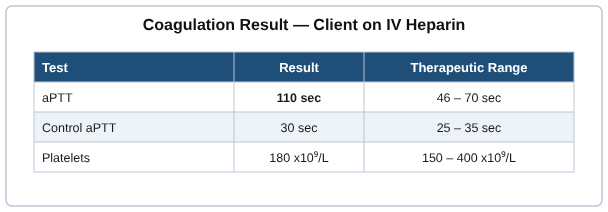
A nurse reviews the coagulation result shown for a client receiving a continuous intravenous heparin infusion. Based on this result, which action should the nurse take?
Answer: A. An aPTT of 110 seconds is far above the therapeutic range and greatly increases the risk of bleeding, so the nurse stops the heparin infusion and notifies the provider, anticipating protamine sulfate as the antidote (option A). Continuing the infusion (B) or increasing the rate (C) would worsen the dangerously high level and bleeding risk. Vitamin K (D) reverses warfarin, not heparin; the specific antidote for heparin is protamine sulfate. The nurse also assesses for signs of bleeding and monitors the aPTT closely. Recognizing a critical anticoagulation value prevents serious hemorrhage.
Source: Burchum, J. R., & Rosenthal, L. D. (2022). Lehne's pharmacology for nursing care (11th ed.). Elsevier.
Your next questions are ready.
The question bank picks up from here: it adapts to what you just missed and brings it back right before you'd forget it.
It binds antithrombin and greatly accelerates antithrombin's inhibition of thrombin and factor Xa. Unfractionated heparin inhibits both; LMWH acts mainly on Xa.
How is heparin monitored?expand_more
Unfractionated heparin is monitored with the aPTT. LMWH usually needs no monitoring, but anti-Xa levels are used in pregnancy, obesity, or renal impairment.
What is heparin-induced thrombocytopenia?expand_more
An immune reaction in which IgG antibodies bind heparin–platelet factor 4 complexes and activate platelets, causing thrombocytopenia and paradoxical thrombosis 5–10 days after starting heparin.
What reverses heparin?expand_more
Protamine sulfate, a positively charged protein that binds negatively charged heparin. It fully reverses unfractionated heparin and partially reverses LMWH.
Study smarter with a short weekly email. No spam — unsubscribe anytime.
✓ You're in — talk soon.
Reading is one thing. Remembering is another.
Turn this guide into questions you’ll actually remember
Progress Note turns concepts like this into adaptive questions and spaced review, so difficult topics come back to you exactly when you’re about to forget them.