Warfarin is an oral vitamin K antagonist that prevents the liver from activating clotting factors II, VII, IX, and X and proteins C and S. Its narrow therapeutic window, slow onset, and many drug interactions make it a favorite Step 1 topic: you need the mechanism, the INR, the bridging rule, the interactions, and the reversal plan.
Evidence-based · For exam prep, not medical advice
update Updated October 2026
Date of last content change
Built by surgery and anesthesiology residents
Written for USMLE Step 1 · Free to read
bolt The 60-second version
Warfarin is an oral vitamin K antagonist that prevents the liver from activating clotting factors II, VII, IX, and X and proteins C and S.
check_circleInhibits vitamin K epoxide reductase (VKORC1), blocking γ-carboxylation of factors II, VII, IX, X and proteins C and S.
check_circleMonitored by PT/INR (extrinsic pathway); usual target INR 2–3 (2.5–3.5 for some mechanical valves).
check_circleFactor VII and protein C have the shortest half-lives, so early warfarin is transiently procoagulant — bridge with heparin.
check_circleMetabolized by CYP2C9; P-450 inhibitors raise INR, inducers lower it.
check_circleAdverse effects: bleeding, warfarin skin necrosis (protein C deficiency), teratogenicity (crosses the placenta).
check_circleReversal: vitamin K (slow) plus 4-factor prothrombin complex concentrate (fast) for serious bleeding.
target What you'll be able to do · aligned to USMLE Step 1 · Pharmacology — Hematology
PHARMDescribe how warfarin inhibits vitamin K epoxide reductase and which factors it affects.
HEMEExplain why warfarin is monitored with PT/INR and why heparin bridging is required.
PHARMPredict how P-450 inhibitors and inducers alter the INR.
PHARMRecognize warfarin skin necrosis and teratogenicity, and choose the appropriate reversal strategy.
How warfarin is tested on Step 1
Expect a patient whose INR rises after starting an antibiotic, a skin necrosis vignette, a pregnancy question, or a request for the fastest reversal in a bleeding patient.
workspace_premium Warfarin vs heparin
Warfarin: oral, slow, extrinsic pathway, PT/INR, reversed by vitamin K and PCC, crosses the placenta. Heparin: parenteral, immediate, intrinsic pathway, aPTT, reversed by protamine, safe in pregnancy.
Mechanism
Vitamin K–dependent factors need γ-carboxylated glutamate residues to bind calcium and phospholipid. γ-Glutamyl carboxylase oxidizes vitamin K to its epoxide, and VKORC1 recycles it; warfarin blocks the recycling.
Vitamin K cycle. Warfarin does not destroy existing clotting factors; it stops new ones from being activated, so its effect depends on factor half-lives.
Onset, INR, and bridging
Warfarin's full effect takes about 5 days because existing factors must be cleared. The factors with short half-lives fall first.
Half-lives. Protein C falls before factors II and X, creating a brief hypercoagulable state; the INR rises early from factor VII loss even though full anticoagulation is not yet reached. Continue heparin until the INR is therapeutic for 24 hours.
Indication
Target INR
Atrial fibrillation (when warfarin is chosen)
2–3
Venous thromboembolism treatment
2–3
Mechanical aortic valve
2–3 (2.5–3.5 with risk factors)
Mechanical mitral valve
2.5–3.5
Antiphospholipid syndrome
2–3
Warfarin, not a DOAC, is required for mechanical heart valves and moderate-to-severe mitral stenosis with AF.
Drug and diet interactions
Warfarin is highly protein-bound and metabolized mainly by CYP2C9, so many drugs shift its effect.
Interactions. NSAIDs and antiplatelet drugs raise bleeding risk without changing the INR.
Adverse effects and reversal
Bleeding is the main risk; two unusual toxicities are classic Step 1 material.
Adverse effect
Key point
Bleeding
GI and intracranial most serious; risk rises sharply with INR > 4
Warfarin skin necrosis
Days 3–5; protein C falls first → microvascular thrombosis; risk ↑ with protein C deficiency
Teratogenicity
Nasal hypoplasia, stippled epiphyses, CNS defects — use LMWH in pregnancy
Purple toe syndrome
Cholesterol microemboli
Warfarin is safe during breastfeeding.
Situation
Reversal
INR high, no bleeding
Hold doses; low-dose oral vitamin K if INR > 10
Serious or life-threatening bleeding
4-factor PCC (immediate) + IV vitamin K (sustained)
PCC unavailable
Fresh frozen plasma (slower, volume load)
Vitamin K takes 12–24 hours because the liver must synthesize new factors.
functions Worked example — the rising INR
A woman stable on warfarin (INR 2.4) is treated for a UTI with TMP-SMX. Five days later she has gum bleeding and an INR of 6.8. Explain the interaction.
Sulfamethoxazole inhibits CYP2C9, the main enzyme that metabolizes S-warfarin, the more potent enantiomer.
It also displaces warfarin from albumin, briefly raising free drug.
Antibiotics reduce gut bacteria that make vitamin K.
Answer. CYP2C9 inhibition plus protein-binding displacement. Hold warfarin, give oral vitamin K for minor bleeding, and choose an alternative antibiotic (such as nitrofurantoin) in future.
Straight from the Progress Note question bank, each with a cited explanation. No account needed.
123
From our NCLEX bank
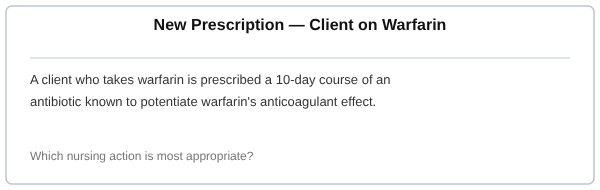
A nurse reviews the new prescription shown for a client who takes warfarin. Which nursing action is most appropriate?
Answer: C. Because the antibiotic potentiates warfarin, it can raise the INR and increase the bleeding risk, so the nurse monitors the INR closely and watches for bleeding (option C). Taking no action (A) ignores a clinically important drug interaction. Encouraging extra vitamin K (B) is not an appropriate way to manage the interaction and could unpredictably alter anticoagulation. Doubling the warfarin dose (D) is unsafe and would further increase the bleeding risk. The nurse anticipates that the warfarin dose may need adjustment based on INR results. Recognizing drug interactions that affect anticoagulation protects the client from harm.
Source: Burchum, J. R., & Rosenthal, L. D. (2022). Lehne's pharmacology for nursing care (11th ed.). Elsevier.
From our NCLEX bank
A client who takes warfarin asks the nurse about eating green leafy vegetables. Which instruction should the nurse provide?
Answer: A. Warfarin works by opposing vitamin K, so a steady intake of vitamin K–containing foods keeps the effect predictable and the INR stable, which is the correct teaching (option A). Avoiding these vegetables entirely (B) is unnecessary and removes nutritious foods from the diet. Increasing them (C) would oppose the drug and reduce its anticoagulant effect. Tying intake to the timing of the dose (D) has no basis and creates unpredictable swings. The nurse emphasizes consistency rather than avoidance and reviews signs of bleeding to report.
Source: U.S. Food and Drug Administration. (2024). COUMADIN (warfarin sodium) [Package insert]. U.S. Food and Drug Administration.
From our NCLEX bank
A nurse is teaching a client who is starting warfarin therapy. Which teaching point is most important for the nurse to include?
Answer: B. Warfarin's effect depends on steady vitamin K intake, and bleeding is the main risk, so teaching the client to keep vitamin K consistent and report unusual bleeding is most important (option B). Taking a double dose after a missed dose (A) can cause dangerous over-anticoagulation. Greatly increasing leafy greens to counteract the drug (C) makes control erratic and is not how the diet should be managed. Stopping the warfarin for minor bruising (D) can lead to clot formation and should not be done without provider guidance. Consistent diet, adherence, and prompt reporting of bleeding keep therapy safe. The nurse reinforces regular INR monitoring and follow-up.
Source: U.S. Food and Drug Administration. (2024). COUMADIN (warfarin sodium) [Package insert]. U.S. Food and Drug Administration.
Your next questions are ready.
The question bank picks up from here: it adapts to what you just missed and brings it back right before you'd forget it.
It inhibits vitamin K epoxide reductase, preventing regeneration of active vitamin K. Without it, the liver cannot γ-carboxylate factors II, VII, IX, and X or proteins C and S.
Why is warfarin monitored with the INR?expand_more
The PT measures the extrinsic pathway, which depends on factor VII — the vitamin K–dependent factor with the shortest half-life. The INR standardizes the PT across laboratories.
What causes warfarin skin necrosis?expand_more
Protein C has a short half-life and falls before most procoagulant factors. In the first days, the imbalance causes microvascular thrombosis in fatty skin. Heparin bridging reduces the risk.
How is warfarin reversed in a bleeding patient?expand_more
Four-factor prothrombin complex concentrate for immediate correction plus IV vitamin K for sustained effect. Fresh frozen plasma is used if PCC is unavailable.
Study smarter with a short weekly email. No spam — unsubscribe anytime.
✓ You're in — talk soon.
Reading is one thing. Remembering is another.
Turn this guide into questions you’ll actually remember
Progress Note turns concepts like this into adaptive questions and spaced review, so difficult topics come back to you exactly when you’re about to forget them.