Disorders of the neuromuscular junction produce weakness without sensory loss by disrupting acetylcholine signaling between nerve terminal and muscle. Localizing the lesion to the presynaptic terminal or the postsynaptic receptor — and noticing whether weakness improves or worsens with repeated use — separates the major diagnoses of myasthenia gravis, Lambert-Eaton myasthenic syndrome, and botulism.
Evidence-based · For exam prep, not medical advice
update Updated October 2026
Date of last content change
Built by surgery and anesthesiology residents·Written for USMLE Step 1
bolt The 60-second version
check_circleMyasthenia gravis is a postsynaptic disorder from antibodies against acetylcholine receptors, causing fatigable weakness that worsens with use and through the day.
check_circleLambert-Eaton myasthenic syndrome is presynaptic, from antibodies to voltage-gated calcium channels, and weakness improves with sustained use.
check_circleLambert-Eaton is frequently paraneoplastic, most often with small cell lung cancer.
check_circleBotulism blocks presynaptic acetylcholine release, producing descending flaccid paralysis with prominent autonomic signs such as dry mouth and dilated pupils.
check_circleRepetitive nerve stimulation shows a decremental response in myasthenia gravis and an incremental response in Lambert-Eaton.
Myasthenia Gravis
Myasthenia gravis is caused by autoantibodies against the postsynaptic nicotinic acetylcholine receptor (or, in a subset, against muscle-specific kinase). The hallmark is fatigable weakness that worsens with activity and toward the end of the day and improves with rest, classically presenting as ptosis and diplopia before bulbar and limb involvement. It is associated with thymic hyperplasia and thymoma. Diagnosis rests on anti-acetylcholine-receptor antibodies, repetitive nerve stimulation showing a decremental response, and supportive bedside findings such as the ice-pack test. Treatment includes pyridostigmine, immunosuppression, thymectomy in selected patients, and plasmapheresis or IVIG for myasthenic crisis.
Lambert-Eaton Myasthenic Syndrome
Lambert-Eaton myasthenic syndrome arises from antibodies against presynaptic voltage-gated calcium channels, reducing acetylcholine release. In contrast to myasthenia, proximal limb weakness tends to improve transiently with sustained contraction because repeated stimulation builds up presynaptic calcium; ocular involvement is less prominent and autonomic symptoms such as dry mouth are common. It is often a paraneoplastic syndrome, most commonly with small cell lung cancer, so a new diagnosis warrants a search for malignancy. Repetitive nerve stimulation shows an incremental response.
workspace_premium Use-dependence clue
If strength improves with repeated effort, think Lambert-Eaton (presynaptic); if it fatigues with effort, think myasthenia gravis (postsynaptic).
Botulism and Toxin-Mediated Blockade
Botulinum toxin cleaves the SNARE proteins that mediate presynaptic acetylcholine vesicle fusion, halting release. The result is a symmetric descending flaccid paralysis that begins with cranial nerves — diplopia, dysphagia, and dysarthria — accompanied by autonomic features such as a dry mouth and fixed dilated pupils. Infant botulism follows ingestion of spores (classically from honey) and presents as a floppy, constipated baby, while foodborne disease follows preformed toxin in improperly canned food. Treatment is antitoxin and supportive care, including ventilation.
Distinguishing the Disorders
A useful framework separates presynaptic causes (Lambert-Eaton, botulism) from the postsynaptic cause (myasthenia gravis). Antibody testing, electrodiagnostics, and the direction of use-dependence usually clarify the picture: decremental response and fatigability in myasthenia versus incremental response and facilitation in Lambert-Eaton. Contrast these with organophosphate poisoning, which produces the opposite problem — excess acetylcholine from acetylcholinesterase inhibition — and a cholinergic toxidrome rather than simple weakness.
Try it now
3 real questions on Neuromuscular Junction Disorders
Straight from the Progress Note question bank, each with a cited explanation. No account needed.
123
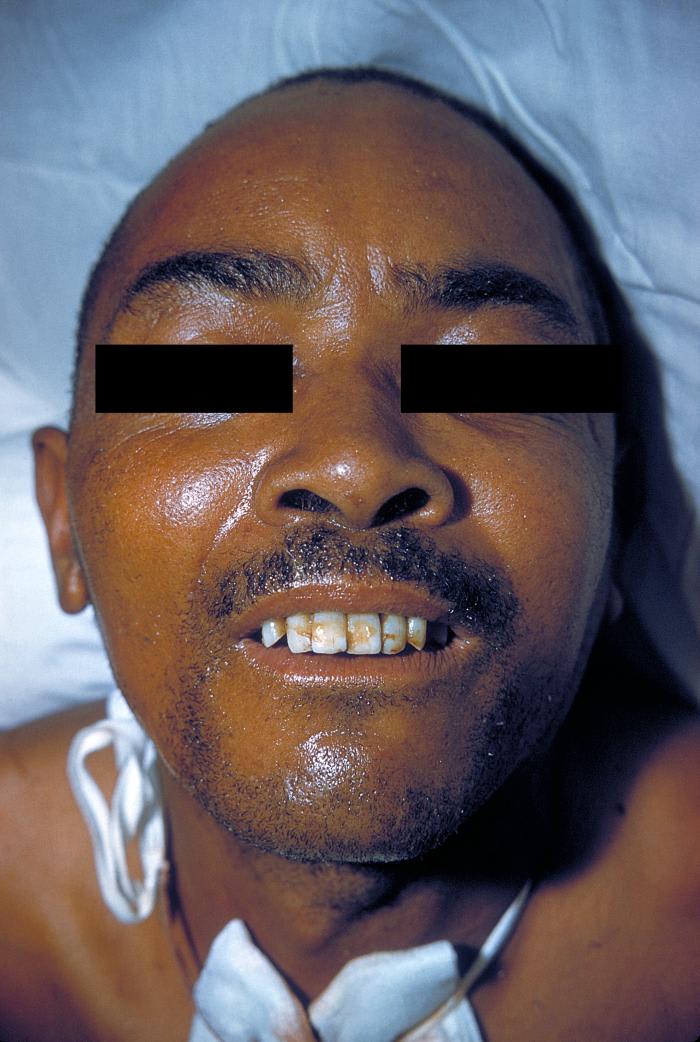
A farmer sustains a deep puncture wound and several days later develops generalized muscle rigidity with episodic spasms. A photo of his characteristic facial expression in shown below. Which mechanism best explains the pathophysiology of this presentation?
Photo Credit:Content Providers(s): CDC/Dr. Thomas F. Sellers/Emory University, Public domain, via Wikimedia Commons
Answer: A. Tetanospasmin is taken up at the neuromuscular junction and undergoes retrograde axonal transport to the central nervous system, where it is transferred into inhibitory interneurons; its zinc metalloprotease light chain cleaves synaptobrevin (a SNARE protein required for vesicle fusion), blocking release of the inhibitory neurotransmitters glycine and GABA, which removes normal inhibitory control of motor neurons and produces the sustained rigidity and spasms characteristic of tetanus. Option B describes botulinum toxin's peripheral mechanism and its resulting flaccid paralysis, the opposite clinical phenotype from tetanus. Option C incorrectly proposes a direct receptor-agonist mechanism rather than the intracellular protease mechanism that defines tetanospasmin. Option D omits the defining retrograde CNS transport step. Option E reverses both the direction of the neurotransmitter effect and the resulting clinical phenotype.
Source: Megighian, A., et al. (2021). Tetanus and tetanus neurotoxin: From peripheral uptake to central nervous tissue targets. Journal of Neurochemistry, 158(6).
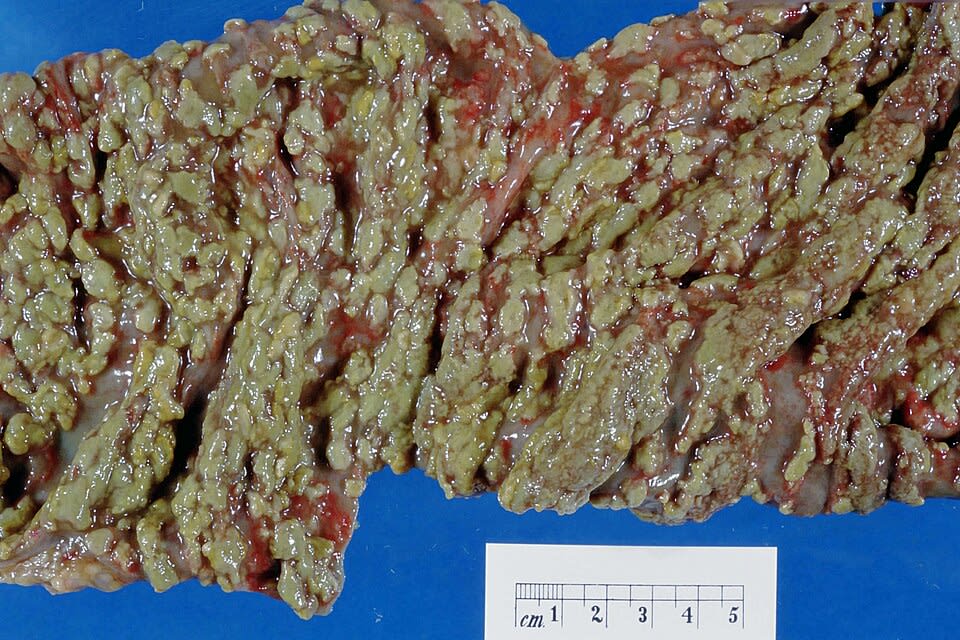
A 62-year-old hospitalized patient develops severe watery diarrhea after recent clindamycin therapy. Colonoscopy shows raised yellow-white plaques overlying erythematous colonic mucosa. Which toxin mechanism is most directly responsible for this condition?
Narraburra, CC0, via Wikimedia Commons
Answer: E. Clostridioides difficile produces toxins A and B, which inactivate Rho GTPases through glucosylation. This disrupts the actin cytoskeleton, leading to loss of tight junction integrity, inflammation, and formation of pseudomembranes in the colon. This results in severe watery diarrhea and characteristic yellow-white plaques on colonoscopy. 60S ribosomal inhibition is seen in macrolides or clindamycin’s class effect but not its toxin mechanism. Gs protein activation causes cholera, neuromuscular blockade is seen in botulinum toxin, and DNA gyrase inhibition is seen with fluoroquinolones.
Source: Leffler, D. A., & Lamont, J. T. (2015). Clostridium difficile infection. New England Journal of Medicine.
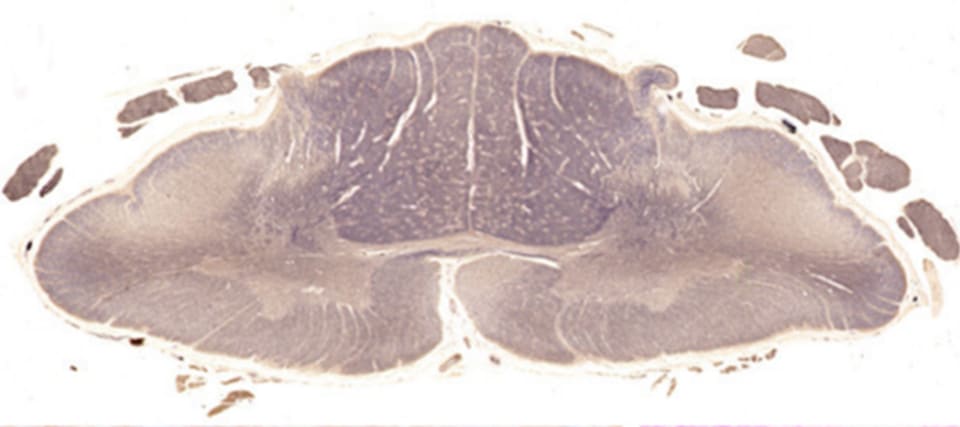
A 58-year-old man presents with progressive limb weakness, muscle atrophy, fasciculations, and hyperreflexia with a positive Babinski sign. Tongue fasciculations are noted, and he has no sensory deficits or bowel/bladder dysfunction. A spinal cord specimen from a similar case is shown below. The combination of upper and lower motor neuron signs in this patient is best explained by which of the following pathophysiologic processes?
TnoXX, CC BY 2.0 <https://creativecommons.org/licenses/by/2.0>, via Wikimedia Commons.
Answer: E. Amyotrophic lateral sclerosis is characterized by selective, progressive degeneration of both upper motor neurons in the motor cortex and corticospinal tracts and lower motor neurons in the brainstem and spinal cord anterior horns, with cytoplasmic aggregation of TDP-43 protein implicated in neuronal dysfunction and death in most cases; this combined degeneration produces the mixture of upper motor neuron signs and lower motor neuron signs seen in this patient, notably without sensory or autonomic involvement. This distinguishes ALS from Lambert-Eaton myasthenic syndrome and myasthenia gravis, both neuromuscular junction disorders without corticospinal tract involvement, from Guillain-Barré syndrome, a demyelinating peripheral neuropathy that typically involves sensory fibers, and from subacute combined degeneration due to vitamin B12 deficiency, which characteristically also involves the sensory dorsal columns.
What is the difference between myasthenia gravis and Lambert-Eaton syndrome?expand_more
Myasthenia gravis is a postsynaptic disorder from acetylcholine-receptor antibodies, so weakness worsens with use and prominently affects the eyes. Lambert-Eaton is presynaptic, from calcium-channel antibodies, so weakness transiently improves with sustained use, spares the eyes more, and is frequently paraneoplastic with small cell lung cancer.
Which cancer is associated with Lambert-Eaton myasthenic syndrome?expand_more
Small cell lung cancer is the classic association. Lambert-Eaton is often a paraneoplastic syndrome, so a new diagnosis should prompt evaluation for an underlying malignancy, particularly of the lung.
Why does botulism cause paralysis?expand_more
Botulinum toxin blocks the presynaptic release of acetylcholine by cleaving SNARE proteins needed for vesicle fusion. Without acetylcholine reaching the muscle, patients develop a descending flaccid paralysis with autonomic signs such as dry mouth and dilated pupils.
How is myasthenia gravis diagnosed?expand_more
Diagnosis combines the clinical picture of fatigable, use-dependent weakness with anti-acetylcholine-receptor (or anti-MuSK) antibodies and repetitive nerve stimulation showing a decremental response. Bedside clues such as the ice-pack test for ptosis support the diagnosis, and chest imaging evaluates for thymoma.
Free weekly high-yield email
One high-yield concept + one question, every week
Study smarter with a short weekly email. No spam — unsubscribe anytime.
✓ You're in — talk soon.
Reading is one thing. Remembering is another.
Turn this guide into questions you’ll actually remember
Progress Note turns concepts like this into adaptive questions and spaced review, so difficult topics come back to you exactly when you’re about to forget them.