A vaccine trains adaptive immunity to recognize a pathogen before the first real encounter. Step 1 tests which vaccine types exist, what immune response each produces, why live vaccines are dangerous for some patients, and why conjugate vaccines work in infants when plain polysaccharide vaccines do not. The core idea: the type of antigen determines the type of immunity.
Evidence-based · For exam prep, not medical advice
update Updated October 2026
Date of last content change
Built by surgery and anesthesiology residents
Written for USMLE Step 1 · Free to read
bolt The 60-second version
A vaccine trains adaptive immunity to recognize a pathogen before the first real encounter. Step 1 tests which vaccine types exist, what immune response each produces, why live vaccines are dangerous for some patients, and why conjugate vaccines work in infants when plain polysaccharide vaccines do not.
check_circleLive attenuated vaccines replicate and present antigen on MHC I, producing strong cellular and humoral immunity, often lifelong after one or two doses.
check_circleLive vaccines are contraindicated in pregnancy and significant immunodeficiency (MMR and varicella are allowed in HIV with CD4 ≥ 200).
check_circleInactivated, subunit, toxoid, and recombinant vaccines produce mainly humoral immunity and need boosters.
check_circlePolysaccharide antigens are T-cell independent; conjugating them to a protein recruits helper T cells, enabling class switching, memory, and effectiveness in infants.
check_circleToxoid vaccines (tetanus, diphtheria) generate antibodies against the toxin, not the bacterium.
check_circlemRNA vaccines deliver mRNA in lipid nanoparticles; host cells make the antigen and present it on MHC I and II.
target What you'll be able to do · aligned to USMLE Step 1 · Immunology & Microbiology
IMMUNOClassify vaccines as live attenuated, inactivated, subunit, toxoid, polysaccharide, conjugate, or mRNA.
IMMUNOContrast the cellular and humoral responses induced by live and non-live vaccines.
IMMUNOExplain how protein conjugation makes polysaccharide vaccines effective in infants.
MICROApply contraindications to live vaccines in pregnancy and immunodeficiency.
How vaccines are tested on Step 1
Questions ask which vaccine type a product is, why a patient cannot receive a live vaccine, what kind of immune response a vaccine induces, or why conjugation matters.
workspace_premium Active vs passive
Active immunity (vaccination, infection) creates memory and takes weeks. Passive immunity (maternal IgG, immune globulin, antitoxin) is immediate but fades over weeks to months.
Vaccine types
Live vaccines are copies of the pathogen that cause a mild, controlled infection. Everything else delivers antigen without replication.
Live vs non-live. The recombinant zoster vaccine (Shingrix) is non-live and is preferred, including in immunocompromised adults.
Hepatitis B (HBsAg), HPV (L1), acellular pertussis, recombinant zoster
Toxoid
Inactivated exotoxin
Tetanus, diphtheria
Polysaccharide
Capsular sugar alone
PPSV23 (pneumococcal), Vi typhoid
Conjugate
Capsular sugar linked to protein
Hib, PCV15/PCV20, meningococcal conjugate
mRNA
Lipid-encapsulated mRNA
COVID-19; one adult RSV vaccine (others are protein subunit)
Sabin oral polio is live and induces mucosal IgA; Salk injected polio is killed and is the only polio vaccine used in the US.
Why conjugate vaccines work in infants
Polysaccharides activate B cells directly by cross-linking receptors, but without T-cell help the response is weak, mostly IgM, and short-lived. Children under 2 respond poorly.
Conjugation converts a T-independent antigen into a T-dependent one. This is why Hib meningitis nearly disappeared after the conjugate vaccine.
Primary vs secondary response
Boosters exploit immunologic memory. The second exposure produces a faster, larger, higher-affinity IgG response.
Primary vs secondary response. A booster at week 6 triggers rapid, high IgG from memory B cells; the IgM response stays small.
Special populations and contraindications
Most vaccine questions about real patients turn on whether a live vaccine is safe for that host.
Situation
Vaccine rule
Pregnancy
Give Tdap (each pregnancy), inactivated influenza, RSV; avoid live vaccines
HIV, CD4 ≥ 200
MMR and varicella allowed; avoid other live vaccines
Severe immunodeficiency or high-dose steroids
No live vaccines
Asplenia
Pneumococcal, meningococcal (including MenB), and Hib vaccines
Egg allergy
Influenza vaccine can be given; yellow fever needs caution
Tetanus-prone wound
Toxoid if > 5 years since last dose; add TIG if vaccination history is incomplete
Household contacts of immunocompromised patients can usually receive live vaccines, except oral polio.
functions Worked example — choose the vaccine
A 30-year-old woman is 10 weeks pregnant and has no record of rubella immunity. Should she receive the MMR vaccine now?
MMR is a live attenuated vaccine.
Live vaccines carry a theoretical risk of fetal infection and are contraindicated in pregnancy.
Rubella immunity protects future pregnancies against congenital rubella syndrome.
Answer. No. Give MMR postpartum, before discharge. Advise against pregnancy for 4 weeks after any MMR dose.
Straight from the Progress Note question bank, each with a cited explanation. No account needed.
123
From our NCLEX bank
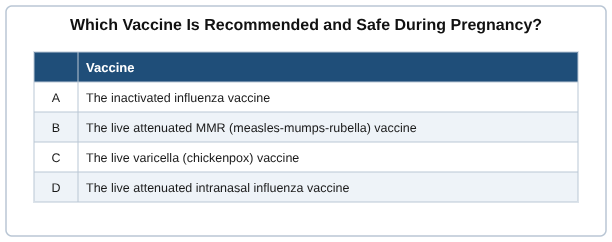
A nurse provides prenatal care and reviews the vaccine options shown. Which vaccine is recommended and safe to administer during pregnancy?
Answer: A. The inactivated influenza vaccine is recommended during pregnancy because it protects both the pregnant client and the newborn and contains no live virus (option A). The MMR vaccine (B), the varicella vaccine (C), and the live intranasal influenza vaccine (D) are all live attenuated vaccines that are contraindicated during pregnancy because of a theoretical risk to the fetus. Live vaccines are given before pregnancy or after delivery. The nurse also recommends the Tdap vaccine during pregnancy to protect the newborn from pertussis. Distinguishing inactivated from live vaccines guides safe immunization in pregnancy.
Source: Lowdermilk, D. L., Perry, S. E., Cashion, K., & Alden, K. R. (2020). Maternity & women's health care (12th ed.). Elsevier.
From our NCLEX bank
A nurse is preparing to give a scheduled vaccine to a child who has a mild cold with a low-grade fever. Which action by the nurse is most appropriate?
Answer: B. A mild illness with or without a low-grade fever is not a contraindication, so the nurse gives the scheduled vaccines (option B). Withholding until the child is completely well (A) is a common cause of missed opportunities and leaves children under-vaccinated, since minor illnesses are frequent in early childhood. Giving half a dose (C) is never appropriate, because a partial dose may not produce immunity. Delaying a month after the illness (D) compounds the delay for no benefit. Moderate or severe acute illness is a reason to defer, so the nurse assesses severity rather than simply the presence of symptoms.
Source: Centers for Disease Control and Prevention. (2023). General best practice guidelines for immunization. Centers for Disease Control and Prevention.
From our NCLEX bank
A nurse is reviewing immunizations with a healthy 68-year-old client. Which vaccine should the nurse anticipate discussing with this client?
Answer: D. An annual influenza vaccine and pneumococcal vaccination are both recommended for adults in this age group, who are at higher risk of severe disease (option D). Saying vaccines are only for children before school entry (A) is inaccurate, since adult schedules exist for exactly this reason. Saying no vaccines are needed because childhood immunizations were completed (B) ignores waning immunity and vaccines added for older adults. Saying a single vaccine never needs repeating (C) is wrong for influenza, which changes annually. Adults are also assessed for shingles, tetanus boosters, and COVID-19 vaccination. Immunity from some childhood vaccines wanes over decades.
MMR, varicella, live zoster, yellow fever, rotavirus, intranasal influenza, oral typhoid, oral polio (Sabin), BCG, and smallpox (vaccinia).
Why are live vaccines contraindicated in pregnancy?expand_more
The vaccine organism replicates and could theoretically infect the fetus. Non-live vaccines such as Tdap and inactivated influenza are recommended in pregnancy.
What is the difference between a polysaccharide and a conjugate vaccine?expand_more
A polysaccharide vaccine is T-cell independent, produces mostly IgM, and works poorly under age 2. A conjugate vaccine links the polysaccharide to a protein carrier, recruiting T-cell help for IgG, memory, and infant protection.
What is a toxoid vaccine?expand_more
An inactivated bacterial exotoxin that is no longer toxic but still immunogenic. Tetanus and diphtheria toxoids induce antibodies that neutralize the toxins.
Study smarter with a short weekly email. No spam — unsubscribe anytime.
✓ You're in — talk soon.
Reading is one thing. Remembering is another.
Turn this guide into questions you’ll actually remember
Progress Note turns concepts like this into adaptive questions and spaced review, so difficult topics come back to you exactly when you’re about to forget them.