How ACE inhibitors are tested on Step 1
Questions describe a patient started on a "-pril" who develops a dry cough, facial swelling, hyperkalemia, or a creatinine rise, or ask which lab values change and in which direction.
Angiotensin-converting enzyme is the same enzyme as kininase II. Blocking it lowers angiotensin II and lets bradykinin accumulate — the source of both the benefits (vasodilation) and the class-specific side effects (cough, angioedema).
Mechanism: blocking the renin–angiotensin–aldosterone system
Renin from the juxtaglomerular cells cleaves angiotensinogen to angiotensin I; ACE in the pulmonary endothelium converts it to angiotensin II, which constricts arterioles, releases aldosterone and ADH, and drives remodeling.
| Variable | Change with ACE inhibitor | Why |
|---|---|---|
| Angiotensin II | ↓ | Conversion blocked |
| Angiotensin I | ↑ | Substrate accumulates |
| Renin | ↑ | Loss of negative feedback |
| Aldosterone | ↓ | Less angiotensin II stimulation |
| Serum K⁺ | ↑ | Less aldosterone-driven K⁺ secretion |
| Bradykinin | ↑ | ACE (kininase II) no longer degrades it |
| GFR | ↓ (small) | Efferent arteriole dilates |
A rise in creatinine of up to about 30% after starting an ACE inhibitor is expected and reflects reduced intraglomerular pressure.
Renal effects: protective but risky
Angiotensin II preferentially constricts the efferent arteriole to maintain GFR when renal perfusion is low. Removing it lowers glomerular pressure — protective in diabetic nephropathy, dangerous when GFR depends on it.
Indications
ACE inhibitors reduce mortality in several conditions by limiting angiotensin II–driven remodeling, not just by lowering blood pressure.
| Indication | Benefit |
|---|---|
| Hypertension | First-line, especially with diabetes, CKD, or heart failure |
| Heart failure with reduced EF | Lower mortality; less ventricular remodeling |
| After myocardial infarction | Prevents adverse remodeling, especially with low EF |
| Diabetic kidney disease, proteinuric CKD | Reduces proteinuria and slows progression |
| Scleroderma renal crisis | Drug of choice |
Black patients without CKD or heart failure respond better to thiazides or calcium channel blockers as initial monotherapy.
Adverse effects and contraindications
Most adverse effects follow from either low angiotensin II or high bradykinin.
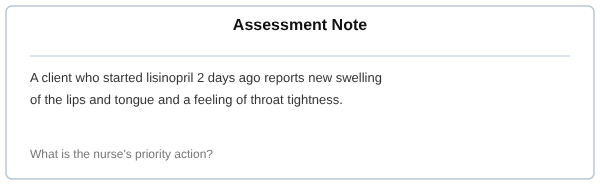
A 54-year-old Black man started lisinopril 3 months ago. He presents with painless swelling of the lips and tongue without urticaria or itching. What is the mechanism, and what is the next step?
- Nonpruritic swelling without hives suggests bradykinin-mediated angioedema, not histamine-mediated allergy.
- ACE normally degrades bradykinin; with ACE blocked, bradykinin accumulates and increases vascular permeability.
- Risk is higher in Black patients and can occur months or years after starting the drug.
- Airway assessment comes first; epinephrine and antihistamines are often less effective than in allergic angioedema.
Answer. Bradykinin-mediated angioedema. Stop the ACE inhibitor permanently and protect the airway; never rechallenge. C1 esterase inhibitor deficiency is a relative contraindication for the same reason.