How thrombosis is tested on Step 1
Vignettes describe a young patient with an unexplained clot, a postoperative leg swelling, or an autopsy finding, and ask for the mechanism, the inherited defect, or the fate of the thrombus.
Start every clot question with Virchow triad: which limb — endothelium, flow, or blood — is abnormal here?
Virchow triad
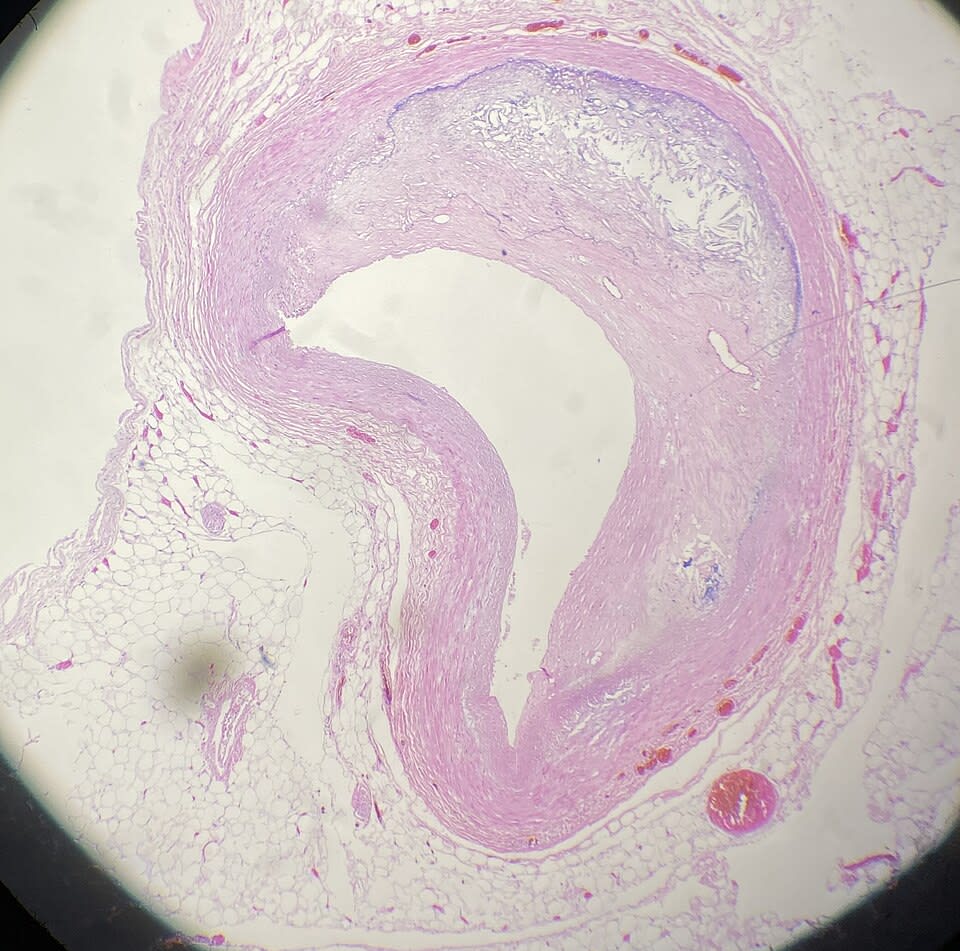
Normal endothelium is anticoagulant: it makes prostacyclin and nitric oxide, displays thrombomodulin and heparin-like molecules, and releases tissue plasminogen activator. Injury flips it to a procoagulant surface.
| Endothelial antithrombotic | Action |
|---|---|
| Prostacyclin (PGI₂), nitric oxide | Inhibit platelet aggregation; vasodilation |
| Thrombomodulin | Binds thrombin → activates protein C |
| Heparin-like molecules | Enhance antithrombin |
| Tissue plasminogen activator (tPA) | Converts plasminogen to plasmin (fibrinolysis) |
Injured endothelium loses these molecules and exposes von Willebrand factor, collagen, and tissue factor.
Hypercoagulable states
Suspect an inherited thrombophilia when a clot occurs young, unprovoked, recurrently, in an unusual site, or with a strong family history.
| Condition | Defect | Key point |
|---|---|---|
| Factor V Leiden | Factor V resistant to inactivation by activated protein C | Most common inherited thrombophilia (white populations) |
| Prothrombin G20210A | ↑ prothrombin levels (3′ untranslated region mutation) | Second most common |
| Protein C or S deficiency | Loss of natural anticoagulant | Warfarin skin necrosis when warfarin starts without heparin bridging |
| Antithrombin deficiency | Heparin cannot work through antithrombin | Relative heparin resistance; also acquired in nephrotic syndrome |
| Hyperhomocysteinemia | Endothelial damage | Arterial and venous clots; inherited or B6/B12/folate deficiency |
| Antiphospholipid syndrome | Antibodies to phospholipid–protein complexes | Arterial + venous clots, recurrent miscarriage; prolonged PTT in vitro |
| Acquired | Multiple | Cancer (Trousseau), pregnancy, estrogen/OCPs, surgery, immobility, HIT, nephrotic syndrome |
Despite a prolonged PTT on testing, antiphospholipid syndrome is a clotting — not bleeding — disorder; the antibodies interfere with the phospholipid used in the lab test.
Arterial vs venous thrombi
Flow speed shapes the clot. Fast arterial flow builds platelet-rich "white" thrombi on damaged endothelium; slow venous flow builds red-cell-rich "red" thrombi.
Alternating pale layers of platelets and fibrin with dark layers of red cells form as blood flows past a growing thrombus. They prove the clot formed during life. Postmortem clots are gelatinous, "chicken fat" yellow over "currant jelly" red, and not attached to the vessel wall.
Fates of a thrombus
After it forms, a thrombus follows one or more of four paths over days to weeks.
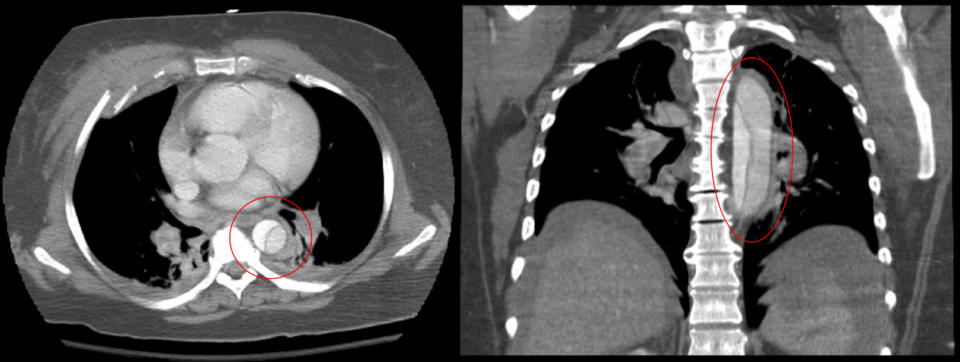
A 28-year-old woman taking combined oral contraceptives develops a swollen, painful left calf after a 14-hour flight. Her mother had a pulmonary embolism at 40. Which limbs of Virchow triad are involved, and which inherited defect is most likely?
- The long flight causes venous stasis (abnormal flow).
- Estrogen increases hepatic synthesis of clotting factors (hypercoagulability).
- A young, family-history clot suggests an inherited thrombophilia; the most common is factor V Leiden.
Answer. Stasis plus hypercoagulability; factor V Leiden is the most likely inherited defect. Confirm DVT with compression ultrasound and anticoagulate; estrogen-containing contraception should be stopped.